Some of the most common advice about planning a Tanzania safari migration sounds simple and is often given with confidence. People might suggest picking a date, hoping for one river crossing, and treating it like a scheduled show. But this approach misses the point. The migration is a dynamic natural event, not something you can book like a concert, so your safari plans should reflect that.
Planning a Tanzania safari migration is easier when you focus on movement instead of trying to guarantee a specific event. The herds follow grass, rain, and water, so your itinerary should be flexible. If you want your trip to succeed in real conditions, flexibility is essential, not just a bonus. A seasonal timing guide for the best time to visit Tanzania can help, but it should guide your planning, not dictate it.
Rethinking the Migration Calendar
The migration isn’t just one event, and it doesn’t follow a strict calendar. It’s a natural process that responds to rainfall, grass growth, and water availability throughout the Serengeti. This is why planning around a specific “crossing date” doesn’t work well. You’re trying to predict something that changes with the weather and food sources.
Instead of booking for a specific date, plan your trip around a phase of the migration.
Each year, about 1.3 million wildebeest move through the broader ecosystem, joined by about 200,000 zebras and large numbers of Thomson's and Grant's gazelles, following a largely clockwise circuit driven by the seasons, according to a Cambridge study of the Serengeti ecosystem. After the short rains, the animals concentrate on the southern short-grass plains, then move west toward Grumeti and north toward the Maasai Mara as conditions dry, before returning south with new rains. That's a cycle, not a countdown.
Practical rule: if your safari only works when the herds hit one river on one day, your itinerary is too brittle.
Think of the migration like managing a busy store, where timing is important but demand changes with conditions. Good planning means matching your resources to these changes, rather than forcing your plans into a fixed schedule that might not fit what’s happening.
Experienced travelers don’t just ask, “When is the crossing?” Instead, they ask, “Which part of the migration fits my travel dates, and how flexible is my trip?” This way of thinking helps avoid disappointment and often leads to better wildlife experiences, since the migration offers something different at every stage.
Mapping the Annual Circuit and Seasonal Routes
Each year, the herds follow a clockwise route shaped by rainfall, soil, and food quality. During the wet season, from about December to May, they gather on Tanzania’s southern short-grass plains. Calving usually happens here because the grass grows quickly and provides the nutrition needed for mothers and their calves.
Southern plains first, then the west, then the north
February is the main calving month in the Ndutu and southern Serengeti areas. This is the best time to see newborn calves and lots of predator activity. As the plains dry out, the herds move west to the Grumeti region, then north through the northern Serengeti. Eventually, they head toward Kenya’s Maasai Mara, crossing into a larger area that goes beyond just the Serengeti National Park.
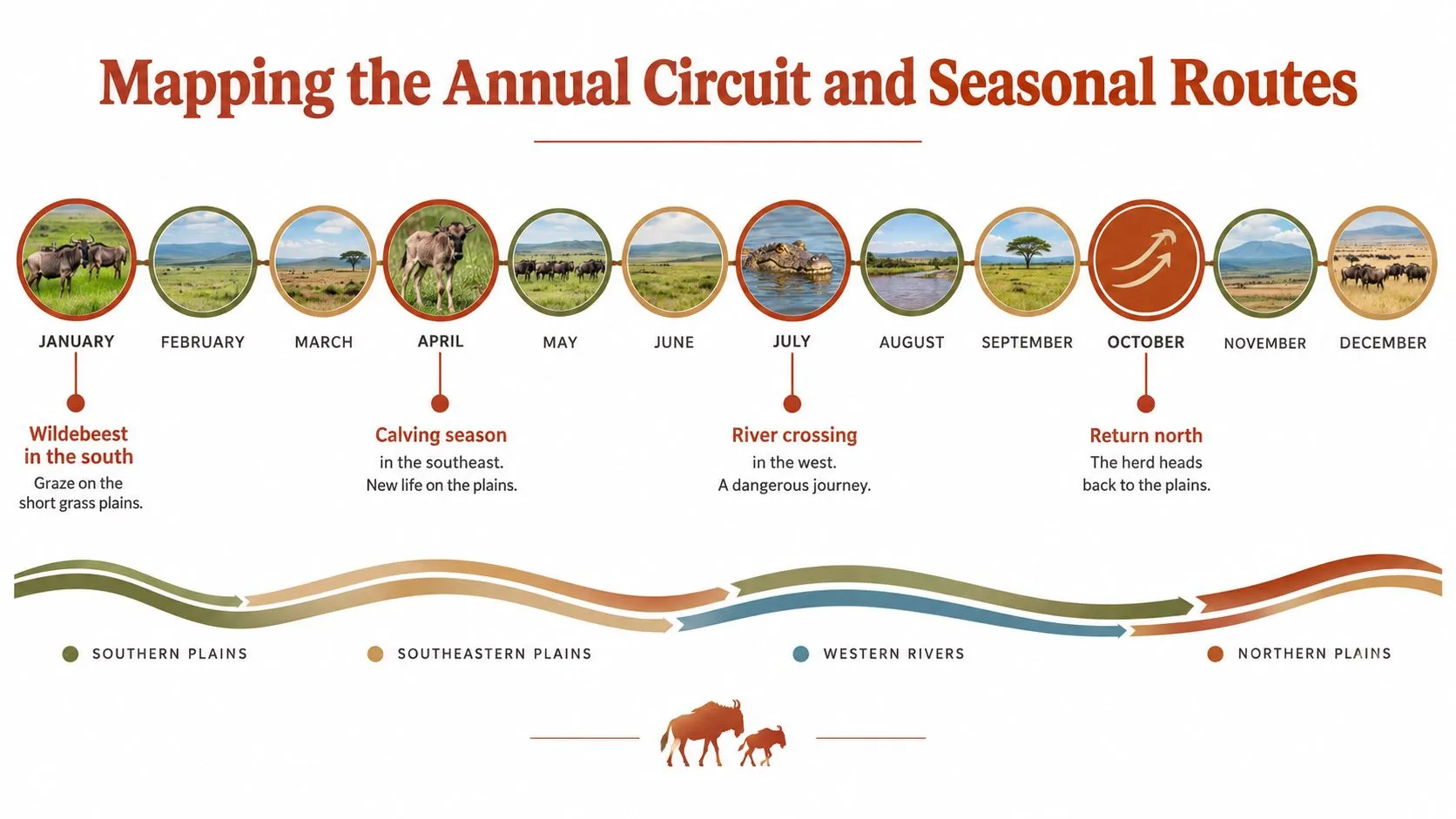
The migration doesn’t happen in a steady or predictable way. Research shows that about 75% of the migration pattern is explained by vegetation growth, while rainfall accounts for 25%. The best models matched real herd patterns in about 77% of areas studied. Another study found that female wildebeest move about 4.5 km per day on average. This explains why herds might seem to stay in one place for days, then suddenly move quickly when the local food runs out.
Why the same month can look different from one year to the next
Environmental differences are important. Rainfall usually increases in the northwest, while the southeastern plains have richer soil. The herds need to follow these changes over distances of about 80 to 100 km, which is why you can’t rely on simple month-by-month predictions.
When planning, remember not to focus too much on a fixed departure date, especially if your route is inflexible. Rainfall can delay, spread out, or concentrate the migration. Having a flexible route is more important than following a brochure’s calendar, so look for tours that offer broad routing options instead of just promising the “best month.”
Selecting the Best Parks and Viewing Zones
Booking a generic “Serengeti” trip isn’t enough. The best area for you depends on what wildlife behavior you want to see and when you’re visiting. The southern plains, western corridors, and northern river zones each play a different role in the migration, so they aren’t interchangeable.
Southern Serengeti for density and predator pressure
If you’re traveling during the calving period, stay in the southern plains or Ndutu area. The herds gather closely here, and predator activity is usually at its peak. Instead of looking for a river crossing, you’ll see large groups, newborn calves, and the dramatic interactions that come with them.
Northern Serengeti and Grumeti for high-variance crossings
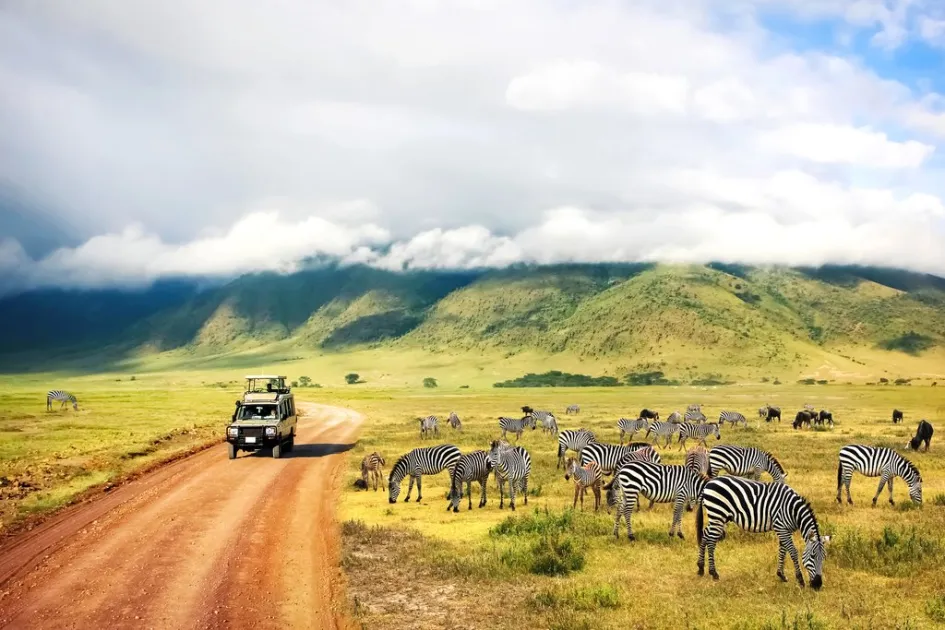
If you want to see river crossings, the northern Serengeti and Grumeti region are your best options. However, this doesn’t guarantee you’ll see a crossing. The herds might cross, wait, gather, or skip an area entirely, depending on food and water conditions.
Use this rule: choose the zone that matches your dates, then choose the camp that gives you options inside that zone.
If you want more variety than just the migration, consider adding Ngorongoro and Tarangire to your trip. This combination gives you a backup if the herds are late, scattered, or not where you expected. Ngorongoro offers dense wildlife, and Tarangire adds to your viewing options without making you rely on one herd location. Use a Serengeti National Park map to see how these areas fit into your migration plan.
Here’s the key: choose your zone first, then your camp, and finally your dates. If you do it the other way around, you might end up disappointed.
Designing a Risk-Managed Safari Itinerary
A well-planned migration safari accepts that there’s always some uncertainty. If you expect wildlife to appear on schedule, you might end up waiting for something that never happens. It’s better to plan a route with enough nights, flexibility, and coverage so your trip still works if the herds move unexpectedly.
Longer stays beat knife-edge timing.
Staying several nights in one region is better than rushing for a single night at a popular spot. The herds might stay put, move quickly, or split up. A short visit makes it harder to catch the action, while a longer stay gives your guide more chances to adjust to what’s happening.
Mobile camps and flexible routing reduce risk.
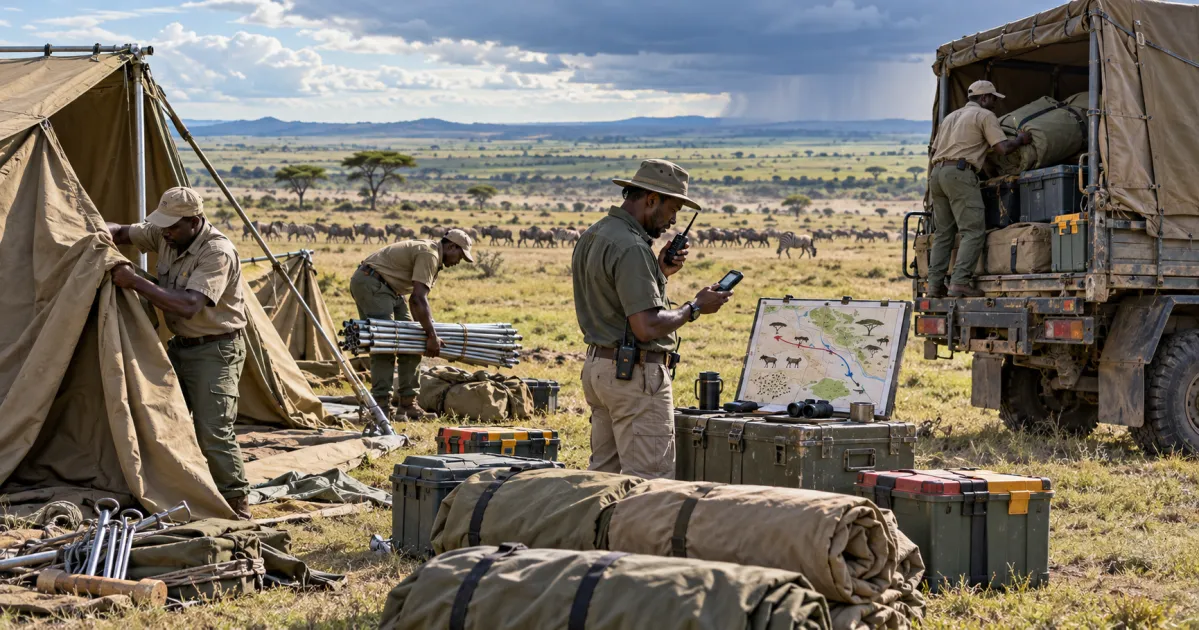
Mobile tented camps are designed to move closer to where the action is. This is especially helpful in the northern Serengeti, where river crossings are unpredictable. Being able to move your camp improves your chances of seeing the migration up close.
Candid advice: if an operator can't explain how they'll reroute when the herd shifts, they're selling luck, not planning.
How you book your safari is just as important as where you go. Compare trips that keep you in one camp with those that let you move between zones. Flexible routes are usually a better choice than rigid, low-cost options. A cheap trip isn’t a good deal if the wildlife is far away.
You can’t remove all uncertainty, but you can plan around it. The aim is to make sure your trip is still enjoyable even if the herds move while you’re there.
Evaluating Lodging Tiers and Geographic Value
When choosing where to stay, location is more important than luxury. You could have a beautiful room but be too far from the migration to enjoy it. The real value of a safari comes from staying close to where the wildlife is.
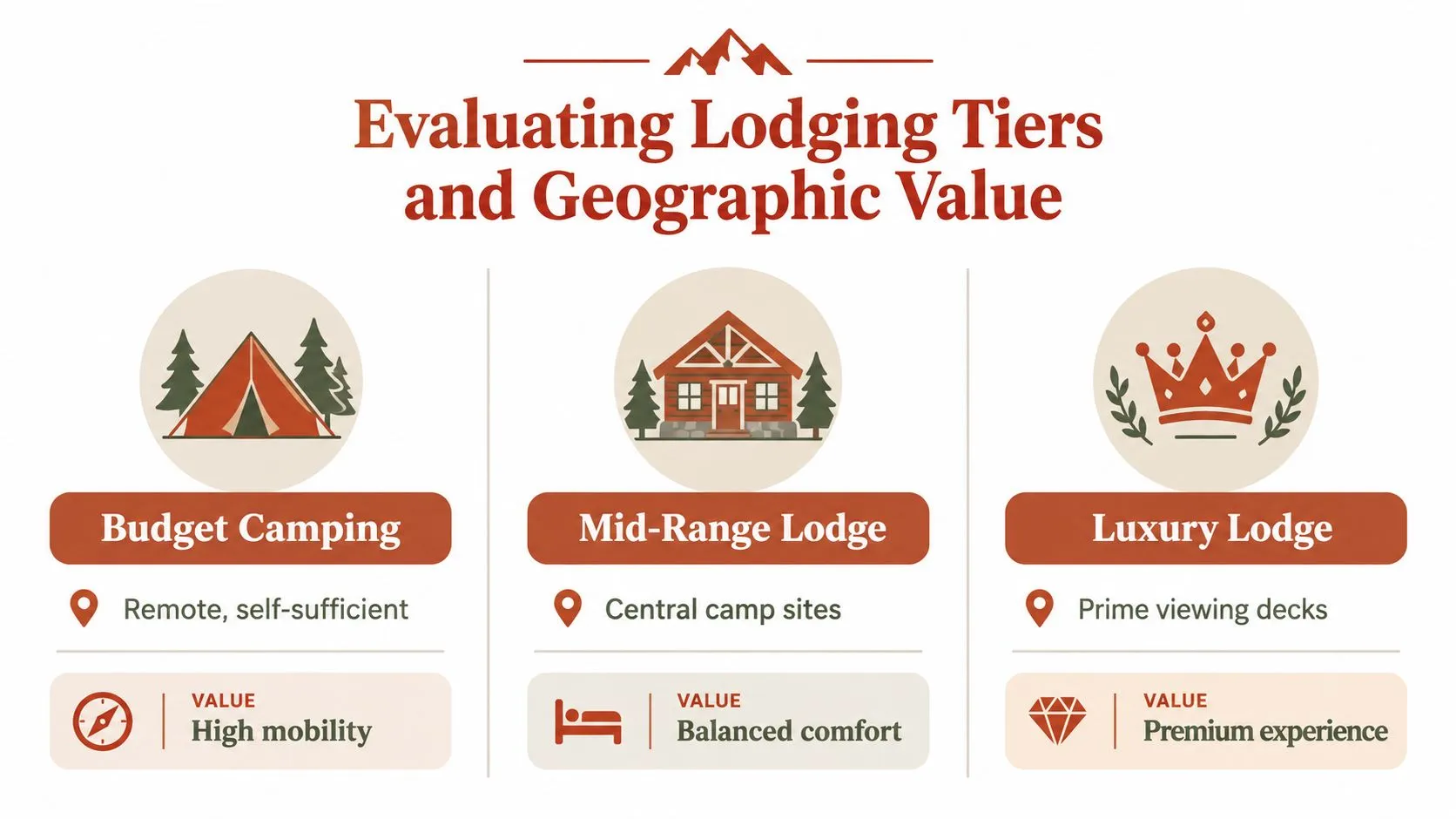
Budget, mid-range, and luxury mean different things in migration territory
Budget camping focuses on mobility and simplicity. Mid-range lodges often offer the best mix of comfort and location. Luxury camps can be great, but only if they’re close to the migration. Fancy amenities can’t make up for being in the wrong place.
Research is clear: the farther your lodge is from the wildebeest, the fewer people want to stay there. Being close to the migration is key. If your lodge looks nice but is far from the herds, your safari experience will suffer.
Choose location before frills.
A lodge with a great pool but poor access to the migration isn’t a good choice. A simpler camp in the right area is often better, because the real experience is outside, not in the room. This matters most when the herds are concentrated and every game drive is important.
If you have to choose between comfort and location, always pick location first. Don’t let marketing sway you. Choosing comfort over location can leave you spending a lot to see very little.
Comparing Verified Operators on Explola
Choosing a safari operator is where many plans go wrong. People get distracted by fancy descriptions and unclear details, ending up with quotes that don’t match their needs. It’s better to use a platform that lets you compare verified operators side by side and focus on the route, not just the price.
Use filters to remove noise fast.
Begin by narrowing your options based on your main needs. Focus on your budget, preferred lodging, travel dates, and migration zone. Filtering early saves you from wasting time on trips that don’t fit your schedule or comfort level.
Next, look at the daily route. See if the trip stays in one area long enough, includes camps that follow the migration, and offers flexibility. If the plan seems rigid or makes vague promises without clear routing, it’s best to skip it.
Ask for proof, not polish.
Check real traveler reviews and message operators directly to see if they have experience with migration timing. Ask how they deal with herd movements, where they plan backup nights, and if they can change the route if the migration shifts after you arrive. Don’t settle for vague answers—specific details matter.
If you’re comparing operators outside of one platform, resources like Passport and Adventure’s guide to finding your ideal safari company can help you know what to ask. Still, the most important thing is how detailed and responsive the operator is about the route.
A practical comparison sequence
Make a shortlist based on which routes fit your migration phase and travel dates. Remove any options that don’t match.
Check what’s included in each trip. Make sure transfers, park fees, and camp changes are clearly listed.
Compare how flexible each itinerary is. Choose trips that can adjust to field reports and changes in herd locations.
Look for patterns in reviews, not just praise. Consistent comments about clear communication are more important than general compliments.
Send a message before booking. How the operator replies can tell you a lot about what to expect from your trip.
Explola centralizes that process. Explola makes this process easier by connecting you with verified safari operators and letting you compare them side by side. You can send direct inquiries and track your conversations, which helps keep everything clear and specific.
Don’t choose your safari based only on the lowest price. Pick an operator who understands how the migration works and plans for it. The best booking offers flexibility, clear communication, and a camp location that fits your travel dates.
Ask clear questions before you pay. What if the herds move? How many nights will I spend in the best area? Which crossing points are reachable from my camp? If the answers aren’t clear, consider it a warning sign.
The best migration safaris are planned by operators who treat your trip as flexible, not fixed. They offer clear routes, honest expectations, and enough flexibility to handle changes in weather. Don’t pay extra for a rigid plan that could leave you in the wrong spot.
If you want your safari to go well, focus on good communication and smart planning, not just glossy brochures. That’s what makes the difference between a well-managed trip and one that relies on luck.
With Explola, you can compare verified safari operators, review migration-focused trips, and send direct questions without the usual hassle. If you’re planning a Tanzania safari migration, use Explola to compare routes, check for flexibility, and book with confidence.
Ready to experience this?
Explore Related Safaris
Destinations Mentioned

Founder of Explola and a passionate advocate for authentic African travel. He writes about safari destinations, conservation, and connecting travelers with trusted local operators across Africa.
Get Safari Tips & Destination Guides
Join our newsletter for exclusive travel tips, wildlife insights, and safari planning advice.