You're probably staring at three safari calendars that all claim to know the best time to visit Serengeti, yet each points to a different month. One promises newborn wildebeest and hunting lions, another sells the drama of Mara River crossings, and a third recommends the rainy season for lower rates and quieter tracks. None is automatically wrong. The Serengeti rewards different priorities at different times, so the right decision starts with what you want to witness, not with a single “perfect” month.
The practical question is whether you care most about calving, river crossings, predator-heavy game viewing, clean photographic light, easy driving, or a quieter and potentially better-value safari. Once you match that goal to the right region and weather pattern, the calendar becomes much easier to use. This guide gives you that matching process, with clear recommendations rather than a vague promise that every month is equally ideal.
Why the Serengeti Has No Single Best Time
The Serengeti's most famous spectacle is called the Great Migration, but it isn't one isolated event. It's a moving sequence shaped by rainfall, fresh grazing, breeding, births, predator pressure, and river conditions. The herds occupy different parts of the ecosystem through the year, so a traveler in southern Ndutu in February is having a different safari from one waiting beside the Mara River in September.
That's why generic advice can mislead. The broad dry-season window from June to October is widely favored for clear conditions, thinner vegetation, and wildlife gathering near concentrated water sources, as described in Serengeti's seasonal climate guidance. It's a strong all-round recommendation, especially for a first safari, but it isn't automatically the best choice for someone who wants the most intimate newborn-animal encounters.
Start with the experience you'd regret missing:
Choose January or February for calving. The southern Serengeti and Ndutu plains become the priority, with synchronized births and unusually active predators.
Choose late June through October for dry-season visibility. Roads are generally easier to use, skies are clearer, and animals are more likely to concentrate around reliable water.
Choose July through September for the strongest river-crossing opportunity. The western and northern zones matter more than the central plains, but a crossing is never a scheduled performance.
Choose April, May, November, or December for atmosphere and value. You'll trade some road reliability and weather certainty for greener scenery, fewer visitors, and a more relaxed pace.
Planning rule: Pick the wildlife event first, then choose the region, camp, and dates. Don't book a northern Serengeti lodge simply because an article calls a month “peak season.”
Your tolerance for crowds and rain matters just as much. A photographer may accept a passing shower for dramatic skies and uncluttered sightings, while a family may value predictable roads and straightforward transfers. Use this Tanzania safari timing guide as a broader planning reference, but make the Serengeti decision around your specific target.
How the Seasons Shape Visibility and Access
The Serengeti's calendar has a clear backbone. June to October is the main dry-season period, with May to August generally described as cool and dry, followed by warmer, dry conditions in September and October. The wetter period runs from November to April, while the heaviest rainfall usually arrives from March to May, with April standing out as the wettest month and rain occurring on roughly 20 days in that month according to Serengeti climate references.
Weather affects more than whether you'll need a rain jacket. During dry months, grasses become thinner and water is more concentrated, which improves sightlines and makes animal activity around permanent water easier to follow. Roads also tend to be more dependable. During the long rains, saturated tracks can become muddy or difficult, and some routes or seasonal camps may be less practical.
The four useful planning seasons
June to October, the long dry season, is the safest general-purpose recommendation. The central, western, and northern circuits are easier to connect, and the combination of low rainfall, open vegetation, and concentrated wildlife supports comfortable game drives. The northern zone becomes especially important when migration herds gather near the Mara River.
November to December, the short-rain period, brings fresh growth and returning herds. Showers can interrupt a drive, but they often arrive as passing weather rather than a constant washout. Green terrain and cleaner air can produce excellent photographic conditions, especially for travelers who prefer a less congested experience.
January to February, the green and calving period, is the specialist choice for southern plains wildlife. The Ndutu area is especially important because short grass supports the calving concentration. Access and visibility can be excellent across open plains, although weather is less uniform than in the core dry season.
March to May, the long-rain period, is the most weather-sensitive option. The scenery becomes lush, skies can be dramatic, and the park feels quieter, but muddy tracks and heavier rainfall demand a flexible itinerary.
| Season | Months | Visibility impact | Access notes |
|---|---|---|---|
| Long dry season | June to October | Thinner vegetation and concentrated water improve sightings | Generally the easiest period for road travel, with northern access tied to river conditions |
| Short rains | November to December | Fresh grass and vivid scenery can improve photographic backgrounds | Intermittent showers require flexible drives and transfers |
| Green and calving season | January to February | Open southern plains support strong sightlines around newborn wildlife | Ndutu is most useful in the dry portion of the calendar, with conditions varying by route |
| Long rains | March to May | Lush growth can reduce visibility in places, while storm light adds photographic drama | Muddy or flooded tracks can slow travel and affect camp and route choices |
The park is not one uniform area. A dry central Serengeti can coexist with a different experience in the western corridor or northern river country. Before booking, check the specific zone, not just the national park name, using the Serengeti National Park guide.
Tracking the Great Migration by Region
Migration timing becomes much more useful when you attach it to geography. The southern plains are the reproductive center of the cycle, the western corridor is a major movement route, and the north is where river drama becomes possible. A lodge in the wrong zone can leave you watching empty grasslands while the herds are many hours away.
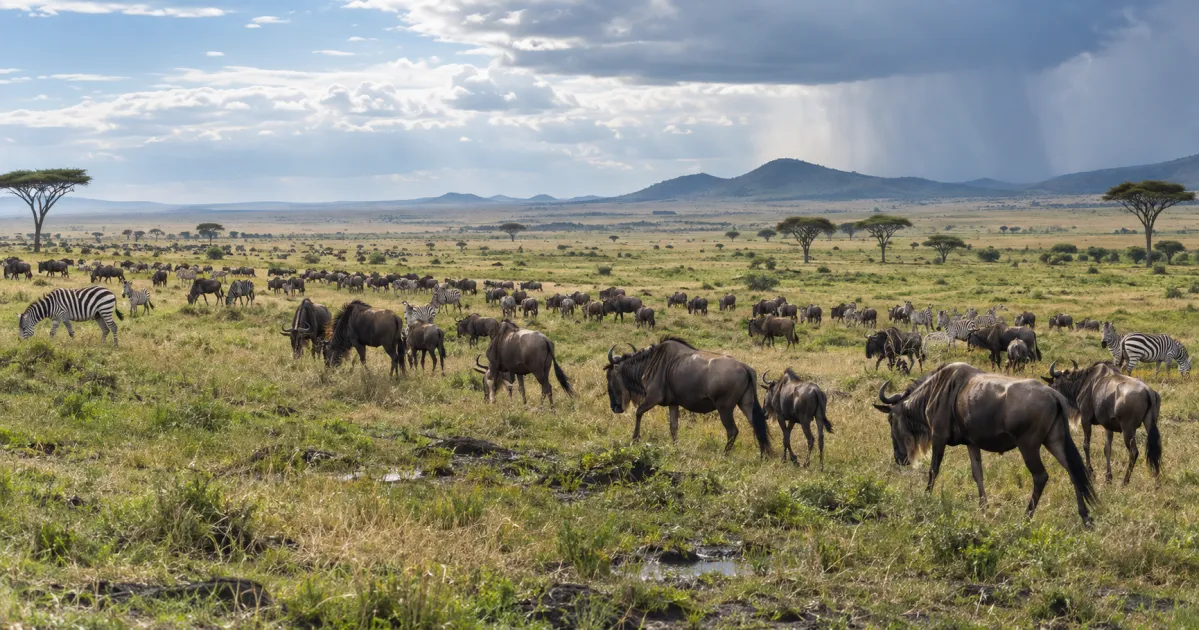
January and February belong to southern Serengeti and Ndutu. The herds gather on nutrient-rich short-grass plains, and calving peaks during this period. The concentration of vulnerable newborns draws lions, cheetahs, hyenas, and other predators into repeated hunting opportunities. This is not a single daily spectacle. It's a sustained wildlife environment in which the chances of finding active behavior remain strong across the plains.
By March, movement begins to pull animals toward the central Serengeti and then toward the west. The herds follow fresh grazing as conditions change, and the experience shifts from stationary calving drama to a more mobile migration. April and May bring the long rains, so road conditions become part of the decision. The western corridor becomes increasingly relevant as herds continue their northward push.
Late June and July are the strongest months for the Western Corridor and northern movement, while July through October offers the main opportunity for Mara River crossings, according to Serengeti migration timing guidance. The Grumeti and Mara systems create natural bottlenecks, but the animals may wait, turn back, split into smaller groups, or cross outside the period you're watching. You're booking access to the terrain and the possibility, not a guaranteed show.
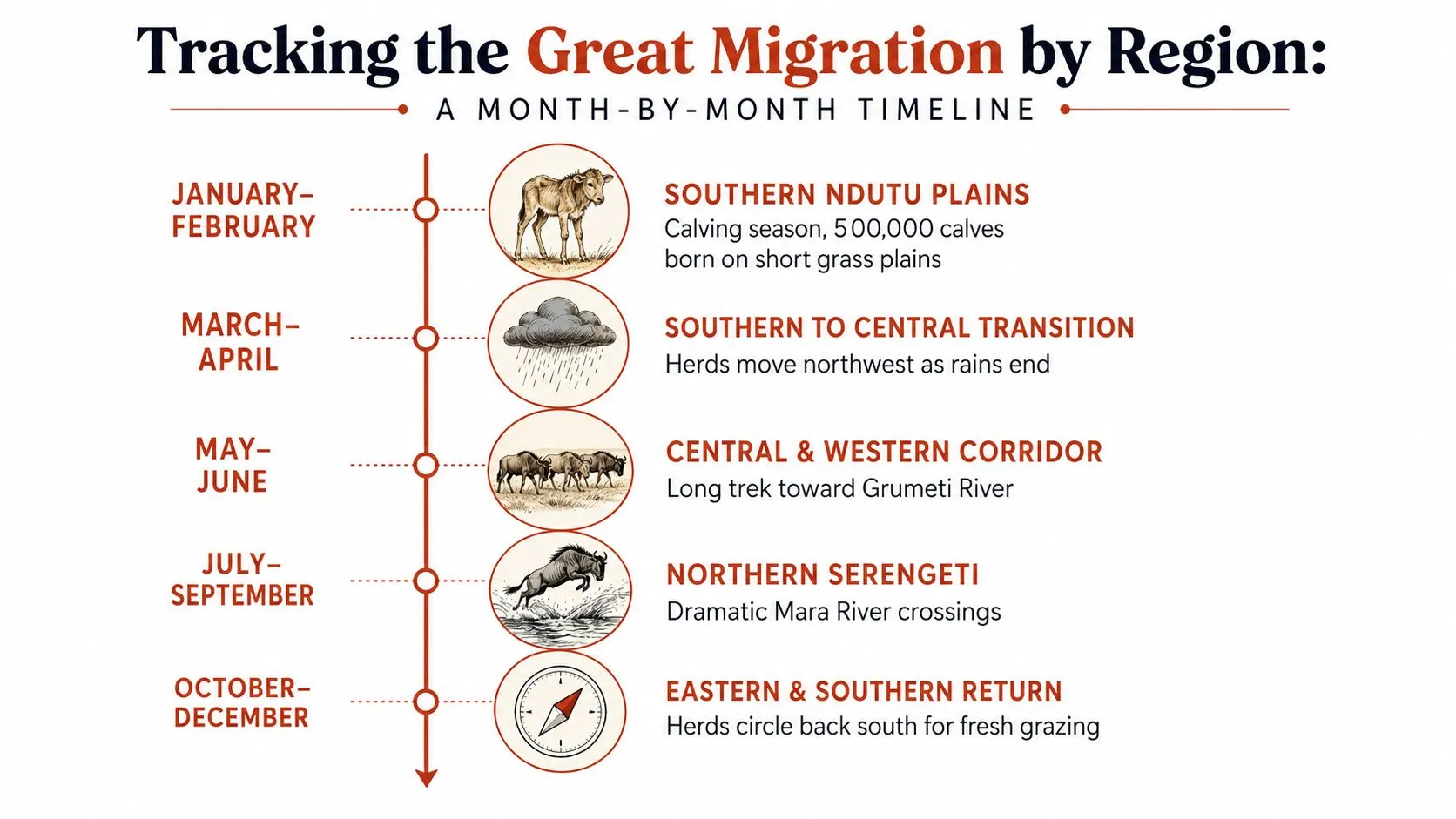
In October and November, movement generally turns back toward eastern and southern grazing areas. The herd's return can produce strong visual imagery and resident-wildlife viewing, even if it lacks the headline drama of a crossing. The northern and eastern zones may still hold animals, but your itinerary should increasingly account for southward movement rather than assume that the river remains the main attraction.
Geographic rule: Migration dates matter only when paired with where you'll sleep. Match your camp to the herd's likely zone, then allow enough flexibility for natural movement.
A Month-by-Month Guide to the Serengeti
A month-by-month guide should help you choose, not pretend to predict animal behavior with calendar precision. The migration responds to rainfall and grazing, and the best month depends on the event and zone you want to see.
| Month | Migration zone | Conditions | Wildlife highlights | Planning trade-offs |
|---|---|---|---|---|
| January | Southern Serengeti and Ndutu | Warm conditions with variable showers | Calving begins, with predators drawn to young animals | Strong wildlife focus, but movement and weather can vary |
| February | Southern Serengeti and Ndutu | Warm, generally favorable calving conditions | Peak calving and intense predator activity | One of the strongest months for reproductive ecology, with higher demand around Ndutu |
| March | Southern to central Serengeti | Humidity and rainfall increase | Calves remain important as herds begin moving west | Quieter travel, but roads become more weather-sensitive |
| April | Central and western areas | Long rains, with April typically the wettest month | Green landscapes, migrating herds, dramatic skies | Excellent for solitude and photography, less dependable for easy driving |
| May | Western Corridor | Rain continues with possible breaks | Herds move toward the Grumeti area and fresh grazing | Lower visitor pressure, but muddy tracks can complicate transfers |
| June | Western Corridor and central Serengeti | Dry season strengthens | Migration buildup, predator activity, and clearer light | A very strong balance between access and movement, before the busiest crossing period |
| July | Northern Serengeti | Dry, cooler mornings and clearer skies | Northern migration and possible Mara crossings | High demand, busy crossing points, and uncertain crossing timing |
| August | Northern Serengeti | Dry and warm, with strong visibility | Continued river-crossing opportunity and concentrated game | Excellent drama, but riverbanks can be crowded |
| September | Northern Serengeti | Dry conditions continue | Mara crossings remain possible, with strong resident wildlife | Good northern access, though the herd may shift unpredictably |
| October | Northern, eastern, and central areas | Dry season begins to ease | Returning herds and broad park game viewing | Fewer peak-season pressures, but crossing odds decline |
| November | Eastern and southern return route | Short rains refresh the landscape | Returning herds, predators, and vibrant scenery | Strong value and photography, with intermittent weather |
| December | Southern Serengeti and Ndutu approach | Warm with scattered short rains | Herds settle south and calving activity approaches | Good blend of migration and green scenery, with holiday demand |
My direct recommendations are simple. Book February if newborn wildlife and predator behavior matter most. Choose June if you want dry-season access and migration without committing entirely to the busiest northern period. Choose July through September only if river crossings are the central purpose of the trip and you're prepared for waiting. Choose April, May, November, or December if solitude, greenery, and value outweigh perfect road conditions.
What Each Safari Window Feels Like
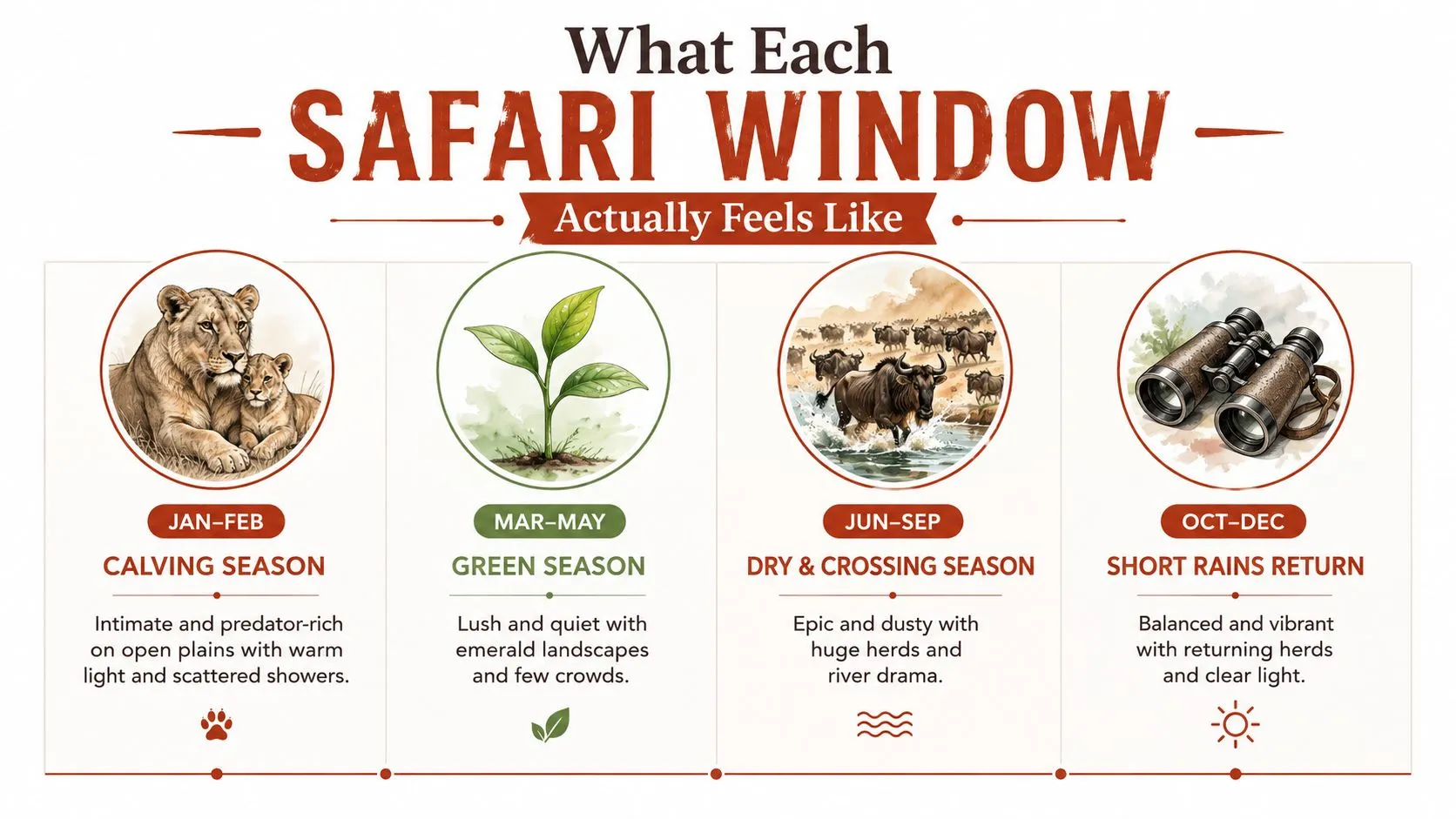
Book the window around the sight you want, not a generic idea of peak season. Calving season feels open, intimate, and constantly active. In southern Serengeti and Ndutu, short-grass plains make distant animals easier to scan, while newborns create tension without requiring one spectacular event. A quiet morning with mothers and calves can turn into a nearby predator encounter. Scattered showers and warm light may shift the plains from pale to vivid during one drive.
The dry-season north has a sharper, more dramatic rhythm. Roads are generally more dependable, dust trails behind vehicles, and wildlife is easier to locate near permanent water. River crossings can be unforgettable, yet they may be brief, hidden from view, or absent after hours of waiting. Crocodiles, current, herd hesitation, and vehicle presence all influence what unfolds.
The quieter green-season experience
April and May provide the clearest contrast with the headline migration months. Green scenery, dramatic cloud formations, and lighter vehicle traffic can make the park feel spacious. Birdlife becomes a major part of the experience, while ordinary sightings feel less managed and more exploratory.
Lower demand can reduce planning costs, but it does not make travel effortless. Heavy rain may slow a short drive, and your operator may need to adjust routes. Choose this period if atmosphere and photographic variety matter more than consistently dry roads.
November and December offer a practical middle ground. Returning herds, green scenery, fresh light, and intermittent storms create movement without the same pressure associated with headline crossing months. Flexibility remains necessary, but short rains suit travelers who want color and changing conditions rather than a completely dry itinerary.
Photographer's choice: Green-season skies and uncluttered sightings can produce more distinctive images than a crowded crossing viewpoint, even when the wildlife event itself is less theatrical.
Families and first-time safari travelers usually find the dry season easier because road access and daily logistics are more predictable. Repeat visitors often gain more from calving or shoulder-season travel, when the experience depends less on checking off a famous scene and more on reading the terrain. Choose the window that matches your priority: newborns and predator action, crossings and suspense, or quiet drives under richer light.
Calving Season or River Crossings
Choose the event before choosing the month. Calving is the stronger choice for consistent wildlife action. River crossings are the stronger choice for spectacle and photographic tension, provided you can accept that nature may ignore your preferred day.
| Factor | Calving season | River-crossing season |
|---|---|---|
| Main window | January to February, extending into the broader early-year calving period | July to October, with the strongest focus on the northern Serengeti |
| Primary zone | Southern Serengeti and Ndutu | Western and northern Serengeti, especially the Mara River area |
| Wildlife action | Repeated predator-prey encounters around vulnerable newborns | Sudden, compressed movement involving large herds and dangerous river crossings |
| Terrain | Open southern short-grass plains | Northern rivers, woodland, and more varied terrain |
| Weather | Warm, with showers possible | Drier, clearer, and dustier |
| Crowd atmosphere | Generally more intimate than major crossing viewpoints | Higher pressure around likely crossing sites |
| Uncertainty | The calving location is comparatively predictable, but exact births and hunts aren't | Timing is highly unpredictable, and a herd may wait or turn back |
Calving offers the more dependable wildlife program. January and February place the herds in southern Serengeti and Ndutu, where roughly 1.7 million wildebeest, alongside hundreds of thousands of zebra and gazelle, may move through the southern plains, as documented in Great Migration calving guidance. February is repeatedly identified as the prime calving month. Nutrient-rich short grass supports synchronized births, which in turn concentrates predator activity.
River crossings create the more theatrical scene. A herd gathers, pauses, and may suddenly enter the water. The famous moment is also the least controllable. The crossing can happen before you arrive, after you leave, or nowhere near your position during the time you spend at that river.
Book calving if you want sustained action, especially on a first Serengeti safari or a family trip. Book crossings if you are a repeat visitor, a dedicated photographer, or willing to spend several days in the north without expecting a crossing on demand.
My recommendation: Choose calving for predator activity and reliable opportunities around newborns. Choose crossings for suspense, scale, and the chance of a dramatic single encounter.
If calving matches your priorities, compare a dedicated eight-day calving-season safari with broader Serengeti itineraries before selecting accommodation. The right choice depends on whether you want repeated encounters or one high-stakes natural event.

Climate Change and Shifting Migration Timing
The old calendar is useful, but it isn't fixed. Recent independent coverage notes that rainfall patterns can shift from year to year, with wettest conditions still usually associated with April, May, and November but without the same predictability every season. That variability affects grazing, herd movement, road conditions, and the likelihood of finding animals at a specific river or camp.
Guides published for 2025 and 2026 increasingly emphasize updated seasonal forecasts and rainfall-based planning rather than treating a calendar month as a guarantee, as discussed in recent Great Migration timing coverage. For travelers, the practical lesson is straightforward: don't build an expensive itinerary around one advertised crossing date.
Book a flexible window instead. Ask your operator where the herds were recently reported, which roads are currently usable, and whether the itinerary can shift between the central, western, northern, and southern zones. A good plan gives your guide room to respond to conditions rather than forcing you to follow a brochure's prediction.

The same principle applies to rain. A wet-season trip isn't automatically a washout, and a dry-season trip doesn't guarantee a crossing. Flexibility is now a safari feature, not an optional extra. Confirm current ground reports close to departure, and choose accommodation and transfers that won't leave you trapped on the wrong side of the ecosystem.
Choosing Your Window and Booking with Confidence
Turn the decision into four practical steps.
Name the experience you want most. Calving points to southern Serengeti and Ndutu. River crossings point north. Predator-heavy dry-season game viewing favors June to October. Green scenery, quiet tracks, and value point toward the rainy and shoulder periods.
Choose the matching zone before the lodge. A beautiful camp cannot compensate for being far from the herd. Select the region first, then compare camps with realistic drive times, transfer options, and access to the habitats you care about.
Decide how much uncertainty you'll accept. Dry-season travel usually offers easier roads and clearer visibility. Green-season travel can offer stronger atmosphere and fewer vehicles, but requires patience with rain and changing tracks.
Book according to demand. For July to October and Mara-focused itineraries, start securing lodges roughly 9 to 12 months ahead. For green-season safaris, 4 to 6 months can often be a more practical planning horizon, though special camps and holiday dates should be checked earlier.
Ask for flexible cancellation terms where possible, and build buffers around internal flights between Serengeti zones. Verify herd locations with your operator 4 to 6 weeks before travel, then confirm again shortly before the safari begins. That conversation should cover recent sightings, road conditions, camp access, and whether your route can change if the migration stalls.
Safety planning belongs in the same conversation as wildlife timing. Travelers comparing remote safari logistics may also find this resource on how prevents tragedy in Kenya useful for thinking about preparedness in remote environments.
Explola can help you compare verified safari operators, review day-by-day itineraries, filter by budget and lodging style, and send direct inquiries without booking or service fees charged to travelers. The best Serengeti window is the one aligned with your priority, so visit Explola, shortlist suitable Serengeti trips, and ask operators where the herds and roads are most favorable for your dates.
Ready to experience this?
Explore Related Safaris
Destinations Mentioned

Daniel writes for the Explola blog, where he covers African safari destinations, wildlife, travel trends, and practical trip planning. His work is centered on making safari travel easier to understand, compare, and plan.
Get Safari Tips & Destination Guides
Join our newsletter for exclusive travel tips, wildlife insights, and safari planning advice.