
Choosing the wrong booking model can silently drain your revenue. A safari operator running $5,000 bookings through a platform charging 20% commission loses $1,000 per booking before covering a single operational cost. Multiply that across a season, and the damage is real. For small to medium-sized operators in Kenya, Tanzania, Uganda, and across East and Southern Africa, the stakes are high. This article breaks down every major booking model available in 2026, compares them on the factors that matter most, and gives you a clear framework for deciding which mix will protect your margins and deepen your guest relationships.
Key Takeaways
Point | Details |
|---|---|
Evaluate commission impact | Choose booking models that help you reduce commission fees and maintain margins. |
Prioritize guest relationships | Direct bookings let you build loyalty and gather valuable guest data for growth. |
Embrace hybrid strategies | Combining different booking models maximizes reach while retaining control. |
Invest in technology | Modern booking engines and trust signals are crucial for driving direct sales. |
How to evaluate safari booking models
Before committing to any booking channel, you need a clear set of criteria. Not all booking models are equal, and what works for a large lodge chain may quietly hurt a smaller operator. Here is what to measure before you decide.
Key evaluation criteria:
Commission costs: What percentage of each booking do you surrender? Even a 10% difference compounds fast over a full season.
Guest data ownership: Do you receive the traveler's contact details, preferences, and travel history? Or does the platform keep it all?
Brand control: Can guests see your story, your values, your unique selling points? Or are you just another listing?
Marketing reach: How many potential travelers does the channel expose you to, especially in your target markets?
Customer experience: Does the booking process feel smooth and trustworthy for guests?
Operator effort: How much time and technical skill does the channel require to manage?
Think about a typical $5,000 safari booking. At 20% commission, you net $4,000. Subtract your operational costs, and the margin shrinks fast. High commission fees can erode operator margins to the point where growth feels impossible. This is why the booking model conversation is not just about convenience. It is about the financial health of your business.
Brand control and guest relationship management deserve special attention. When a third party owns the booking, they own the relationship. You may never know if that guest traveled with you three times before. That lost insight means lost upsell opportunities, lost loyalty, and lost referrals.
Pro Tip: Start tracking your repeat guest rate by booking channel right now. If guests who book directly return at a higher rate than those who come through third parties, that data will make your channel decisions much easier to justify internally.
When you increase direct bookings, you are not just saving on fees. You are building an asset: a database of loyal travelers who chose you specifically.
Online travel agencies (OTAs)
With your criteria set, let's start by unpacking the most widely used and most debated booking channel: OTAs.
Online travel agencies are platforms like Booking.com, Expedia, and safari-specific aggregators that list multiple operators and allow travelers to compare and book in one place. They dominate online travel discovery. OTAs account for more than 50% of online safari bookings, which explains why so many operators feel they cannot afford to ignore them.
Advantages of OTAs:
Massive global marketing reach with minimal effort from the operator
High-volume booking potential, especially during peak seasons
Built-in trust signals like reviews and secure payment systems
No upfront marketing spend required
Disadvantages of OTAs:
OTA commissions typically range from 15% to 25% per booking
Operators have limited control over how their brand is presented
Guest contact details are often withheld, blocking direct follow-up
Dependency on platform algorithms means your visibility can drop overnight
Price parity clauses on some platforms restrict your ability to offer better rates elsewhere
On a $5,000 booking at 20% commission, you pay $1,000 to the OTA. That is before staff costs, vehicle maintenance, park fees, or food. The math gets uncomfortable quickly.
"Operators need to weigh visibility against profit margin. The reach OTAs provide is real, but so is the cost. The smartest operators use OTAs strategically, not as their primary channel." — expert safari tips
The deeper problem is dependency. When an OTA changes its algorithm or increases its commission rate, operators who rely on it almost entirely have no leverage. You are essentially renting your customer base from a third party, and that rent can increase at any time.
OTAs make the most sense as a discovery tool for new operators building brand awareness, or for filling last-minute availability. Treating them as your main revenue engine is a risk that grows larger every year as commission structures tighten.
Destination management companies (DMCs) and traditional agents
OTAs are just one option. Many operators also work with DMCs or travel agents, which have a different business model and different relationship implications.
A destination management company is a local or regional specialist that designs, coordinates, and sells travel packages to agents or travelers. Traditional travel agents are intermediaries who sell packages on behalf of operators, often to high-net-worth clients seeking curated experiences.
Advantages of DMCs and agents:
Expert trip planning that reduces the burden on your team
Highly personalized itineraries that attract premium travelers
Strong relationships with international markets you may not reach directly
Guest hand-holding from inquiry to return, which improves satisfaction
Disadvantages of DMCs and agents:
Commission layers can stack, with agents earning 10% to 20% and DMCs adding their own margin on top
Communication passes through multiple parties, slowing response times
Guest data rarely reaches the operator directly
You lose the chance to build a direct relationship for future bookings
DMCs and agentscan provide tailored guest experiences but may reduce direct engagement, leaving operators with satisfied guests they will never hear from again.
The distinction from OTAs is worth noting. Where OTAs compete on price and volume, agents and DMCs compete on curation and trust. A well-connected agent in Germany or the United States can send you a steady stream of high-spending travelers who would never find you through a search engine.
"Great for unique high-end bookings, but beware of losing customer insights. Every guest who books through an agent is a guest you cannot market to next season."
For safari experiences for guests that command premium pricing, DMCs and agents remain valuable partners. The key is to treat them as one channel in a broader strategy, not your only source of business.
Direct booking on your website
Many operators dream of more direct bookings. Here's what's involved, and why it's worth the effort.
Direct booking means a traveler finds you, evaluates you, and pays you without any third party involved. Zero commission. Full guest data. Complete brand control. Direct bookings help operators reduce costs and build lasting relationships that compound in value over time.
What you need for a strong direct booking strategy:
A fast, mobile-friendly website with clear safari descriptions and pricing
A secure payment gateway that travelers trust
Visible trust signals for direct booking like verified reviews, accreditations, and transparent cancellation policies
A simple inquiry or instant-book system that responds quickly
Clear calls to action on every page
The challenges are real. Building and maintaining a website that converts requires upfront investment. You also take on more customer support responsibility. Scaling your direct channel means investing in marketing, SEO, and sometimes paid advertising to replace the visibility OTAs provided for free.
But the math is compelling. On that same $5,000 booking, you keep the full amount. Over 100 bookings per season, shifting even 30% to direct saves you $30,000 at a 20% commission rate. That is money you can reinvest in your product, your team, or your marketing.
Pro Tip: Use guest reviews prominently and display pricing transparently on your website. Travelers who land on your site are already interested. Clear trust signals and honest pricing are often the difference between a booking and a bounce.
When you win more direct bookings, you also gain something harder to quantify: the ability to shape the guest's entire journey from first contact to post-trip follow-up.
Hybrid and emerging models in safari bookings
Most operators use a mix, not just one model. Let's explore how hybrid approaches offer both power and protection.
A hybrid booking model means deliberately combining two or more channels, using each where it performs best. An operator might list on an OTA for global discovery, work with a DMC for high-end European clients, and drive direct bookings through SEO and email marketing for returning guests.
When to use each model:
New operators: Lean on OTAs and agents for initial volume and visibility while building your direct channel
Established operators: Shift toward direct and reduce OTA dependency as your brand recognition grows
Peak season gaps: Use OTAs to fill last-minute availability without sacrificing margin on pre-sold inventory
Niche offerings: Partner with specialist DMCs for unique experiences that justify premium pricing
Tools that support hybrid models include channel managers, which synchronize availability across platforms in real time, and meta-search integrations that surface your direct booking option alongside OTA listings. Instant-book features on your own website reduce friction and compete directly with OTA convenience.

Hybrid models let operators balance reach and control, which is why they are increasingly the standard for operators who have moved past the startup phase.
Booking model comparison:
Model | Commission | Guest data | Brand control | Operator effort |
|---|---|---|---|---|
OTA | 15% to 25% | Limited | Low | Low |
DMC / Agent | 10% to 20%+ | None | Medium | Medium |
Direct booking | 0% | Full | Full | High |
Hybrid | Varies | Partial to full | Medium to full | Medium to high |
For safari planning strategies that protect your revenue long term, the hybrid model gives you flexibility when markets shift, seasons change, or a platform updates its algorithm.
The uncomfortable truth about booking model loyalty
Most articles on this topic will tell you to diversify your channels and reduce OTA dependency. That advice is correct. But there is a harder truth that rarely gets said directly: many operators stay trapped in high-commission models not because they lack options, but because building a direct channel feels overwhelming when you are already running full operations.
The real barrier is not technology or budget. It is time and confidence. Operators who have built strong direct booking channels almost always say the same thing: they wish they had started earlier, and the first steps were simpler than they expected.
The other uncomfortable reality is that OTAs are not your enemy. They are a tool with a specific cost. The problem is not using them. The problem is using them by default, without a deliberate plan to reduce that dependency over time. Every season you wait to build your direct channel is another season of paying commissions that could have funded better equipment, better staff, or better marketing.
Start small. Even shifting 10% of your bookings to direct in year one changes the economics meaningfully. Build from there. The operators who thrive long term are not the ones who abandoned OTAs overnight. They are the ones who treated direct booking as a growing asset, adding to it consistently while using third-party channels strategically.
Ready to take control of your bookings?
If this breakdown has made one thing clear, it's that the right booking model is the one that puts more revenue in your hands and more guest relationships under your control.
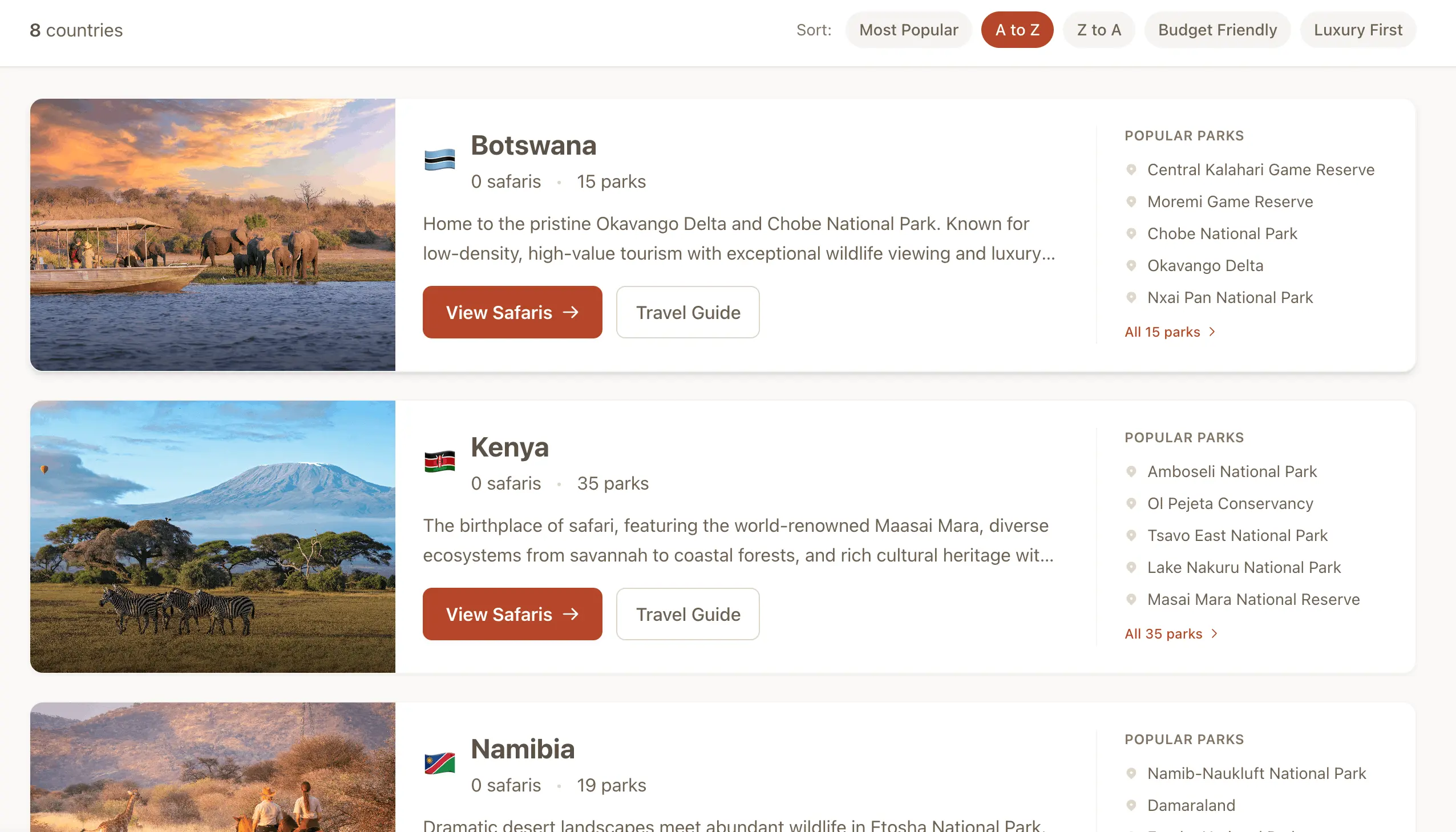
Explola is built specifically for safari operators in East and Southern Africa who are ready to reduce commission dependency and own their guest relationships. The platform connects you directly with travelers through AI-powered discovery, giving you full data ownership and zero commission on bookings. With tools for inquiry automation, quote generation, and content optimization, Explola makes it practical to grow your direct channel without needing a technical team. Explore what Explola offers and see how operators like you are shifting the balance in their favor.
Frequently asked questions
What is the most cost-effective safari booking model?
Direct booking on your own website is typically the most cost-effective, since it eliminates commission fees entirely and gives operators full control over guest relationships and data.
How much commission do OTAs charge for safari bookings?
Most OTA commissions fall between 15% and 25% per booking, which can significantly compress operator margins, especially on high-value safari packages.
Can I use multiple booking models at the same time?
Yes, and most successful operators do. Hybrid booking models let you capture broad market reach through OTAs and agents while steadily growing your direct channel for better margins.
Why is guest data control important for safari operators?
When you own your guest data, you can personalize future trips, market directly without platform fees, and build the kind of loyalty that drives repeat bookings. Guest loyalty grows consistently when operators control more of the relationship from the start.
Recommended

Founder of Explola and a passionate advocate for authentic African travel. He writes about safari destinations, conservation, and connecting travelers with trusted local operators across Africa.
Get Safari Tips & Destination Guides
Join our newsletter for exclusive travel tips, wildlife insights, and safari planning advice.