Safari operator visibility: better booking choices in 2026
TL;DR:
Safari operator visibility affects how easily travelers find and assess operators online.
Higher visibility often indicates better transparency, reviews, and direct booking options.
Travelers can evaluate visibility through search presence, reviews, pricing clarity, and enquiry responsiveness.
Most travelers assume that the best safari operators are easy to find online. Just search, pick a top result, and book. But that assumption leaves countless outstanding operators invisible to you, and it may cost you authentic experiences, fair pricing, and real trust. Safari operator visibility refers to the online discoverability and prominence of safari tour operators in search results and booking platforms. This guide walks you through what visibility actually means, why it shapes your entire booking journey, and how to use it to find operators worth trusting.
Key Takeaways
| Point | Details |
|---|---|
| Visibility boosts trust | Being able to find and compare safari operators online leads to more confident, informed bookings. |
| Direct booking advantages | Operators with strong visibility often provide more transparent pricing, authentic experiences, and better support. |
| Travelers can influence visibility | Your choices in searching, booking, and reviewing impact which operators stand out and improve transparency industry-wide. |
| Look for transparency signals | Check for real reviews, open pricing, and direct enquiry options to ensure you’re dealing with a reputable safari operator. |
Defining safari operator visibility
At its simplest, safari operator visibility means how easily you can discover a specific operator online. If you search “safari tours Kenya” and a company appears on page one, that company has strong visibility. If a smaller, equally credible operator only shows up on page five, most travelers never find them at all.
Visibility exists across several platforms, not just Google. Search engines are the most familiar channel, but online travel agencies (OTAs) like Viator, review aggregators like TripAdvisor and SafariBookings, and dedicated marketplaces all play a role. Each platform rewards different signals: keyword relevance, review volume, booking frequency, and content quality.
Here is what happens when you type “safari tours Kenya” into Google. You get a mix of paid ads, large OTAs, well-funded agencies, and occasionally a direct operator website. The operators you see are not necessarily the best. They are the most visible. That distinction matters.
Who benefits from strong visibility?
Travelers discover more options, compare transparent pricing, and access real reviews before committing.
Operators reach the right audience without relying entirely on middlemen who charge steep commissions.
The industry moves toward authenticity when smaller, specialized operators can compete fairly.
For your safari planning process, understanding visibility helps you look beyond the first page and ask smarter questions before you book.
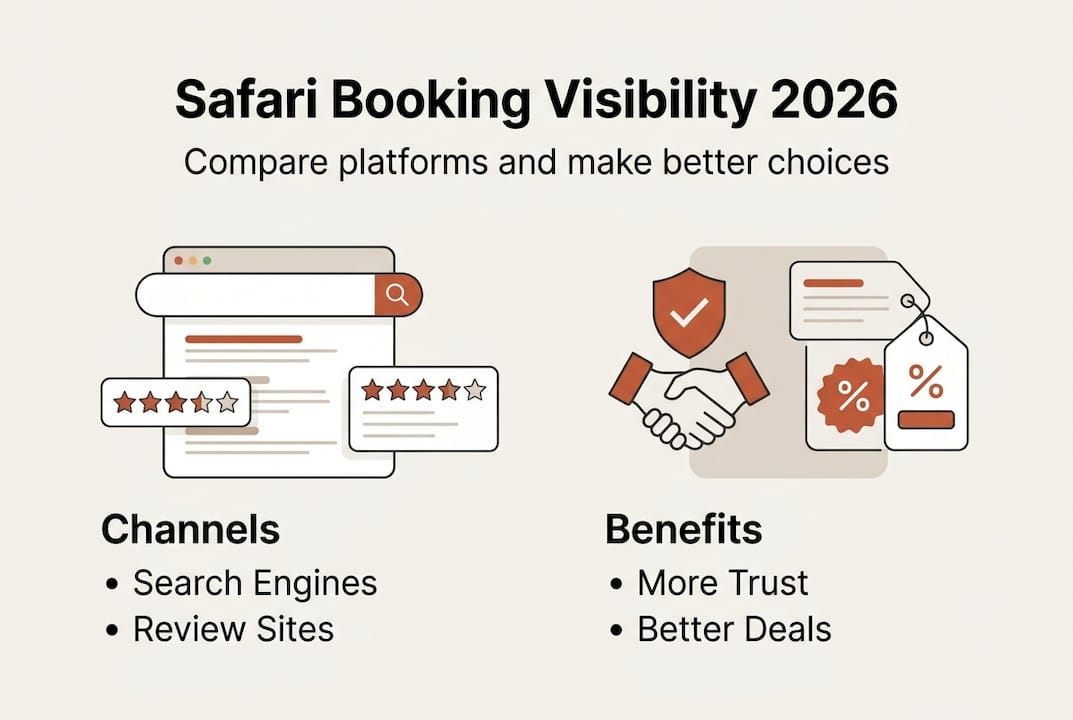
| Visibility platform | What it shows you | How to use it |
|---|---|---|
| Search engines | Operator websites, paid ads | Start broad, then dig deeper |
| OTAs (Viator, etc.) | Aggregated tours | Compare, but check direct sites too |
| Review aggregators | Customer feedback | Verify authenticity of reviews |
| Safari marketplaces | Curated operators | Find transparent, vetted options |
Pro Tip: Search an operator’s exact name in Google. If their own website does not appear first, or if there are no reviews anywhere, treat that as a reason to investigate further before booking.
Why visibility matters for your safari experience
Visibility is not just a marketing concept. It directly shapes the quality of information you receive, the price you pay, and the trust you can place in an operator before you hand over a deposit.
When an operator ranks well for terms like “best safari tours Kenya,” they are likely investing in their online presence, which often correlates with investing in their guest experience too. But low search visibility pushes operators toward OTA dependency and lost direct bookings, meaning you interact with a middleman rather than the people who will actually run your trip.
“The operator you book with through an OTA may be excellent, but you lose the direct conversation that helps you customize your experience, understand what is included, and build genuine trust.”
Here is what low visibility costs you as a traveler:
Inflated pricing. OTAs add margins ranging from 15% to 25%, and those costs are usually passed on.
Less personalization. Booking through a third party limits the information flow between you and the operator.
Missed unique experiences. Smaller operators running extraordinary itineraries may simply never reach you.
Weaker accountability. Operators dependent on OTAs have less incentive to maintain a direct relationship with you.
Choosing direct bookings gives you better access to the actual team planning your safari. You can ask about guide experience, vehicle conditions, group sizes, and conservation commitments in ways that an OTA booking form never allows. Understanding different safari operator models helps you recognize which type of operator you are actually dealing with.

40% higher conversions. According to booking flow audits, top operators convert inquiries into bookings at 40% higher rates when they have optimized, transparent enquiry flows. That efficiency benefits you, because faster and clearer responses mean less frustration and more confidence in your decision.
How visibility is built: strategies and challenges
Understanding how operators build or lose visibility helps you read between the lines when evaluating your options. It is not magic. It comes down to a few consistent strategies and a handful of common mistakes.
The core methods operators use to build visibility:
SEO for intent-driven keywords. Operators optimize their websites for phrases like “gorilla trekking Uganda” or “Masai Mara wildebeest migration.” This is how they show up when you have a specific trip in mind.
Storytelling content. Blog posts, safari journals, and destination guides build authority over time. An operator who publishes genuine, detailed content ideas for safari companies signals expertise and passion for what they do.
Fast, mobile-friendly booking flows. If an operator’s site is slow or clunky on your phone, their winning direct bookings rate drops sharply. And if the booking flow is confusing, you will likely abandon it.
Review generation. Actively collecting and displaying authentic reviews builds credibility across platforms.
OTA dependency risks brand control loss for operators, and the core mechanics for avoiding that involve consistent SEO, storytelling, and fast mobile sites to boost direct visibility.
| Channel | Traveler experience | Pricing transparency | Personalization |
|---|---|---|---|
| Direct operator website | High | High | High |
| OTA platform | Medium | Low to medium | Low |
| Booking aggregator | Medium | Medium | Medium |
Common pitfalls operators fall into include poor mobile site performance, no visible reviews, weak tour pricing strategies, and a complete absence of storytelling. When you land on a site that feels abandoned or generic, that is a real signal about how the operator treats their online presence, and possibly their guests.
Pro Tip: Red flags when browsing operator sites include no blog or news section updated in the last year, pricing with no detail or breakdown, no reviews from named travelers, and no clear contact method beyond a generic form.
Visibility in action: What travelers should look for
Knowing how visibility is built is useful, but what matters most is knowing how to evaluate it yourself before you book. Here is a practical approach.
Steps to check an operator’s visibility and trustworthiness:
Run a branded search. Type the operator’s exact name into Google. Their own site should appear first. If it does not, that is unusual and worth questioning.
Cross-check on OTAs. Search for the same operator on TripAdvisor, SafariBookings, or Viator. Do their reviews match across platforms?
Look at review recency and detail. Generic five-star reviews with no specifics are less reliable than detailed accounts naming guides, locations, or specific moments.
Check for transparent pricing. Visible operators who care about safari booking engagement models typically display price ranges or inclusions clearly, not just a “contact us for a quote” button.
Test the enquiry flow. Send a simple question. How fast do they respond? Is the response personalized or templated? Speed and quality of communication predict a lot about the experience ahead.
Platforms like SafariBookings aggregate reviews for transparency, and top operators convert at 40% higher rates via optimized enquiry flows. Certifications from bodies like ATTA (African Travel and Tourism Association) add another layer, but visibility and certifications are not the same thing. An operator can be certified and still be nearly impossible to find online, or vice versa.
What good visibility looks like in practice:
Active website with recent content and real safari experiences stories
Detailed itineraries with day-by-day breakdowns
Genuine reviews across multiple platforms
Clear pricing structures or transparent quote processes
Social media that shows actual trips, not just stock imagery
Marketing agencies push SEO and direct channels for operator independence, while vetting sites emphasize certifications over pure visibility. The smart traveler uses both lenses.
The uncomfortable truth: Why traveler choices drive visibility
Here is what most guides on this topic miss entirely. Operator visibility is not just something that happens to you as a traveler. You are actively shaping it every time you search, click, book, and review.
When you book through an OTA instead of an operator’s direct site, you are telling the algorithm that OTAs are where safari transactions happen. When you leave a detailed review after a trip, you are giving that operator a visibility asset they cannot buy. When you share a safari story with friends or post about an experience online, you are building word-of-mouth that drives discovery in ways no paid ad can replicate.
Inspiring safari experiences shared by real travelers consistently outperform operator-generated content in reach and trust. That is the loop most people do not see.
The traveler who seeks out direct, transparent booking channels is not just getting a better deal for themselves. They are helping shift the industry toward smaller, more authentic operators who cannot afford massive OTA commissions. Visibility, at its core, is a two-sided relationship. Operators must be findable and trustworthy. But travelers who engage thoughtfully, book directly when possible, and share honest reviews close the loop and make the whole ecosystem healthier for everyone.
Plan your next safari with total transparency
You now know how visibility works, why it matters, and exactly what to look for when evaluating operators. The next step is finding a platform that already does the hard work of surfacing trustworthy, transparent operators for you.
Explola is built specifically for travelers who want real options, real reviews, and real pricing without the noise of opaque OTA layers. Launching in Q2 2026, the platform connects you directly with vetted safari operators across Kenya, Tanzania, Uganda, Rwanda, South Africa, Botswana, and beyond. No hidden markups. No guesswork. Just clear, side-by-side comparisons and direct operator connections. Explore safaris transparently and discover what booking with genuine visibility actually feels like.
Frequently asked questions
What does safari operator visibility actually mean?
Safari operator visibility means how easily travelers can find and assess safari operators online, especially in search engines and booking platforms. The more visible an operator, the easier it is for you to research and trust them before booking.
Why should I care if a safari operator is visible online?
Visible operators are typically more transparent, offer better direct deals, and have more reviews to guide your decisions. Low search visibility pushes operators toward OTA dependency, which can mean higher costs and less personalization for you.
How can I verify a safari operator’s visibility and trustworthiness?
Check for a strong search engine presence, genuine customer reviews across multiple platforms, and a clear booking or enquiry flow. Top operators convert 40% higher via optimized, transparent enquiry flows, so responsiveness is itself a trust signal.
Do operators with low visibility offer worse experiences?
Not always, but low visibility can signal less transparency or missing reviews, and that makes vetting harder. Marketing agencies recommend using both SEO presence and certifications together, not one alone.
Is booking direct or via OTAs better for safaris?
Direct bookings generally offer more personalization and sometimes better pricing, but always verify visibility, reviews, and pricing first. OTA dependency can mean higher costs and reduced direct operator accountability for travelers.
Recommended

Daniel writes for the Explola blog, where he covers African safari destinations, wildlife, travel trends, and practical trip planning. His work is centered on making safari travel easier to understand, compare, and plan.
Get Safari Tips & Destination Guides
Join our newsletter for exclusive travel tips, wildlife insights, and safari planning advice.