You've probably got the same question most first-time travelers do. You want the wildlife, the early starts, the crackle of a campfire at night, but you also don't want to end up in a damp tent, guessing what's included, or realizing too late that the “cheap” safari quote left out the camp category you needed. Tanzania safari camping can be a brilliant fit, but only when you understand that it runs on a spectrum, from simple bush camping to premium mobile migration camps with real comfort and serious wildlife access.
At its best, camping in Tanzania isn't about roughing it for the sake of it. It's a supported safari style where a driver-guide, camp crew, meals, bedding, and itinerary logistics are handled for you while you sleep close to the park network that makes the Serengeti and neighboring circuits so compelling. Tanzania's demand base is real, too, with Serengeti National Park alone receiving about 430,219 visitors in 2023/24 and 491,398 in 2024/25, while revenue rose from Sh210.9 billion to more than Sh266.8 billion over the same period, according to The Citizen. That scale is why camping is not a side show here, it's part of a major safari corridor.
What Tanzania Safari Camping Really Means
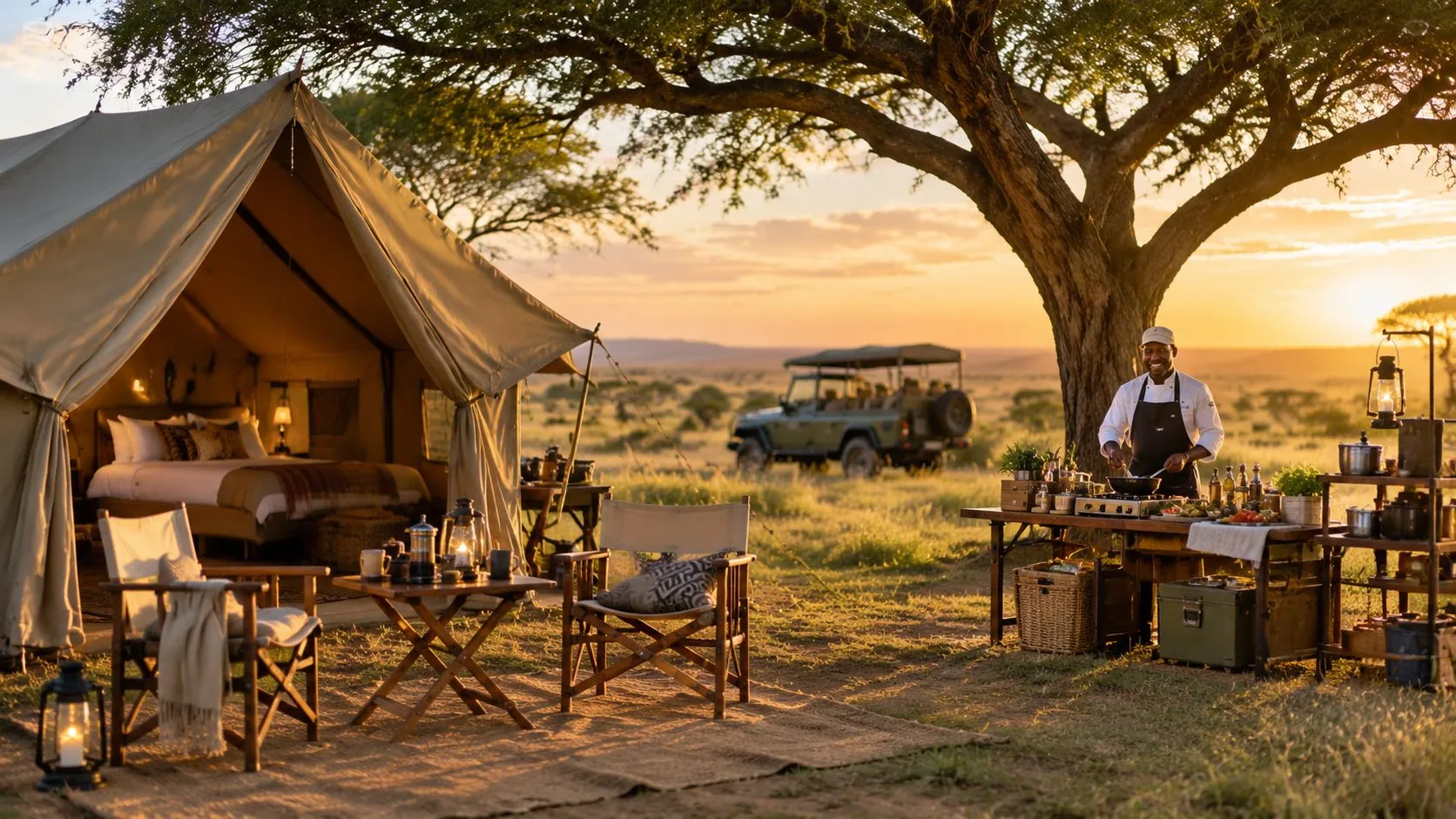
The first night usually feels bigger than the booking form suggested. You arrive after a long game drive, dust on your shoes, a cold drink in hand, and suddenly there's a tented room, a made bed, and a cook finishing dinner while the sky changes color. That's the point where many travelers realize camping in Tanzania doesn't automatically mean hardship. It often means a closer, more immediate version of safari life.
Supported camping, not bare-bones survival
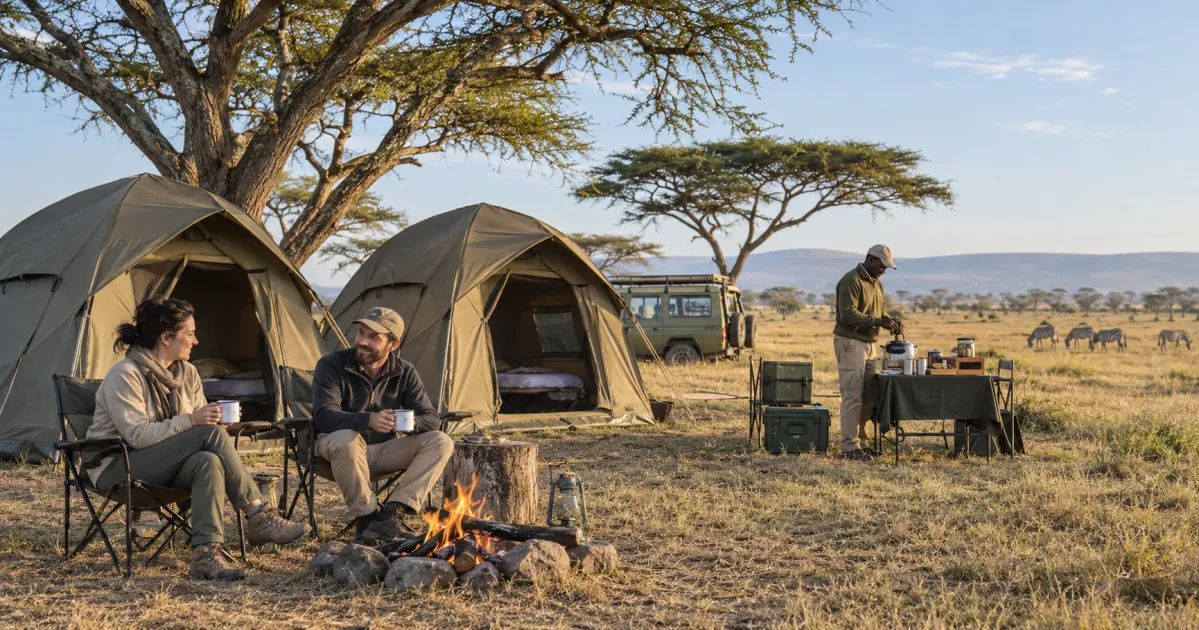
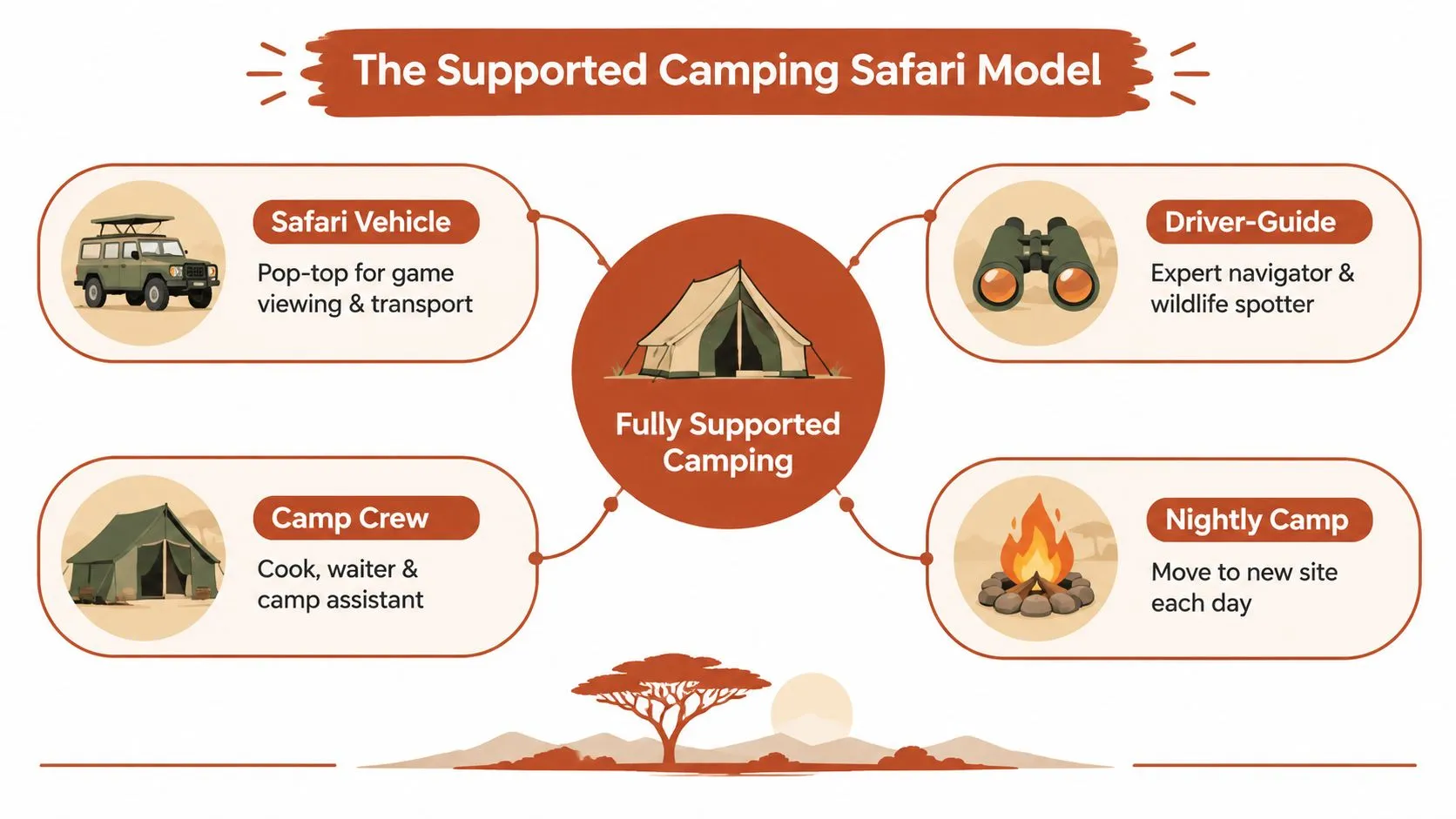
In a properly run tanzania safari camping trip, you're not carrying gear on your back or setting up camp yourself. The operator handles transport, tents, bedding, meals, and the day-to-day movement between safari stops. Your job is mostly to arrive on time, keep your camera ready, and follow camp instructions after dark.
That support matters because the experience is shaped by the wildlife corridor, not by hotel walls. Tanzania's safari camping economy is tied closely to the big-name parks and long overland circuits, especially the Serengeti and Ngorongoro area, where visitors move through multi-day routes rather than fixed bases. When those routes are busy, the camping market has room for more than one style of traveler.
Practical rule: if a quote makes camping sound like a self-service outdoor holiday, ask again. Real safari camping should explain who sets up the tents, who cooks, where you sleep, and how moving between parks works.
Why the term confuses first-timers
People often compare camping to lodges as if they were opposites, but that's too simple. In Tanzania, camping can mean budget bush camping, midrange tented camps, or premium mobile migration camps that move with seasonal wildlife patterns. The common thread is proximity to the safari route, not a single comfort level.
That's why camping suits travelers who want to feel inside the environment, not separated from it. It also suits people who don't want to spend all day shuttling back and forth from a fixed hotel when the park itself is the main attraction. If you're choosing by trip style, not just price, the camping category suddenly makes much more sense.
How Camping Safaris Work in Tanzania
A supported camping safari works like a moving hotel with a very specific rhythm. You travel in a safari vehicle with a driver-guide, your camp team arrives ahead of you or prepares the site, and each night is planned around a designated campsite. The whole system exists because camping in Tanzania is regulated, not casual.
The legal and logistical frame
Under Tanzania's park regulations, camping is only allowed in designated sites, and no one may stay or camp in a campsite between 7 p.m. and 7 a.m. without paying the prescribed fee, unless special permission is granted, as stated in the National Parks Regulations on Tanzlii. That detail changes how itineraries are built. You can't just drift into a park at sunset and hope to find a spot.
It means the operator has to coordinate gate timing, campsite allocation, and fee handling before you even leave Arusha or the previous park. For travelers, that creates a simple booking test. If the quote is vague about campsite type, nightly fees, or late access, the operator hasn't finished the logistics.
What's usually included
A proper camping quote often bundles the basics that matter most on the road. That normally includes the tent, mattress or bedding, meals, a safari vehicle, and a guide. Some itineraries also include park fees, while others break them out separately, so don't assume the headline price tells the whole story.
Useful comparison: lodge safaris fix you in one property style. Camping safaris fix the support system, but let the scenery change every day.
What feels different is the pace. You wake early, drive for game viewing, eat in the park or at camp, then move on to the next night's site. That's why camping works especially well on circuits that link several parks together, because the nights become part of the route rather than a break from it.
Mobile Camps Versus Fixed Camps and How to Choose
Many travelers get stuck because both options sound similar until you look at how they shape the trip. A mobile camp moves with wildlife movement or seasonal access, while a fixed tented camp stays in one place and usually has more stable facilities. Neither is automatically better. Each one fits a different kind of traveler.
Side by side trade-offs
| Feature | Mobile Camping | Fixed Tented Camp |
|---|---|---|
| Location logic | Moves with seasonal wildlife patterns | Stays in one permanent location |
| Feel | More temporary, more flexible | More settled and predictable |
| Access | Can improve positioning for migration-focused routes | Better for consistent access to a specific park zone |
| Facilities | Usually simpler and more variable | More likely to have reliable showers and structured service |
| Night atmosphere | Often quieter and more remote | Can feel calmer and more comfortable for light sleepers |
| Best for | Wildlife-first travelers, repeat visitors, migration timing | First-timers, families, travelers who want consistency |
A mobile camp makes sense when wildlife access is the main goal. It can be a smart choice if you care more about being near the action than about polished infrastructure. A fixed tented camp makes more sense if you want a steadier shower routine, less uncertainty, and a bit more psychological comfort after long drives.
Who should choose what
If you're traveling as a couple and want atmosphere, privacy, and a strong sense of place, either style can work. If you're a family with children, the fixed camp often feels easier because the routine is clearer and the facilities are less improvised. If you're a first-timer who's nervous about noise or sleeping in the bush, start with a fixed tented camp and use one mobile camp night only if wildlife access is the priority.
The biggest mistake is choosing by price alone. The better question is whether you want movement, comfort, or seasonal access to guide the itinerary. If you ask it that way, the right camp style usually becomes obvious.
What to Expect on a Typical Day and Night in Camp
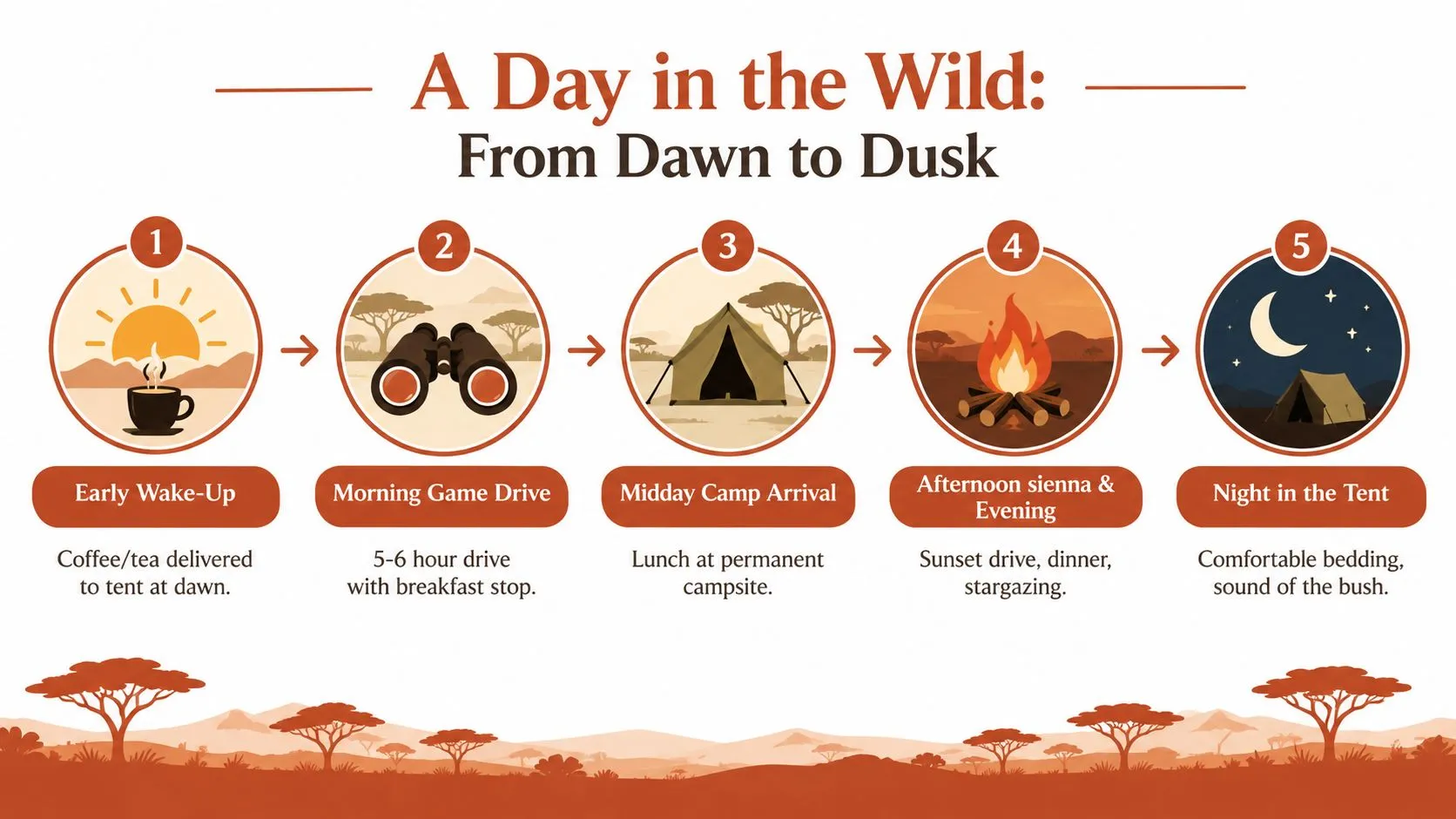
A camp day starts earlier than one might expect and ends later than first imagined. Coffee or tea comes to the tent, bags get loaded, and you're on the road before the heat builds. Later, after the drive, you return to a ready camp, dinner, and a quiet night where the sounds outside are part of the experience.
The rhythm from dawn to dark
The day usually begins with an early wake-up and a light breakfast. Morning game drives can run for several hours, with a stop for coffee, a toilet break, or breakfast in the field. By midday, you're back at camp or at a picnic site, then the afternoon is reserved for more driving, sunset light, and dinner.
That rhythm matters because the tent is not where you spend your safari day, it's where you reset. Beds are often simple but comfortable, and depending on the camp, bathrooms may be private or shared. The difference isn't whether the tent looks elegant in a photo, it's whether the operator keeps the practical pieces working when you're tired, dusty, and ready to sleep.
Safety after dark is procedural, not decorative
At unfenced camps, safety depends on behavior. Guests are told to use escorts after dark, keep tent zippers fully closed, and store all food outside the tent because scent attracts animals and an open zip creates a direct entry path. The camp's system should make those rules obvious without you having to ask twice.
Important rule: if you're walking at night and nobody is escorting you, pause and ask before leaving the tent area.
If you like quiet sleep, pack a soft layer for colder nights, a headlamp, and a power bank. A sleeping bag liner can help if you're unsure about bedding comfort or hygiene. For travelers who want a lower-fuss version of the overnight feel, explore glamping pod options to compare how enclosed sleep spaces change the experience.
For a fuller sense of how the day flows in Tanzania, this internal guide is also helpful, what a day on safari in Tanzania really looks like. The main thing to remember is that camping days are structured around wildlife movement, not hotel convenience, so the more flexible you are, the better the trip usually feels.
Best Parks and Circuits for Camping Safaris
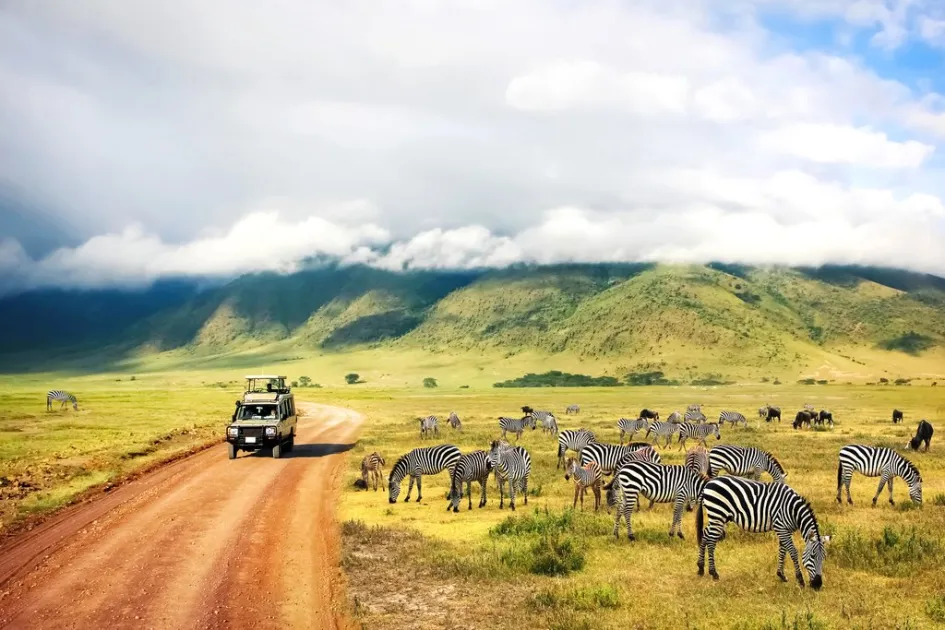
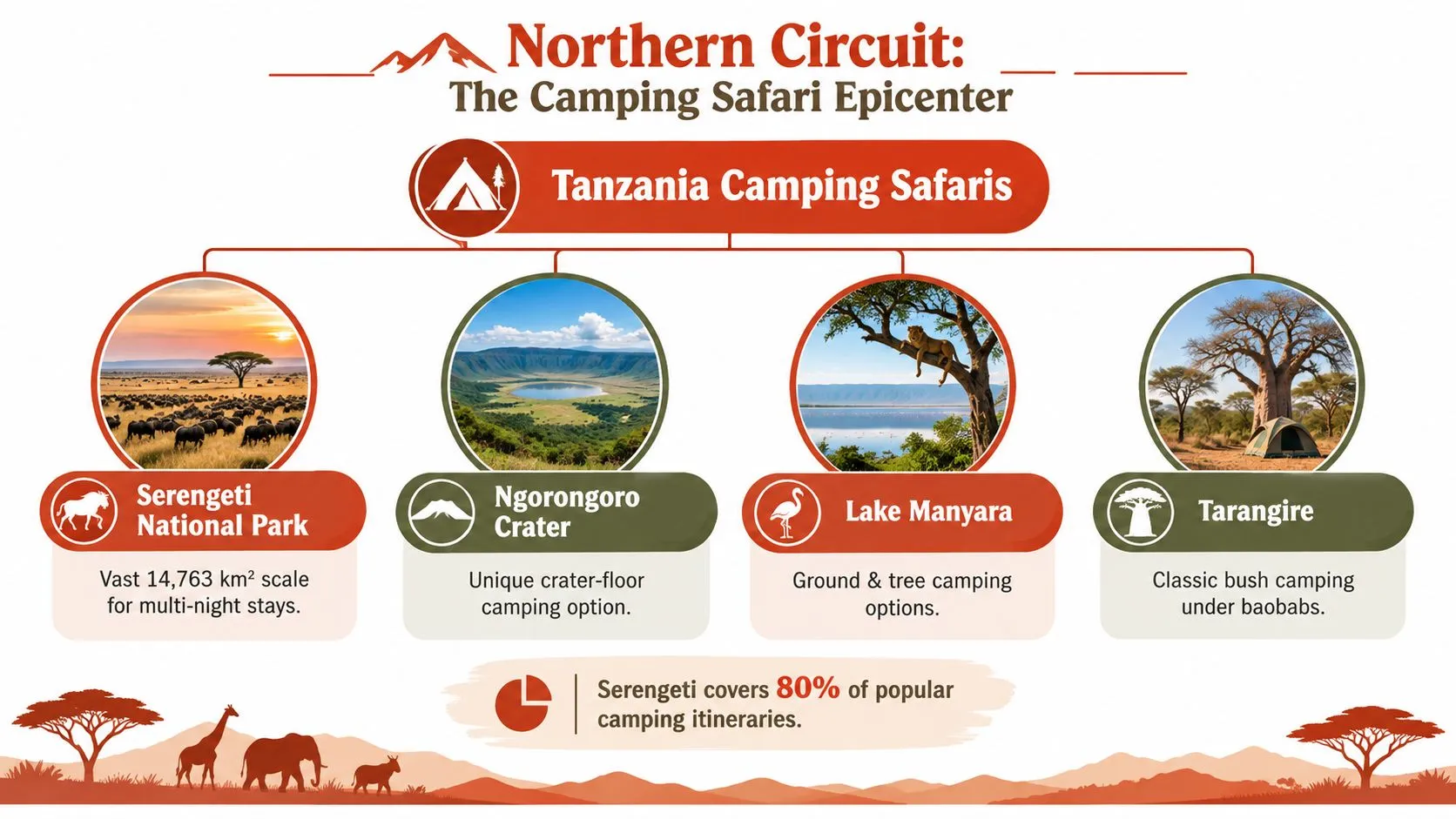
Camping fits best on routes built for several nights on the road. In Tanzania, that usually means the Northern Circuit, where the Serengeti, Ngorongoro, Tarangire, and sometimes Lake Manyara can be linked into one trip. The value is not just proximity. Each park changes the pace of the journey, so one camp night can feel very different from the next.
Why the Serengeti anchors most camping itineraries
The Serengeti sits at the center of many camping plans because it is so large. It covers 14,763 km², which allows for long drives, a wide spread of tented camps, and mobile setups that follow wildlife movement across the ecosystem, according to Serengeti National Park. For camp planners, that size matters like a road network does for a city, it gives room for different styles of overnights without crowding every stop into the same place.
That scale also matches demand. The park continues to draw heavy interest, which is why campsite systems, guiding routines, and supply chains there are more developed than in many smaller parks.
For first-timers, the Serengeti is often the park that justifies camping rather than replacing it. You are not sleeping there only to save money. You are camping there because the park rewards slower travel, and a quick in-and-out visit usually misses the point.
Ngorongoro and Tarangire change the rhythm
Ngorongoro gives camping a different feel. Official reporting says the conservation area generated 693.96 billion/- in revenue over four years and attracted 2.9 million visitors from July 2021 to February 2025, while visitor numbers rose from 425,386 in 2021/22 to 752,232 in 2022/23 and then 908,627 in 2023/24, according to Daily News. Those figures point to a place with steady traffic and established logistics, which is helpful if you want camping that feels supported rather than improvised.
Tarangire fits the more classic bush-camping mood. It often sits at the start or end of a northern route, and it gives the circuit a different texture because the setting feels less like a headline park and more like a quiet wildlife stop with good overland access.
For route planning, your verified operator from Explola can help you think in terms of circuit flow instead of isolated park names.
If you want a park-specific planning lens, Serengeti National Park is a useful place to compare multi-night itineraries. Camping choices there now range from simple bush setups to more specialized mobile migration camps, so the right pick depends more on comfort, access, and trip style than on price alone.
Equipment Packing and Costs Explained
The easiest way to avoid disappointment is to separate operator-provided items from personal comfort items before you book. Most camping safaris provide the tent, mattress, linens, and cooking gear. You're usually responsible for the small things that make sleep and movement easier on the road.
Pack for sleep, dust, and power
A short checklist is enough for most travelers.
Sleep layers: bring a warm layer for cool mornings and a lighter layer for sleeping.
Headlamp: you'll use it more than a flashlight because your hands stay free.
Power bank: useful when charging is limited at camp or in the vehicle.
Dust protection: a scarf, buff, or similar cover helps on long road sections.
Closed shoes: better for moving around camp at night and on uneven ground.
A lot of first-timers overpack clothes and underpack convenience items. The goal is not to dress for a photo shoot. It's to be comfortable after a full day in the vehicle and not worry about finding your charger or stumbling between the tent and bathroom at night.
Why camping is not always the cheapest choice
Camping can be lower cost, but it isn't automatically the cheapest safari style once park fees, campsite categories, crew support, and route complexity are included. Tanzania's market also makes clear that midrange lodges and tented camps account for about 60% of safari travelers, while only 20% choose budget camping and 18 to 20% choose luxury camps, based on the market. That tells you something important. Camping is a meaningful option, but it isn't the default for most travelers.
The other change is qualitative, not just financial. Recent industry commentary points to more new camps, more mobile migration setups, and more eco-focused properties with solar power and water recycling, which means some camping products are moving upmarket rather than staying basic. If you're comparing quotes, look closely at what changes between one camp and another, because the gap may be comfort, access, or privacy rather than just price.
For a practical planning comparison on spending and inclusions, this Tanzania safari budget guide is useful if you want to see how quotes are usually framed. The best booking habit is simple. Ask what's included, ask what category of campsite you're getting, and ask whether the trip is designed around cost control or comfort.
Planning Your Tanzania Camping Safari With Confidence
The right camping safari feels calm on paper and smooth in motion. You know whether you're choosing it for wildlife access, a more immersive route, or a comfort level that sits between a lodge and a rough overland trip. You also know that the decision should be based on comfort, access, and trip style, not on the assumption that camping is only the cheap option.
The clearest way to self-select is this. If you're a light sleeper, traveling with younger children, or want consistent showers and a more settled base, a lodge mix may suit you better. If you want early access, flexible routing, and a closer relationship with the natural surroundings, camping can be the better fit. Either way, the operator should be able to show you campsite types, park-fee handling, nightly logistics, and safety procedures before you pay.
For travelers comparing verified options, Explola is one place to search, compare itineraries side by side, and send direct inquiries to verified operators without intermediary fees. That matters because camping quotes are only useful when the inclusions are clear and the operator can explain the actual night-by-night setup.
If you're ready to compare Tanzania safari camping routes by park, comfort level, and campsite style, start with Explola and check the verified operators that match your dates. You can shortlist itineraries, compare inclusions side by side, and ask for quotes that reflect the exact camp category you want before you commit.
Ready to experience this?
Explore Related Safaris
Destinations Mentioned

Daniel writes for the Explola blog, where he covers African safari destinations, wildlife, travel trends, and practical trip planning. His work is centered on making safari travel easier to understand, compare, and plan.
Get Safari Tips & Destination Guides
Join our newsletter for exclusive travel tips, wildlife insights, and safari planning advice.