
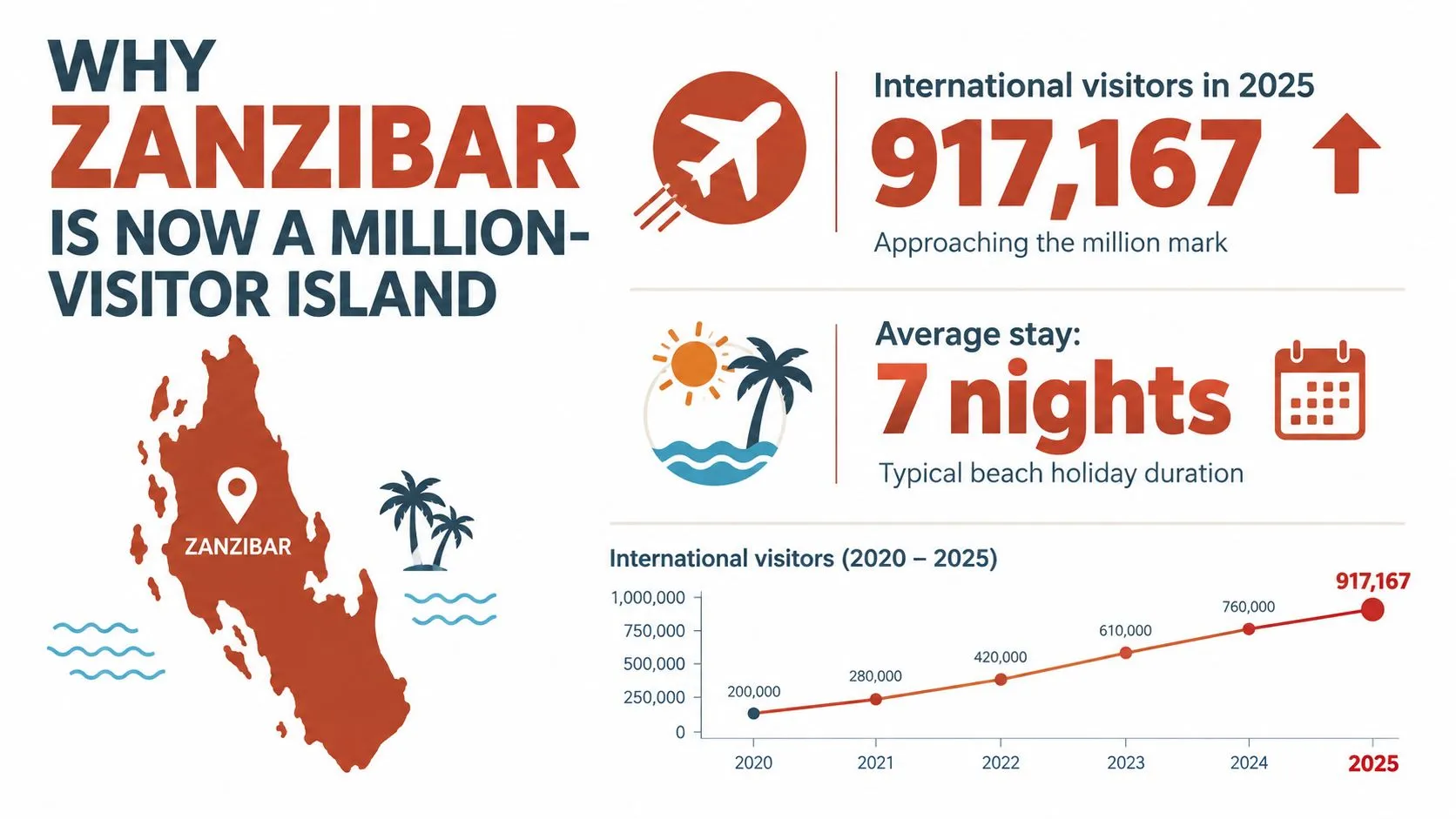
Zanzibar recorded 917,167 international arrivals in 2025, and the average stay was about seven nights. For most travelers, the right vacation is seven to ten days, split between Stone Town and the north or east coast.
That opening figure changes how you should plan. Zanzibar isn't an undiscovered beach hideaway where you can arrive casually and find a perfect room on the spot. It's a mature, fast-growing island destination with substantial resort demand, strong air connections, and a holiday product built around beaches, Swahili culture, marine excursions, and safari combinations.
The good news is that the island is straightforward to enjoy if you structure it properly. Spend enough time in Stone Town to understand Zanzibar beyond its coastline, then settle into one beach base instead of changing hotels every night. Use an operator when your trip involves mainland Tanzania, internal flights, several transfers, or a honeymoon with no tolerance for avoidable mistakes.
Why Zanzibar Is Now a Million-Visitor Island
The most important fact about vacations to Zanzibar is its scale. The island received 917,167 international visitors in 2025, compared with 601,006 in 2024, while tourism earnings reached USD 1,190.8 million, up from USD 997.8 million in the previous year, according to the Bank of Tanzania tourism sector survey. The average visitor stay was about seven nights, which tells you that Zanzibar is primarily a complete holiday destination, not merely a one-night stop after a mainland safari.
The island's tourism demand is also international rather than narrowly regional. In 2024, Europe supplied 527,845 arrivals, or 71.6% of all international visitors, and 646,830 visitors entered through the airport, representing 87.8% of arrivals, according to Zanzibar's official 2024 tourism statistics. That concentration supports regular air access, broad accommodation choice, and increasingly polished package itineraries.
What the scale means for your trip
Plan around a seven-to-ten-night structure:
Two nights in Stone Town, ideally near the historic center, for architecture, markets, food, and a spice-farm excursion.
Five to eight nights on the coast, choosing the north for easy swimming and sunset energy, or the east for quieter beaches and marine activities.
A mainland safari before Zanzibar, if you're extending the trip beyond the island.
The beach-and-culture split matters because Zanzibar's strongest itinerary isn't purely passive. Stone Town gives the trip context, while the coast supplies the recovery time that most travelers want after long-haul travel or a safari. You can research the island's protected areas through this Unguja Island destination guide, but don't mistake a long activity list for a reason to keep moving every day.
Planner's rule: Zanzibar works best when you give culture a defined opening block and relaxation an uninterrupted closing block.
The arrival growth also explains why safari-and-beach packages have become more common. Visitors can combine mainland wildlife with a predictable island finish, while operators coordinate regional flights, airport pickup, accommodation, and the handoff between safari vehicles and Zanzibar transfers. Independent travel remains viable, but the more moving parts you add, the more valuable coordination becomes.
Best Time to Visit and How Season Shapes Your Trip
Zanzibar stays warm throughout the year, with climate summaries placing the typical range at roughly 70°F to 91°F, but warmth doesn't guarantee equally reliable beach weather. The most favorable period for general outdoor tourism runs from late June to mid-September, while beach and pool conditions are strongest from early June to early October, according to this month-by-month Zanzibar climate summary.
The dry season is the safest choice for a first trip, especially if you care about clear scheduling, swimming, snorkeling, and long days outside. It also brings the strongest demand, so the best beachfront properties disappear first and popular excursions feel less spontaneous. Book early if your dates fall in the dry-season peak.
The wetter periods aren't automatically bad. Short rains can produce attractive value and greener scenery, but humidity, cloud cover, and sudden showers make boat days and beach time less predictable. The longer rains are a poorer fit if Zanzibar is the centerpiece of a tightly timed honeymoon or if you plan to rely on remote-road transfers.
| Season | Conditions | Best For | Trade-Off |
|---|---|---|---|
| Late June to mid-September | Drier, comfortable, reliable for outdoor plans | First-time visitors, beach holidays, cultural touring | Strong demand and tighter availability |
| Early June to early October | Strong beach and pool conditions | Swimming, resort stays, water activities | Premium properties require earlier planning |
| Shoulder periods | Warm with more variable rainfall | Flexible travelers seeking value | Weather can disrupt boat or excursion plans |
| Wet-season months | Hotter, more humid, cloudier, with greater rain sensitivity | Travelers prioritizing flexibility and lower pressure | Less dependable outdoor scheduling |
For divers and snorkelers, choose the season before choosing the hotel. Marine conditions determine whether your Mnemba or reef excursion feels exceptional or merely acceptable. Honeymooners should prioritize dependable weather and a room they want, rather than saving money on dates that introduce unnecessary uncertainty.
If you're combining Zanzibar with a mainland safari, ask your operator to design the sequence around the whole Tanzania trip, not just the island. A beach stay is easier to enjoy when the preceding safari has been routed sensibly and you aren't losing the first island day to a badly timed transfer.
Where to Stay, Stone Town, Nungwi, Kendwa, and the East Coast
Choose your base according to how you spend a normal day. Zanzibar's beaches look similar in photographs, but the experience differs sharply between a historic city, a lively northern resort strip, and a quiet east-coast property.
Stone Town
Stone Town deserves two nights for most first visits. Walk the narrow streets, examine the carved doors, visit historic sites, eat at Forodhani Gardens, and use the city as your launch point for a spice tour. A restored Swahili townhouse makes more sense here than a generic resort because the architecture and atmosphere are the reason to stay.
Use this Stone Town travel guide to shortlist cultural experiences, but keep expectations realistic. The center is atmospheric and busy, not polished in the resort sense. Stay somewhere with air conditioning, reliable reviews, and an easy walking route to the waterfront.
Nungwi
Nungwi is the most practical choice for travelers who want swimming, restaurants, diving schools, and evening activity. The northwest coast is lively and convenient, and its beach is less constrained by tidal changes than much of the east coast. The cost is a busier shoreline and a more developed tourist scene.
Kendwa
Kendwa suits couples who want the north-coast advantages without Nungwi's constant movement. Its broad beach and calmer mood work well for a resort-focused stay, particularly when the hotel itself has strong dining and sunset space. It isn't isolated, but it feels more composed.
The northeast coast
Matemwe, Pwani Mchangani, and nearby coastal areas are better for travelers who value space, marine excursions, and slower evenings. The coast is a sensible base for Mnemba access, though beach conditions and swimming change with the tides. Pick it for tranquility, not nightlife.
| Area | Vibe | Best For | Approx. Nightly Rate (USD) | Transfer from Stone Town |
|---|---|---|---|---|
| Stone Town | Historic, urban, atmospheric | Culture, food, short opening stay | Varies widely by property | Shortest island transfer |
| Nungwi | Lively, social, developed | Swimming, diving, nightlife | Varies by hotel tier | Long north-coast transfer |
| Kendwa | Relaxed, polished, beach-centered | Couples, sunsets, resort downtime | Varies by hotel tier | Long north-coast transfer |
| Northeast coast | Quiet, spacious, excursion-oriented | Divers, repeat visitors, privacy | Varies by hotel tier | Longer transfer, depending on property |
Transfer duration depends on traffic, road conditions, and the exact hotel, so don't treat the table as a promise of a fixed drive. My preference for a first trip is Stone Town followed by Kendwa or Nungwi. Choose the northeast instead when peace and marine access matter more than evening options.
Planning Your Itinerary and Safari Combos
The best Zanzibar itinerary protects your energy. Long-haul arrivals, airport queues, road transfers, boat departures, and heat all consume more attention than a brochure suggests. Build the trip around a few strong bases rather than trying to collect every beach.
A seven-night beach break
Use this for a straightforward island holiday. Spend the first night in Stone Town if your arrival is late or if you want a gentle landing, then move north or east for the remainder. Keep the middle days open for swimming, a spice tour, snorkeling, or a dhow cruise.
If your flight arrives after a long overnight journey, don't add a remote-coast transfer immediately. A short first night near Stone Town reduces the risk of arriving exhausted at an expensive resort and wasting the first morning recovering.
A nine-night culture and beach split
This is my preferred shape for first-time visitors who aren't adding safari:
Stone Town, two nights: Explore the historic quarter, markets, waterfront, and local food scene.
Transition day: Take a spice excursion on the way to the coast, or return to Stone Town before transferring.
North or east coast, seven nights: Settle into one property and schedule only a few anchor activities.
The beach block should be long enough to absorb a weather change without turning the holiday into a checklist. Place Mnemba-related activities or other boat excursions in the middle of the coastal stay, not on the final day before departure.
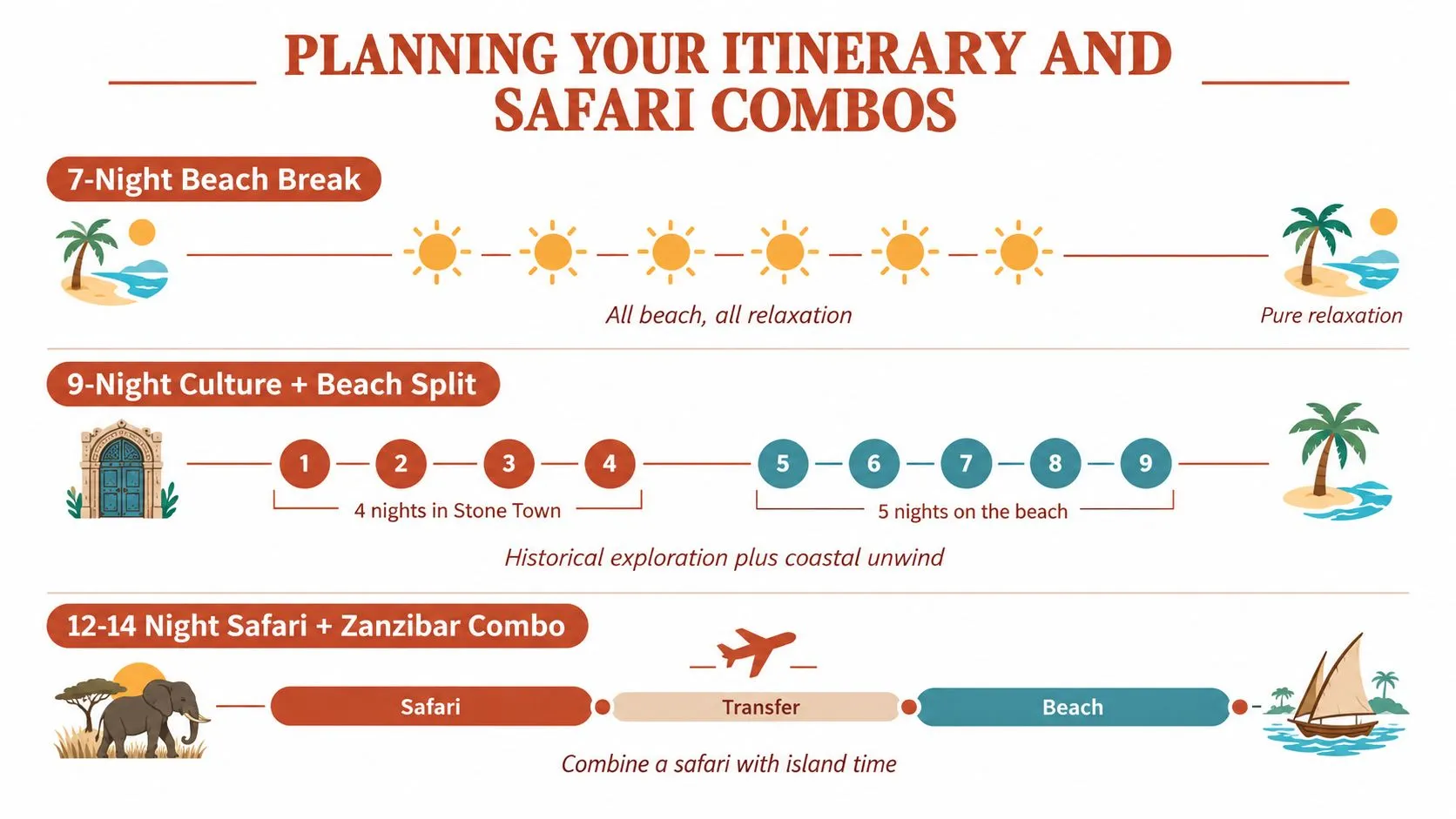
A 12-to-14-night safari and Zanzibar combination
For a Tanzania combination, start on the mainland and finish on Zanzibar. Route the safari through an operator that can coordinate the internal flight to Stone Town, then use the island for recovery rather than adding demanding activities immediately.
A practical sequence looks like this:
Mainland safari: Complete the wildlife portion while you're already in safari mode.
Internal flight: Fly to Zanzibar with the arrival transfer confirmed in advance.
Stone Town: Spend two nights on culture and acclimatization.
Beach coast: Finish with the longest, least complicated portion of the trip.
Final night: Stay where the onward airport transfer is dependable, especially for an early departure.
The Tanzania safari and Zanzibar package guide is useful when comparing routing logic, but judge every proposal by its transfer chain. An operator may bundle the safari, internal flight, airport pickup, and beach hotel, yet you still need to confirm what happens if a domestic flight is delayed.
Put the safari first and the beach second. Ending with the coast gives you a buffer for fatigue, weather changes, and the occasional transfer delay.
Don't cram Stone Town into a few hours between flights unless your schedule leaves no alternative. The city is most rewarding when you can walk without watching the clock, while the beach portion needs uninterrupted nights to feel restorative.
Packages, Independent Travel, and Using Explola to Compare Operators
The package question has a clear answer for complicated trips. In 2025, package tours accounted for 67.2% of Zanzibar arrivals, while leisure travel represented 92.9%, according to reporting based on Bank of Tanzania tourism data in this analysis of Zanzibar's tourism surge. That doesn't mean every traveler should buy a package. It does show that bundled planning fits the way a large share of visitors already travels.
Book independently if you're comfortable comparing hotels, arranging licensed transfers, checking ferry or flight connections, and solving problems locally. Independent booking can work particularly well for flexible travelers who want to spend several nights in one area and don't need a mainland safari.
Use an operator when your itinerary contains several handoffs. A safari plus Zanzibar combination, a family trip with fixed room requirements, or a honeymoon with internal flights creates enough coordination risk that the lowest headline price shouldn't decide the purchase.
The practical decision
Independent travel makes sense when:
You have flexible dates and can accept alternative hotels.
You're booking one island base rather than a multi-country route.
You understand Zanzibar's road, tide, and excursion logistics.
You can verify every transfer instead of assuming the hotel will arrange it.
A package is safer when:
Your safari and island flights must connect cleanly.
You need a particular room category or family setup.
You're traveling during a high-demand period.
You don't already have a shortlist of reputable operators.
Explola provides a comparison and direct-inquiry layer for African safari operators. Travelers can compare itineraries, lodging levels, inclusions, reviews, and starting prices, then contact verified operators directly rather than buying through an anonymous reseller. That's useful for safari-and-beach planning because you can ask who handles the mainland-to-island handoff before paying a deposit.
Don't accept the word “package” as proof of quality. Request an itemized itinerary, named hotels, transfer responsibilities, cancellation terms, and a clear answer about delays. The operator's identity should be visible, and the payment route should be understandable.
Budgeting and What a Zanzibar Vacation Actually Costs
Zanzibar has a wide price range, but vague “cheap island” advice is misleading. Your total cost depends on accommodation, season, transfers, marine activities, and whether a mainland safari is included. The official tourism data gives useful context: visitors stayed about seven nights on average, while tourism earnings reached USD 1,190.8 million in 2025, as recorded in the Bank of Tanzania survey.
That earnings figure isn't a traveler price list, so don't use it to manufacture a per-person quote. Use it as a reminder that Zanzibar supports everything from simple guesthouses to high-end resorts, and that the final bill reflects the level of service and coordination you choose.
| Tier | Mid-Range Beach Resort | Boutique Stone Town + Beach | Luxury Villa or Resort |
|---|---|---|---|
| Accommodation | Comfortable room, shared facilities, organized excursions | Character hotel in Stone Town plus a quality coastal stay | Private space, premium location, higher-touch service |
| Transfers | Shared or standard private transfers | Private transfers between bases | Private transfers with more flexible scheduling |
| Activities | Selected spice, boat, or snorkeling outings | Curated cultural and marine activities | Private excursions, upgraded boats, premium dining |
| Main trade-off | Less privacy and fewer included extras | More planning between two properties | Highest cost, with convenience and exclusivity |
Budget for these line items separately:
International flights: The route and travel season usually shape the total more than the island itself.
Accommodation: Compare what the rate includes, especially breakfast, transfers, taxes, and resort fees.
Internal transport: Add airport transfers, inter-coast drives, and any mainland-to-Zanzibar flight or ferry.
Activities: Boat trips, diving, snorkeling, spice tours, and conservation visits can materially change the total.
Safari costs: Treat the mainland section as its own budget, including guides, park fees, lodging, and internal transport.
Tips and cash purchases: Tipping is expected in practice but isn't mandatory, and small operators may prefer cash, as noted in this independent Zanzibar travel guide.
The easiest savings come from staying in one coastal area, choosing shared excursions, and traveling in a flexible shoulder period. Don't save by choosing a badly located hotel or removing the transfer plan. A cheap room becomes poor value if reaching it consumes hours, requires multiple unplanned taxis, or leaves you exposed to unreliable transport.
Flights, Visas, Transfers, and Health Essentials
Most international visitors arrive by air, so choose the gateway before choosing the hotel. Direct seasonal services and charter flights can simplify the journey for European travelers, while connections through Doha, Istanbul, Addis Ababa, Nairobi, or Johannesburg may offer better scheduling depending on your origin. A connection that looks efficient on the booking screen can still produce a tiring door-to-door journey, so protect the first island night.
Check current entry rules through official Tanzanian immigration channels before departure. Visa eligibility, e-visa procedures, passport validity, proof of onward travel, insurance requirements, and payment methods can change. Don't rely on a blog's old fee or assume that visa on arrival will be equally convenient at every border point.
Transfers that deserve advance planning
The airport is the central arrival point for most travelers, but Zanzibar isn't a tiny resort compound. Stone Town, Nungwi, Kendwa, Matemwe, Pwani Mchangani, and the southeast coast require different road arrangements. Book a licensed transfer and confirm the driver's name, meeting point, vehicle, and payment terms before landing.
Tap water isn't recommended for drinking, according to the independent Zanzibar travel guidance. Carry or buy sealed drinking water, and ask your accommodation how it handles refill stations and ice.
Health preparation
Malaria risk persists in Zanzibar year-round, even though transmission is lower than in many mainland safari areas. Travel-health guidance recommends discussing antimalarial prophylaxis with a clinician and using evening bite prevention, screened or air-conditioned rooms, and long clothing at dusk, as outlined in this Zanzibar vaccination and malaria guidance.
Logistic | Key Detail | Lead Time / Cost |
|---|---|---|
Entry documents | Check visa and passport rules with official Tanzanian authorities | Before booking and again before departure |
Travel insurance | Choose cover that includes medical treatment and evacuation | Arrange before travel |
Airport transfer | Confirm a licensed driver and exact meeting point | Before arrival |
Drinking water | Use bottled or properly treated water | Throughout the trip |
Malaria planning | Seek professional advice about prophylaxis and bite prevention | Discuss before departure |
Yellow fever | Requirements depend on your travel history and origin | Check before flying |
Money and communication | Carry usable payment options and arrange mobile data | Before or at arrival |
Tipping is customary but discretionary. Carry some Tanzanian shillings for small purchases, keep valuables secured, and dress more conservatively in Stone Town and local villages than you would at a resort beach.
Booking, Lead Times, and Your Final Pre-Trip Checklist
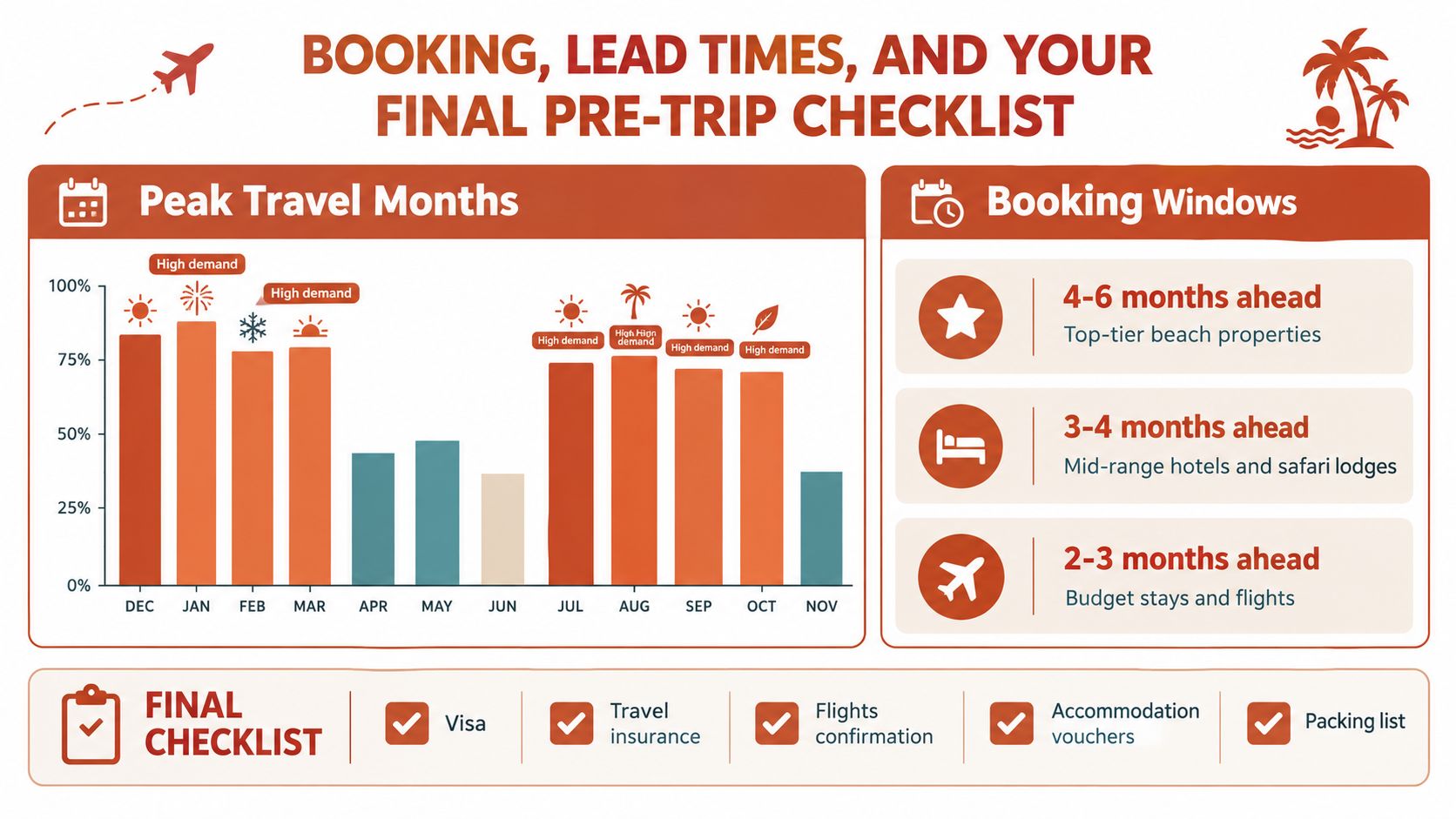
Demand now rewards early planning. For peak travel periods, particularly December to March and July to October, I recommend securing a sought-after beach property several months ahead. Shoulder-season travelers can keep more flexibility, but they should still reserve the exact hotel and room type early if those details matter.
December 2025 showed how quickly capacity can tighten, with 100,729 arrivals, bed occupancy near 89%, and an average intended stay of just over eight nights, according to the reported tourism surge data. That is a strong reason to avoid booking flights first and hoping the right coastal room appears later.
Your booking sequence
Choose the trip shape: Decide whether Zanzibar stands alone, follows a safari, or forms part of a broader Tanzania route.
Lock the anchor properties: Book Stone Town and the main beach stay before filling the itinerary with excursions.
Confirm the transport chain: Match international flights, domestic connections, airport pickup, road transfers, and departure timing.
Verify the operator: Check company details, reviews, inclusions, cancellation terms, and who is responsible for each handoff.
Arrange health and insurance: Speak to a clinician about malaria prevention and buy cover that includes medical evacuation.
The final countdown
Thirty days out: Recheck passport validity, entry paperwork, insurance, health arrangements, accommodation vouchers, and transfer confirmations. Ask the operator to confirm every flight connection in writing.
Seven days out: Download booking documents, save emergency contacts offline, confirm airport pickup, prepare suitable clothing for Stone Town, and organize medication in carry-on luggage.
Twenty-four hours out: Check flight status, reconfirm the arrival meeting point, carry accessible payment options, and tell your accommodation when to expect you.
Don't leave the mainland-to-island handoff to chance. That is where a polished safari-and-beach plan can unravel, especially when separate suppliers assume somebody else is monitoring the connection.
Explola lets you compare verified African safari operators, review detailed Tanzania itineraries, and send direct inquiries for trips that combine mainland wildlife with Zanzibar beaches. Visit Explola to compare safari-and-island options, clarify transfers before paying, and build a vacation that fits your dates, comfort level, and budget.
Ready to experience this?
Explore Related Safaris
Destinations Mentioned

Daniel writes for the Explola blog, where he covers African safari destinations, wildlife, travel trends, and practical trip planning. His work is centered on making safari travel easier to understand, compare, and plan.
Get Safari Tips & Destination Guides
Join our newsletter for exclusive travel tips, wildlife insights, and safari planning advice.