You're probably staring at two Kilimanjaro quotes that look close enough on the surface to be confusing. One says it's cheaper, one looks more polished, and both promise the same summit. That's where most buyers get burned, because the difference usually isn't the brochure language, it's the route length, the mandatory park charges, the crew setup, and whether the operator spells out what's included.
A proper Kilimanjaro trek package isn't just a mountain holiday with a tent and a guide. It's a bundle of fixed government fees, logistics, and safety decisions, and the quote only makes sense when you separate those pieces cleanly. If you don't, a “cheap” climb can end up looking expensive, and a premium quote can be the better value.
What a Kilimanjaro Trek Package Really Includes
If you're comparing two quotes line by line, start by asking a simple question, what is the package paying for? The answer should always come back to the same three pillars, park and conservation fees, rescue and evacuation coverage, and the mountain crew who make the climb possible. Everything else is secondary if those three are unclear.
The 2026 park-fee reset changed the pricing conversation because the mandatory charges rose to about US$70 per person per day, with route-based camping charges of about US$50 per camping night, or US$60 per hut night on Marangu, plus a one-time US$20 rescue fee (park-fee breakdown for 2026). For a typical 7-day camping climb, published fee structures imply park-fee-only costs of roughly US$820 to US$1,050 before operator margin, transport, gear, or crew wages are added. That's why two itineraries that look similar can land miles apart in price.
A serious package should normally include your guide team, assistant guides, porters, cook, mountain tents, meals, transfers, and some form of medical readiness such as emergency oxygen and pulse oximeter checks. It should also tell you whether hotel nights before and after the trek are included, because that changes the comparison a lot more than most travelers realize. If oxygen, accommodation, or transfers are “available on request,” treat that as unfinished pricing, not a complete offer.
Practical rule: if a quote doesn't separate park fees from service fees, you're not comparing climbs, you're comparing formatting.
What's usually excluded is just as important. Flights, visa costs, tips, travel insurance, sleeping bag rental, and personal gear are commonly left out, and those omissions can distort the headline number badly. The same applies to rescue coverage if it's hidden in vague language instead of listed as a named line item.
Before you compare two packages side by side, force both operators to answer the same checklist in writing. Confirm park fees, rescue fees, accommodation type, meal plan, crew makeup, gear rental, oxygen, transfers, hotel nights, tipping guidance, and insurance requirements. If they won't answer those clearly, don't book.
Main Kilimanjaro Routes and How They Compare
Choose the route first, then judge the package price. Route length changes acclimatization, crowding, and crew pressure, so it also changes whether a Kilimanjaro trek package is good value or just cheap on paper.
Lemosho and the Northern Circuit are the routes I recommend first for most first-time climbers. They give the mountain enough time to work with your body instead of against it, which is why they usually justify the higher all-in cost. Shorter routes can look cleaner in a quote, but they often push climbers into a harder summit night and a weaker chance of success. Marangu only makes sense if you specifically want hut accommodation and accept the trade-off.
The route comparison below puts the trade-offs where buyers can use them.
Route | Days | Success Rate | Traffic | Best For |
|---|---|---|---|---|
Marangu | 5 to 6 | about 27% on 5-day routes, 44% on 6-day routes (success-rate guide) | Busy | Travelers who want huts and accept lower odds |
Machame | 6 to 7 | commonly higher than short routes, exact rate varies by itinerary length | Busy at camps | Fit climbers who want a classic camping route |
Lemosho | 7 to 8 | about 64% on 7-day routes, often higher with 8 days | Moderate | First-timers who want the safer mainstream choice |
Shira | 7 to 8 | similar to Lemosho when routed well, but not as commonly sold | Moderate to busy | Climbers who want a western approach with early altitude |
Northern Circuit | 9 | often reported in the 85% to 95% range | Low | Buyers who want the strongest acclimatization profile |
Rongai | 6 to 7 | usually stronger than the shortest routes, but depends on itinerary | Low to moderate | Travelers who want a quieter northern approach |
Umbwe | 6 to 7 | lower because it is steep and aggressive | Low | Very strong climbers who want the hardest line |
The British Mountaineering Council's rule of thumb is simple, sleep no more than 300 m higher than the previous night's camp and add an extra night at every third camp above 2,500 m. That matches the route data above. Longer itineraries usually buy better acclimatization rather than just more comfort.
Route length is not a luxury add-on. It is the main lever that changes summit odds.
Direct advice: if you are a normal fit traveler and this is your first Kilimanjaro climb, start with Lemosho or the Northern Circuit unless your budget forces a compromise.
For route context, the Kilimanjaro National Park guide helps you place the mountain inside a broader Tanzania trip.
Budget, Mid-Range, and Premium Package Tiers
The old way of reading Kilimanjaro pricing, looking only at the headline total, is useless. The better way is to ask what part of the spend is buying acclimatization, safety, and crew quality, and what part is just making the trip feel nicer. Once you do that, a lot of expensive-looking upgrades stop mattering.
Tier | Crew Ratio | Accommodation | Typical Inclusions | 2026 Price Range |
|---|---|---|---|---|
Budget | Larger teams, thinner support | Shared tents, shared Moshi hotel | Basic meals, standard transfers, core mountain logistics | Lower headline quote, but park fees still dominate the total |
Mid-Range | Smaller team ratios | Better tents, better mats, private transfers | Stronger meal setup, more organized support, more consistent gear | Mid-market quote with clearer all-in math |
Premium | Lower guide-to-climber ratio | Lodge or higher-end hotel before and after climb | Better sleeping setup, stronger summit-night support, more private logistics | Highest quote, with some comfort upgrades that don't change summit odds much |
The 2026 fee reset squeezes budget packages the hardest because the mandatory government charges are fixed. When park fees are already eating a large share of the total, a cheap quote can only stay cheap by cutting something else, usually crew quality, route length, or both. That's where buyers get misled.
You should judge tiers by what moves the summit needle. A smaller guide-to-climber ratio, experienced lead guides, and a route that respects acclimatization matter far more than a fancier lodge or a branded sleeping mat. A premium hotel before the climb feels good, but it doesn't help you on summit night.
By contrast, some upgrades are mostly cosmetic. A polished airport pickup, better duffels, and a nicer lodge can improve the experience, but they don't compensate for a rushed itinerary or a crew that looks thin on mountain day four. If you're choosing between “luxury” and “longer,” choose longer.
Independent 2026 fee breakdowns also show how quickly park-related costs push typical climbs into the high hundreds or roughly USD 1,000+ per person on standard 6 to 8 day routes (acclimatization and pricing breakdown). That's why the cheapest package is often not the cheapest final bill.
Strong recommendation: pay for route length and guide quality first. Pay for hotel polish last.
Sample 7 to 8 Day Lemosho Itinerary
Lemosho is the route I'd hand to a first-time buyer who wants a serious but rational climb. It starts lower, gives you a cleaner acclimatization profile, and avoids the worst of the early-crowding problem that hits some other western approaches. The shape of the route matters more than the marketing language around it.
Here's the daily structure that usually makes sense for a well-run Lemosho climb, starting at Londorossi Gate around 2,250 m. Day two should push you onto the Shira Plateau around 3,500 m for active acclimatization, and the longer version can add the Moir or Shira camp detour to build time at altitude without forcing a bad sleep jump. That extra day isn't indulgent, it's the reason the climb works better for you.
Day | Start Elevation | High Point | Overnight Camp | Walking Hours | Acclimatization Role |
|---|---|---|---|---|---|
1 | Londorossi Gate, about 2,250 m | Higher forest trail | Forest camp | Moderate | Easy start, low stress |
2 | Forest camp | Shira Plateau, about 3,500 m | Shira Camp | Moderate | First real altitude exposure |
3 | Shira Camp | Moir or Shira detour | Higher Shira or Moir area | Longer day | Adds acclimatization buffer |
4 | Shira area | Lava Tower, 4,630 m | Barranco Camp, 3,960 m | Long | The classic climb high, sleep low day |
5 | Barranco Camp | Barranco Wall and upper trail | Karanga Camp | Moderate | Technical movement, altitude consolidation |
6 | Karanga Camp | Barafu approach | Barafu Camp | Moderate | Summit prep and rest |
7 | Barafu Camp | Uhuru Peak, 5,895 m | Mweka Camp | Very long | Summit night and major descent |
8 | Mweka Camp | Mweka Gate | Finish | Descent only | Exit and recovery |
The central maneuver is the Lava Tower to Barranco day. You climb to 4,630 m and then sleep lower at 3,960 m, which is exactly the sort of altitude management that pays off later. The Barranco Wall can feel awkward in wet weather because the rock scramble gets slick, so don't let anyone sell it as a casual walk.
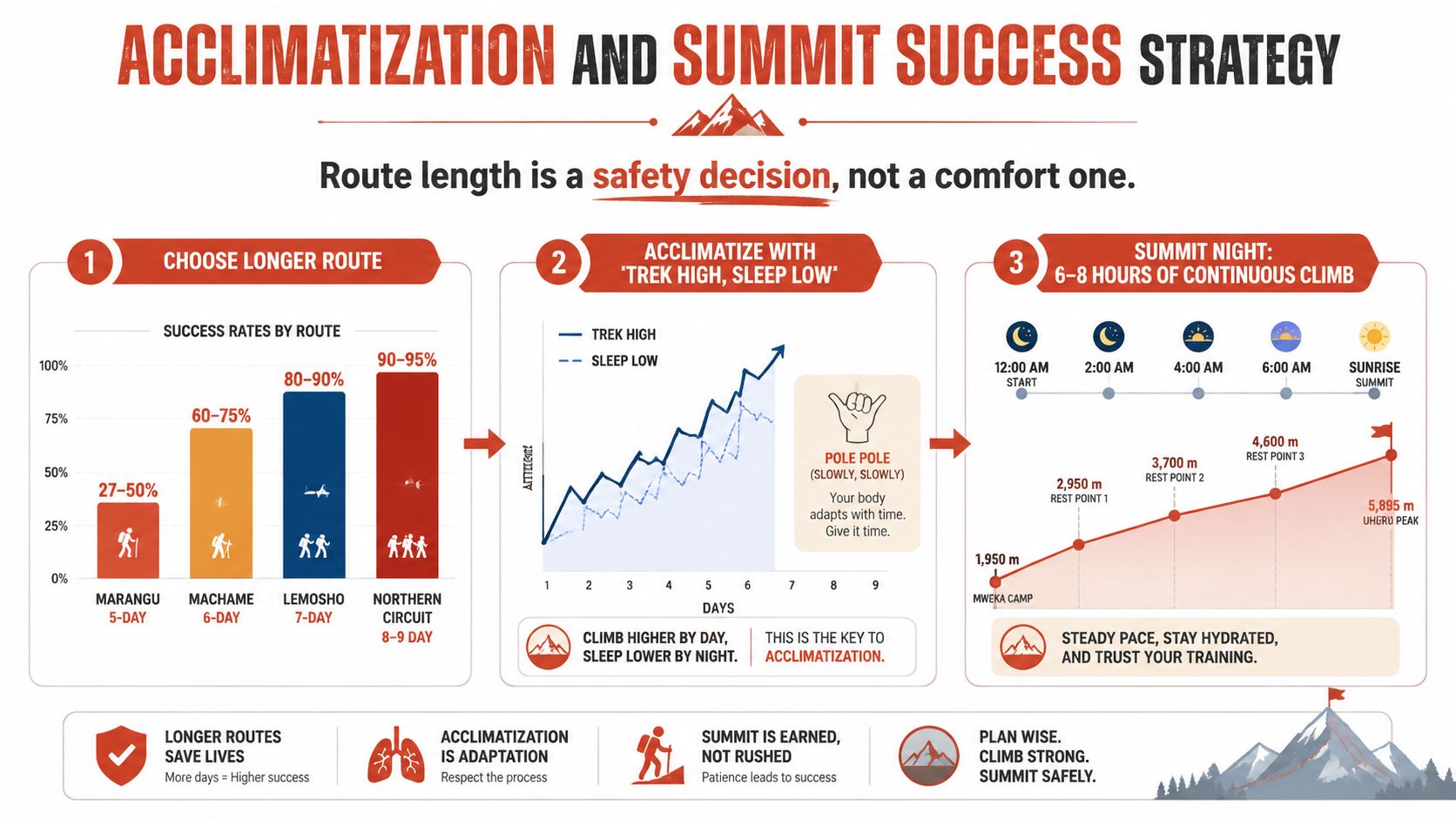
Summit night needs to be treated like an operation, not a hike. A good operator wakes you around 11:00 PM, gets you moving near midnight, pushes through the long switchbacks, reaches Gilman's Point at 5,681 m, and then continues for roughly 45 minutes to Uhuru Peak at 5,895 m before the long descent to Mweka Camp. That descent is brutal because your body is already drained, so the quote should reflect the extra porter, fuel, and support burden that comes with an 8-day climb.
For a reference point on this route style, the 8-day Lemosho route listing shows how a serious itinerary is usually packaged. The important part isn't the label, it's whether the schedule gives you enough days to adapt.
Acclimatization and Summit Success Strategy
Treat route length as a safety variable, not a comfort preference. Shorter climbs compress the mountain into your body's least forgiving zone. Longer climbs give you a real chance to adapt, and that is why I steer buyers away from 5-day options unless they already know exactly what they are doing.
Published operator statistics, as detailed in the route comparison section, show the pattern clearly. 5-day Marangu sits around 27%, 6-day routes around 44%, 7-day routes around 64%, 8-day routes around 85%, and the 9-day Northern Circuit often lands in the 85% to 95% band. Those figures are not marketing flourishes, they are a price tag on acclimatization time.
The British Mountaineering Council advice is simple, climb high, sleep low, and do not gain sleeping elevation too quickly above 2,500 m. Routes like Lemosho and the Northern Circuit follow that logic far better than rushed itineraries. If a package ignores that pattern, summit odds fall with it.
Acute mountain sickness needs to be handled early, not after it turns serious. The Lake Louise scoring system is the standard way operators should check symptoms, and you should know the warning signs yourself, headache, nausea, dizziness, poor sleep, and reduced appetite. If a guide shrugs those symptoms off, that is bad safety culture.
Diamox, or acetazolamide, is another useful signal. A serious operator will talk about it openly, usually as part of medical planning and the first-aid kit, because the medication only makes sense with hydration, slow pacing, and a route that allows adaptation. If altitude medicine is treated like trivia, risk is not being managed properly.
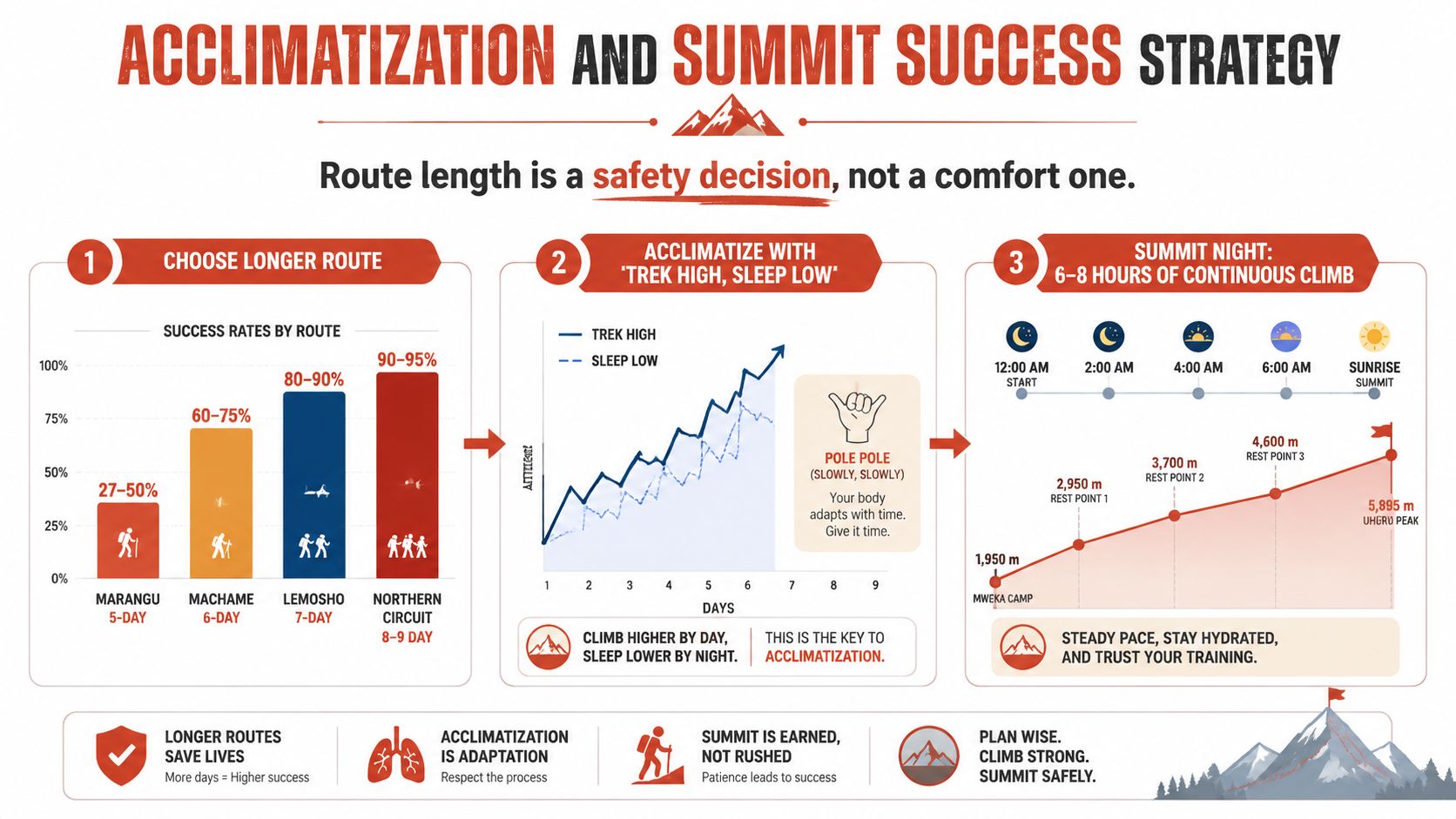
My blunt take: the cheapest summit attempt is often the one with the weakest acclimatization plan. That is not value, that is gambling.
Fitness Training and Packing Checklist
You don't need to be a hero to climb Kilimanjaro, but you do need to stop treating summit night like a standard hike. The mountain is cold, the footing turns to scree, and the final push is long enough to expose every weakness in your prep. If your training and gear are soft, the route will punish you.
A sensible 12-week block should build in stages. In the first month, aim to establish an aerobic base with regular cardio, then add stair climbing and leg strength in the middle weeks, and finish by simulating long, tired climbs with a loaded pack. By the final week, taper hard and arrive fresh, not cooked.
Aerobic base: build toward about 150 minutes weekly of zone 2 work by week four.
Long hike work: carry 10 to 12 kg and build one hike to about four hours by week eight.
Stair sessions: do two sessions a week that mimic summit-night cadence.
Final taper: reduce volume in the last week so your legs recover.
Packing needs the same discipline. A 4-season tent is usually provided, so don't waste energy buying one unless you're climbing independently. Spend your money on the items that protect you when the temperature drops and the pace slows.
Clothing: insulated sleeping bag, layered clothing system, hardshell outer, broken-in waterproof boots with gaiters.
Gear: trekking poles, headlamp with 200+ lumens, and at least 2 L of water capacity.
Summit-night extras: electrolyte tabs, UV sunglasses category 4, SPF 50, hand warmers, and an insulated water bottle.
Rental quality in Moshi can be fine, but only if you inspect it before you wire money. The single biggest mistake is underestimating summit-night cold and assuming your regular hiking kit will be enough. It won't be.
Useful rule: if an operator can't show you its gear list before payment, that's a warning sign, not a convenience issue.
Comparing Operators and Booking Safely on Explola
A Kilimanjaro operator quote is only worth reading if the company can prove it's real and properly licensed. Before you pay a deposit, ask for KPAP or KATO membership, a current certificate ID, Tanzania Tourist Board licensing, public liability and emergency medical insurance that covers altitude evacuation, and written guide-to-climber ratios. If the answer is vague, walk away.
The ratio matters more than most buyers think. Above 4,000 m, a written 1:2 guide-to-climber ratio is the minimum I'd want to see, and the crew should be large enough to support food, tents, fuel, and rescue logistics without improvisation. A 12-client group with a thin crew is a bad sign, especially if the operator can't explain who is carrying what.
Red flags are easy to spot once you know what to look for. A 5-day Machame quote often screams compressed acclimatization. A missing rescue fee means the operator is either hiding costs or cutting corners. A vague “tips not included” note without a written tipping guideline tells you the paperwork is sloppy.
Here's the quote checklist I'd use:
Checklist Item | Operator A | Operator B |
|---|---|---|
Park fees itemized separately | ||
Rescue fee listed clearly | ||
Accommodation before and after the climb | ||
Guide-to-climber ratio in writing | ||
Insurance coverage details | ||
Crew-tip guideline | ||
Gear rental list | ||
Oxygen and medical kit included | ||
Cancellation terms | ||
Evacuation responsibility |
If you want a platform example, Explola's Kilimanjaro operator listings show how a marketplace can centralize verification and quote comparison in one place. Explola also separates park-fee components, so you can see where the mandatory charges end and the operator service begins. That's the right way to compare quotes, because it stops the headline number from hiding the underlying structure.
The safest booking flow is simple. Verify the operator, compare identical written quotes, and only then pay a deposit. If the company can't document what happens when a climb is cancelled or downgraded, don't assume you'll be protected later.
Your Next Steps to Book the Right Climb
Start by choosing the route length before you get distracted by price. Use the success-rate data, your altitude history, and your budget to make a blunt call, 7 days on Lemosho or 8 days on the Northern Circuit should be the default unless you have a strong reason to compromise. If budget is tight and you still want the mountain, Marangu is the compromise, but don't pretend it's the same risk profile.
Then shortlist three operators and make them quote the same trip the same way. Ask for itemized 2026 park fees, crew ratios, rescue coverage, hotel nights, gear rental, and tipping guidance, then compare them on a per-day all-in basis that includes tips and flights. That's the only way to know whether a $2,500 quote is cheaper than a $3,800 quote once the mandatory charges are exposed.
Finally, lock your admin in early. Check passport validity, line up a travel-medicine consult for Diamox, and confirm the summit-month weather window before you pay a deposit. Then work backward from departure, 12 weeks for fitness, 8 weeks for gear purchases, 4 weeks for acclimatization hikes, and 1 week for packing and kit checks.
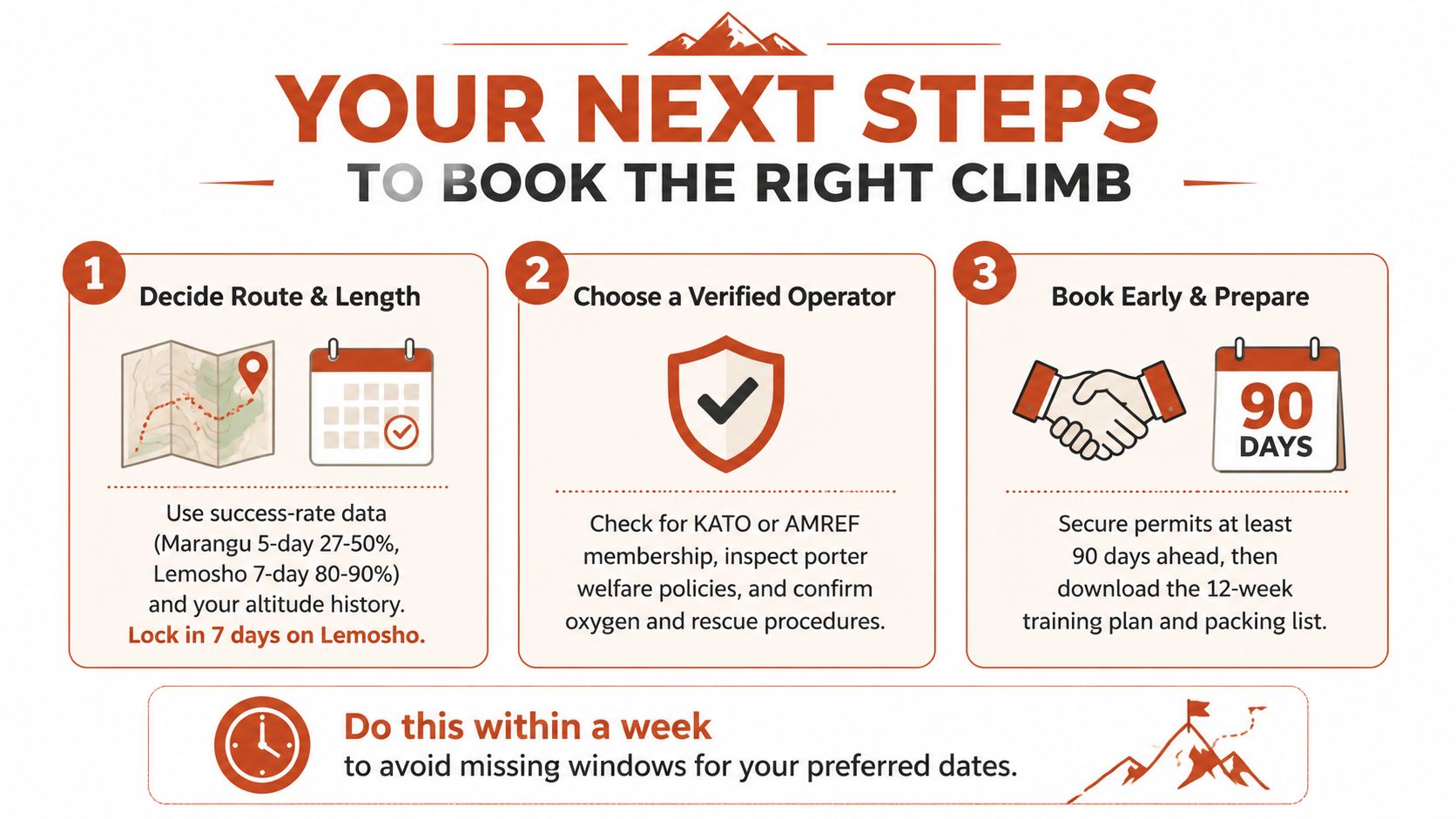
Do this within a week, not “sometime soon,” because good dates and strong operators go first. A clear plan now saves you from bad quotes, thin crews, and a climb that fails before you've even left for Tanzania.
Ready to experience this?
Explore Related Safaris
Destinations Mentioned
Daniel writes for the Explola blog, where he covers African safari destinations, wildlife, travel trends, and practical trip planning. His work is centered on making safari travel easier to understand, compare, and plan.
Get Safari Tips & Destination Guides
Join our newsletter for exclusive travel tips, wildlife insights, and safari planning advice.