TL;DR:
Proper pricing maximizes safari operator margins by understanding regional market segments and costs.
Building transparent, value-based pricing encourages direct bookings and long-term guest loyalty.
Advanced strategies like linking prices to conservation and using dynamic pricing boost profitability and sustainability.
Pricing is one of the most powerful levers you have as a safari tour operator, yet it’s also where most operators quietly bleed revenue. Whether you’re running five-day bush camps in Tanzania or multi-country itineraries across Southern Africa, the gap between what you charge and what you could charge is often wider than you think. Relying on travel agents and OTAs to fill your calendar means surrendering up to 25% in commissions and losing direct access to your guests. This guide walks through a practical, region-specific approach to building a pricing strategy that protects your margins, attracts the right travelers, and strengthens direct booking relationships.
Key Takeaways
| Point | Details |
|---|---|
| 2026 market benchmarks | Midrange and luxury safari prices vary widely by region and offer key context for setting rates. |
| Direct pricing advantage | Operators can boost profits and flexibility by shifting toward direct booking strategies. |
| Leverage sustainability | Eco-premiums and transparency can increase both rates and guest loyalty. |
| Continuously optimize | Monitoring results and clear communication help adapt pricing for peak returns. |
Understanding the safari tour market landscape
Before you set a single rate, you need to know exactly where you sit in the market. The safari industry in East and Southern Africa spans four broad segments: budget, midrange, luxury, and ultra-luxury. Each attracts a different traveler profile, carries different cost structures, and responds to pricing signals in distinct ways. Understanding which segment you serve, and which you could serve, is the first step.
The East Africa market generated $12.5 billion in revenue in 2023, with the luxury segment accounting for the largest share. That tells you something important: volume is not the dominant game here. Margin is.
2026 price benchmarks at a glance:
| Segment | East Africa (USD/pp/day) | Southern Africa (USD/pp/day) |
|---|---|---|
| Budget | Under 250 | Under 200 |
| Midrange | 350-550 | 250-450 |
| Luxury | 900-2,000 | 900-2,000 |
| Ultra-luxury | 2,000+ | 2,000+ |
As the table shows, midrange East Africa runs USD 350-550 versus USD 250-450 in Southern Africa, reflecting higher park fees, infrastructure costs, and demand concentration in destinations like the Masai Mara and Serengeti. The 2026 overall benchmarks place midrange at USD 450-900 per person per day, luxury at USD 900-2,000, and ultra-luxury above USD 2,000.
Key cost drivers shaping these numbers include:
Park and conservation fees, which vary significantly by country and season
Accommodation infrastructure, from tented camps to private lodges
Guide quality and certification, which directly affects perceived value
Local currency fluctuations, particularly relevant for operators paying costs in local currency but pricing in USD
Occupancy rates, which determine how fixed costs are spread across bookings
Southern Africa generally offers more accessible entry points for budget travelers, while East Africa commands a premium driven by iconic wildlife corridors and concentrated demand. Knowing your regional position shapes every pricing decision that follows. Understanding the range of operator business models can also clarify which pricing tier aligns with your operation.
Essential elements for setting effective safari tour prices
Once you understand the regional market, it’s critical to assemble your own pricing toolkit. You cannot price confidently without a clear picture of what your product actually costs to deliver and what makes it worth more than the competitor down the road.
A typical 7-day midrange safari runs USD 3,150-6,300 per person. That range exists because of how differently operators structure their costs and value propositions. Your job is to know exactly where you fall and why.
Your pricing checklist:
Fixed costs: accommodation, vehicle lease or ownership, staff salaries, insurance
Variable costs: park fees, fuel, meals, activity permits, laundry, guest transfers
Seasonal cost shifts: wet season discounts, peak season surcharges, school holiday demand
Brand value-adds: private guides, exclusive conservancy access, conservation storytelling, local community partnerships
Upsell opportunities: balloon safaris, private dinners, photography workshops, extended game drives
Guest expectations by segment: what does your target traveler assume is included?
One area operators consistently undervalue is the commission saving from direct bookings. If an agent takes 20%, a USD 5,000 booking nets you USD 4,000. Price the same trip at USD 4,500 direct, and you earn more while the guest pays less. That’s a genuine win on both sides.
Pro Tip: Build a simple spreadsheet that captures every cost line for each itinerary, including a “hidden costs” column for things like vehicle breakdowns, emergency evacuations, or last-minute park fee increases. Revisit it every quarter. You’ll be surprised what creeps in.
Articulating your brand’s value is equally important. Conservation partnerships, exclusive wildlife access, and deeply local experiences are not just marketing language. They are legitimate price justifiers. Guests who understand what they’re paying for are far more likely to book direct and recommend you to others. Explore safari planning tips to see how top operators frame their value online.
Step-by-step: Building your safari tour price structure
With your building blocks in place, you can now craft and compare different pricing structures. Here’s a practical sequence that works for small to medium operators across East and Southern Africa.
Step 1: Map your costs and set a minimum viable price. Calculate the true cost per guest per day at your target occupancy. Add a 15-20% buffer for unexpected costs. This is your floor, not your price.
Step 2: Benchmark against regional and competitor pricing. Use the table from the previous section as a reference. Research three to five comparable operators in your destination. Are you priced below, at, or above market? Know why.
Step 3: Layer on value-adds and experience premiums. Private game drives, exclusive conservancy access, and personalized itineraries all justify higher rates. Quantify what each element adds to the guest experience and price accordingly.
Step 4: Decide between transparent pricing and tactical discounts. Direct booking delivers more transparent pricing, while agents sometimes negotiate rates below your public price for bulk bookings. Transparent pricing builds trust. Tactical discounts can fill gaps but erode perceived value if overused.
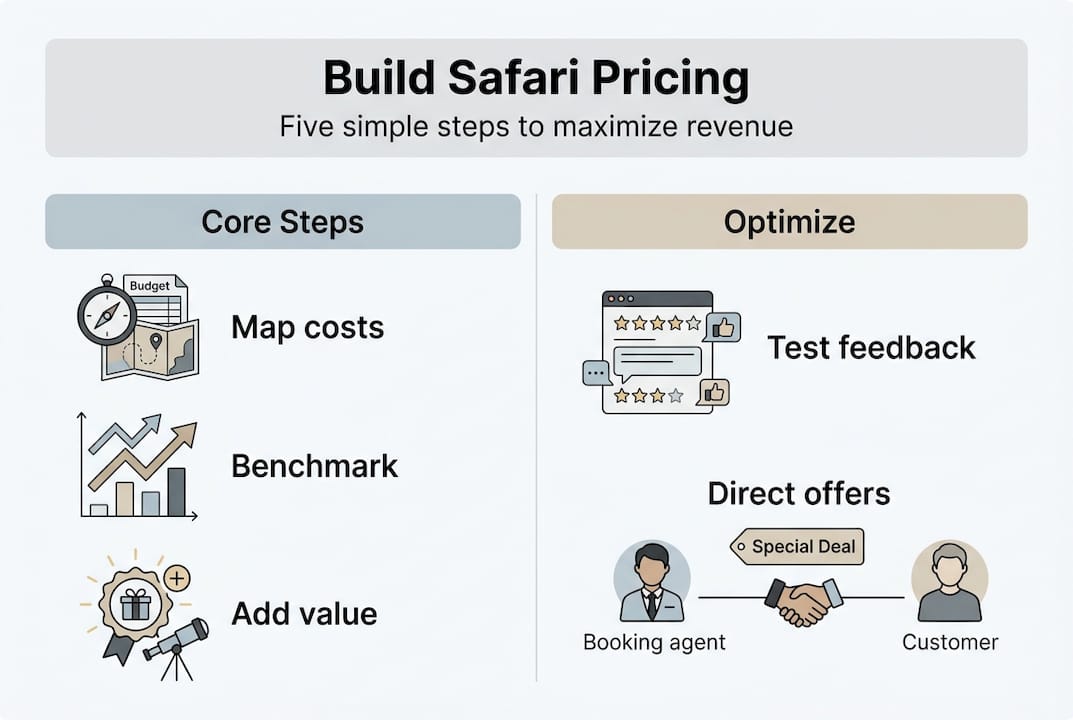
Step 5: Test and optimize using direct customer feedback. Run a quarterly review of inquiry-to-booking conversion rates. If you’re getting lots of inquiries but few bookings, your price may be misaligned with perceived value. If you’re booking out fast, you may be underpriced.
| Factor | Direct booking | Agent booking |
|---|---|---|
| Commission retained | 100% | 75-80% |
| Guest relationship | Direct | Mediated |
| Pricing flexibility | High | Limited |
| Repeat booking potential | High | Low |
| Data ownership | Full | Partial or none |
Pro Tip: Offer a small but meaningful direct booking benefit, such as a complimentary sunset game drive or a conservation briefing. It reinforces the value of booking direct without requiring a price cut. Learn how leading operators win more direct bookings for more tactics. You can also explore different direct engagement models to find the right fit.
Advanced strategies: Leveraging sustainability and dynamic pricing
Building on the basics, advanced strategies can help you stand out and further boost profit. The most powerful of these is linking your pricing to sustainability and conservation outcomes.
78% of travelers prioritize eco-friendly options, and operators who communicate conservation impact clearly can justify price uplifts of 20-30%. This isn’t greenwashing. It’s aligning your pricing with what guests already value.
What drives premium pricing in this space:
Exclusive conservancy or private reserve access, where wildlife density and exclusivity are higher
Private guides with deep naturalist knowledge and storytelling ability
Low guest-to-guide ratios that create an intimate, personalized experience
Documented conservation contributions, such as anti-poaching support or community revenue sharing
Carbon offset programs integrated into the package price
“Botswana’s high-cost, low-volume model is the clearest proof that fewer guests paying more yields better conservation outcomes and stronger operator margins. The country limits visitor numbers, charges premium rates, and consistently outperforms volume-based destinations on revenue per guest.”
Dynamic pricing is the other lever worth mastering. Adjust rates based on occupancy forecasts, booking lead times, and seasonal demand. If your peak season camp fills by June for a July departure, raise your July rates for next year. If shoulder season is soft, offer a value-added package rather than a straight discount. Protecting your rate integrity matters more than filling every bed. Connecting your pricing to responsible tourism principles also strengthens your brand story with eco-conscious travelers.
Monitoring, adapting, and communicating your pricing
No pricing strategy is static. Ongoing adaptation keeps you competitive and protects you from market shifts you didn’t anticipate.
How to track and adapt your pricing performance:
Review inquiry-to-booking conversion rates monthly. A drop signals a pricing or value communication problem.
Track occupancy by season and segment. Compare against prior years to spot trends early.
Monitor competitor pricing quarterly. Use direct outreach, mystery shopping, or industry reports.
Collect post-trip feedback specifically about value perception. Ask guests directly: “Did the experience match what you expected to pay?”
Adjust package inclusions before adjusting price. Adding value is often more effective than cutting rates.
Botswana’s luxury camps reach 92% occupancy during peak periods, a figure that reflects years of disciplined pricing communication and guest relationship building. That kind of loyalty doesn’t happen by accident.
Communicating your pricing transparently is just as important as setting it correctly. Guests who understand exactly what’s included, what conservation impact their trip supports, and why your rates reflect genuine value are far more likely to book again and refer others. Post-trip follow-up is underused by most operators. A simple email three weeks after the trip, asking for feedback and sharing a conservation update, keeps the relationship alive.
Pro Tip: Refresh your website packages at least twice a year. Highlight any rate changes with a clear explanation of what’s new or improved. Guests respect honesty. Operators who boost direct bookings through content consistently outperform those who rely solely on agent referrals.
Our perspective: Why smarter pricing is a competitive edge for safari operators
Here’s the uncomfortable truth most pricing guides won’t tell you: lowering your price to fill beds is a strategy that works exactly once. After that, you’ve trained your market to expect a discount, attracted guests who prioritize cost over experience, and made it nearly impossible to raise rates without pushback.
The operators we see thriving in 2026 are not the cheapest. They are the clearest. They know their costs, they know their value, and they communicate both with confidence. When a guest asks “why does your safari cost more?” the best operators have a specific, compelling answer ready. Not a defensive one.
Strategic, transparent pricing also does something less obvious: it filters your guests. Travelers who choose you based on value alignment, conservation commitment, and authentic experience are the ones who leave five-star reviews, refer friends, and come back. Deal hunters rarely do any of those things.
Building guest loyalty through pricing integrity is a long game, but it’s the only one that compounds. Every direct booking at your true rate is a relationship asset. Every discounted agent booking is a transaction that ends when the guest lands home.
Unlock smarter pricing and direct engagement with Explola
If you’ve worked through this guide and you’re ready to put these strategies into practice, the next challenge is execution. Managing dynamic pricing, showcasing your sustainability story, and converting direct inquiries efficiently takes more than a spreadsheet.
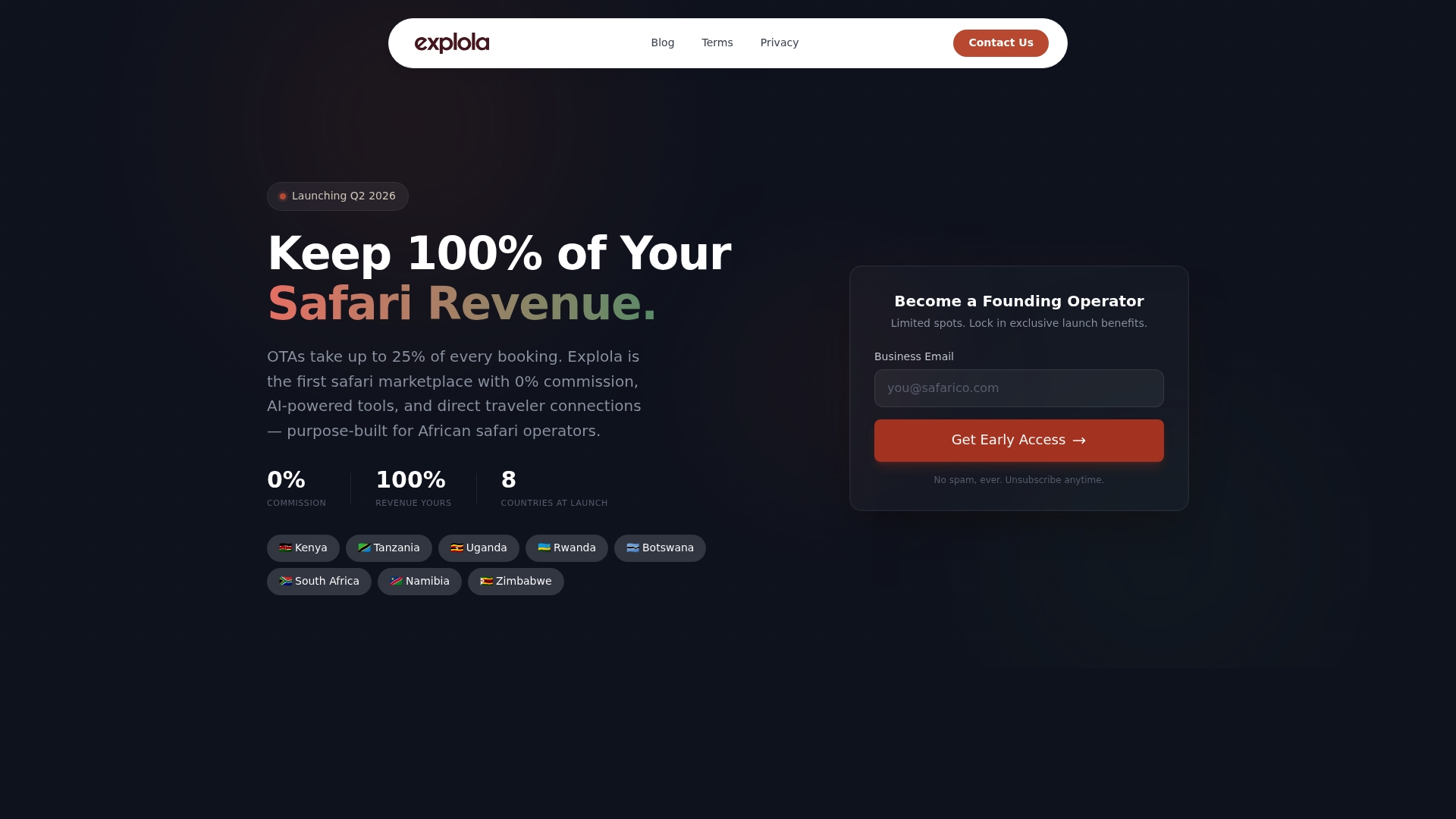
The Explola platform is built specifically for safari operators in East and Southern Africa who want to move beyond agent dependence and own their guest relationships. With AI-powered tools for quote generation, lead scoring, and content optimization, you can test and adapt your pricing for direct channels without needing a technical team. Explola gives you full data ownership, featured marketplace visibility, and the infrastructure to attract travelers who are actively searching for operators like you. Connect with Explola today to see how the platform can help you maximize revenue and build the direct booking pipeline your operation deserves.
Frequently asked questions
What are the average daily costs for a safari in 2026?
Midrange safaris run USD 450-900 per person per day, luxury starts at USD 900, and ultra-luxury exceeds USD 2,000, with East Africa generally priced higher than Southern Africa due to park fees and demand.
How can I use sustainability to justify higher safari prices?
Conservation-linked pricing supports a 20-30% price uplift, and with 78% of travelers prioritizing eco-friendly options, clearly communicating your conservation impact makes that premium easy for guests to accept.
Is direct customer booking better than using travel agents?
Direct booking increases pricing flexibility and eliminates commissions, though some agents can negotiate bulk rates that benefit high-volume operators in specific markets.
How can I adapt my safari pricing for peak seasons?
Track occupancy trends monthly and adjust rates proactively. Peak season occupancies of 92% in destinations like Botswana show that disciplined seasonal pricing, paired with strong guest communication, supports both higher rates and repeat bookings.
Related

Founder of Explola and a passionate advocate for authentic African travel. He writes about safari destinations, conservation, and connecting travelers with trusted local operators across Africa.
Get Safari Tips & Destination Guides
Join our newsletter for exclusive travel tips, wildlife insights, and safari planning advice.