The worst advice about a Tanzania safari migration is simple, and it's usually sold with confidence. People tell you to book a date, pin your hopes on one river crossing, and treat the whole thing like a scheduled show. That approach is wrong. The migration is a moving ecological system, not a ticketed event, and your safari should be built around that reality.
Tanzania safari migration planning works best when you stop chasing certainty and start planning for movement. The herds are following grass, rain, and water, which means your itinerary needs room to adapt. If you want a trip that performs in the field, not just on paper, flexibility isn't a nice extra, it's the core strategy. For a broader seasonal overview, the practical timing guide at best time to Tanzania safari is useful, but it should support your planning, not control it.
Rethinking the Migration Calendar
The migration is not a single event, and it's not locked to a neat calendar. It's a resource-tracking system that responds to rainfall, grass growth, and seasonal water availability across the wider Serengeti ecosystem. That's why the idea of "the crossing date" is such a bad planning anchor. You're trying to predict a moving target in a region that changes with weather and forage.
Stop booking for a date and start booking for a phase
Each year, about 1.3 million wildebeest move through the broader ecosystem, joined by about 200,000 zebras and substantial numbers of Thomson's and Grant's gazelles, following a largely clockwise circuit driven by the seasons, according to the Cambridge study on the Serengeti ecosystem. The animals concentrate on the southern short-grass plains after the short rains, then move west toward Grumeti and north toward the Maasai Mara as conditions dry, before returning south with new rains. That's a cycle, not a countdown.
Practical rule: if your safari only works when the herds hit one river on one day, your itinerary is too brittle.
Treat the migration like retail scheduling at a busy venue, where timing matters but demand shifts with conditions. A useful analogy is smart scheduling for retail venues, because good planning there, like here, depends on matching resources to fluctuating foot traffic rather than forcing a fixed slot onto a changing crowd.
The smartest travelers stop asking, “When is the crossing?” and start asking, “Which ecological phase fits my dates, and how much flexibility does my trip have?” That change in mindset saves people from disappointment. It also leads to better wildlife viewing, because the migration is good in different ways at different times.
Mapping the Annual Circuit and Seasonal Routes
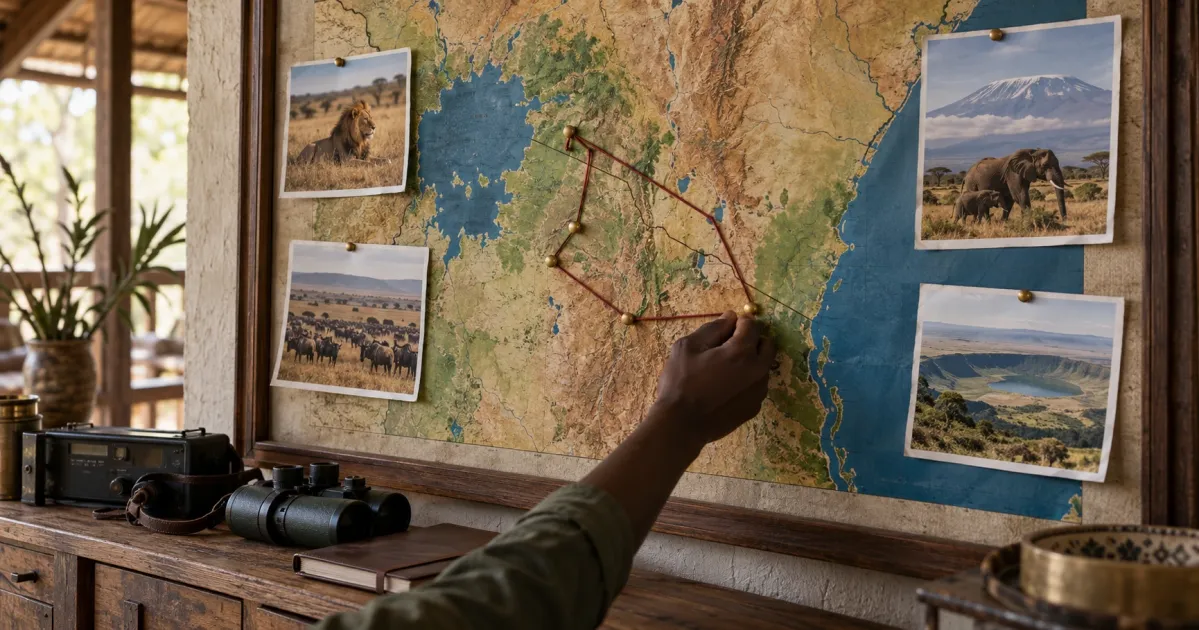
The annual route is a clockwise loop shaped by rainfall, soils, and forage quality. During the wet season, roughly December through May, the herds concentrate on Tanzania's southern short-grass plains. Calving generally happens there because the plains offer high-quality forage and rapid grass growth, which supports lactating females and newborn calves.
Southern plains first, then the west, then the north
February is the key month for calving in the Ndutu and southern Serengeti area, and that's where the action is usually strongest for people who want newborn calves and predator activity. As the plains dry, the herds move west toward the Grumeti region and then north through the northern Serengeti. The route eventually pushes them toward Kenya's Maasai Mara, where they cross into a broader transboundary system that isn't confined to Serengeti National Park alone.
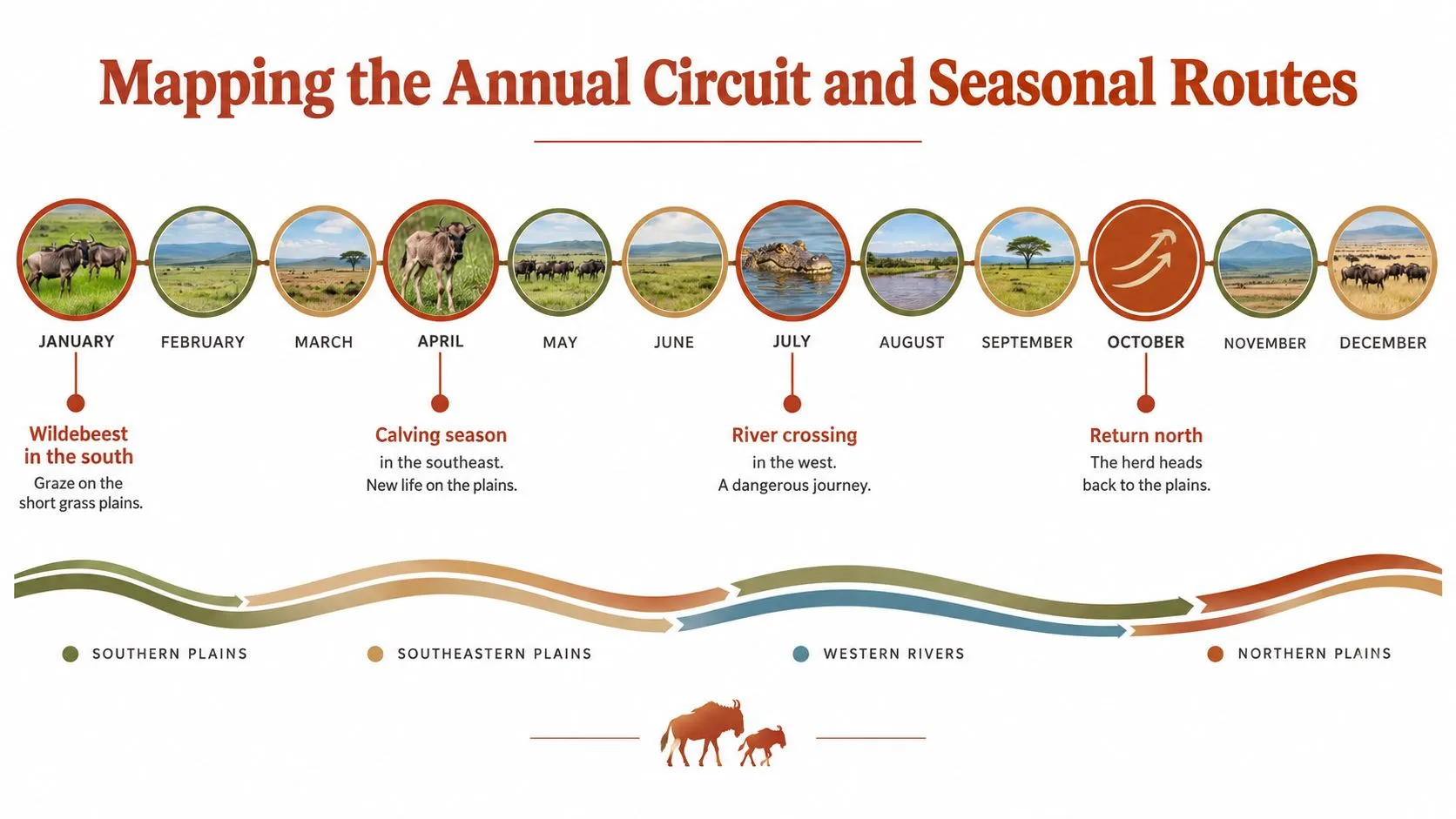
The movement is not even or mechanical. A simulation model found that vegetation growth explained approximately 75% of the modeled migratory signal, compared with 25% for rainfall, while the best model matched observed herd-density patterns in 76.8% of spatial blocks, according to the Serengeti study cited in the verified data. A separate movement analysis found average female displacement of about 4.5 km per day. That's why herds can look stuck for days and then suddenly shift fast when local forage drops.
Why the same month can look different from one year to the next
The environmental gradients matter. Rainfall generally increases toward the northwest, while soil fertility is higher in the southeastern plains. Successful movement requires the herds to track those changes across scales greater than roughly 80 to 100 km, which explains why simple month-by-month guarantees don't hold up.
For planning, this means one thing: don't overvalue a fixed departure date if the routing is rigid. The migration can be delayed, dispersed, or concentrated depending on rainfall. A flexible route matters more than a tidy brochure calendar, which is why the broad routing concepts from different tours in Great Migration safaris collection are more useful than a one-size-fits-all “best month” promise.
Selecting the Best Parks and Viewing Zones
A generic “Serengeti” booking is lazy planning. The right zone depends on what kind of wildlife behavior you want, and when you're traveling. Southern plains, western corridors, and northern river zones are not interchangeable. They each serve a different purpose in the migration cycle.
Southern Serengeti for density and predator pressure
If your dates line up with the calving period, base yourself in the southern plains or Ndutu area. The herds cluster tightly here, and predator interactions are usually most intense. You're not chasing a crossing here, you're chasing concentration, vulnerable calves, and the ecological drama that comes with them.
Northern Serengeti and Grumeti for high-variance crossings
If your goal is river-crossing country, the northern Serengeti and the Grumeti region are the right bets, but don't confuse “right bet” with “guaranteed outcome.” River-crossing visibility is probabilistic. Herds may cross, stall, cluster, or bypass a sector entirely depending on forage and water conditions.
Use this rule: choose the zone that matches your dates, then choose the camp that gives you options inside that zone.
If you want more than migration pressure alone, widen the route. The Serengeti pairs cleanly with Ngorongoro and Tarangire on the Tanzania circuit, and that mix gives you insurance when the herds are late, scattered, or not where the glossy itinerary said they'd be. Ngorongoro adds compressed wildlife density, while Tarangire can improve the overall viewing mix without forcing every day to depend on one herd location. For a map of how those areas fit together, the park overview at Serengeti National Park is worth using alongside your migration plan.
The bottom line is simple. Pick the zone first, then pick the camp, then pick the date. Travelers who reverse that order usually end up paying for wishful thinking.
Designing a Risk-Managed Safari Itinerary
A good migration safari absorbs uncertainty instead of pretending it doesn't exist. If you plan like the wildlife will cooperate on cue, you'll spend too much time waiting for an outcome that nature never promised. The better approach is to build a route with enough nights, enough flexibility, and enough geographic coverage to stay useful when herd movement shifts.
Longer stays beat knife-edge timing
Multiple nights in one region are more effective than a single overnight race toward an advertised sighting point. The herds can hold in one area, move quickly, or split into smaller groups. A short stay magnifies that volatility, while a longer stay gives your guide room to work with real-time conditions.
Mobile camps and flexible routing reduce risk
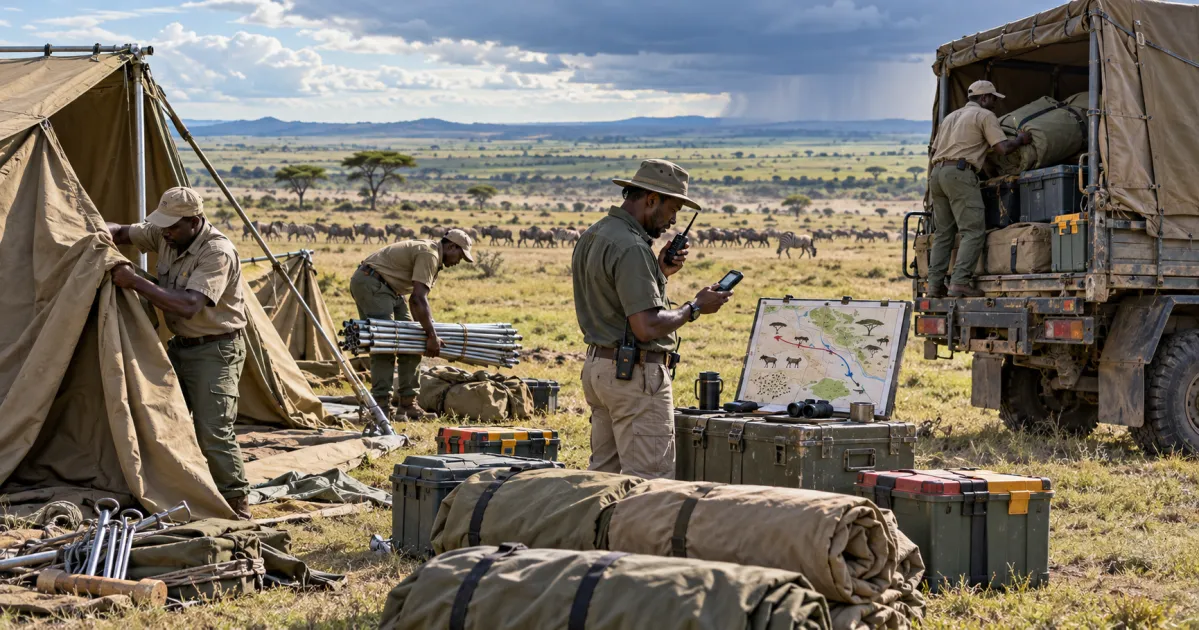
Mobile tented camps exist for a reason. They can reposition closer to the movement, which reduces the gap between where you sleep and where the action is unfolding. That matters most in the northern Serengeti, where crossing visibility is especially variable and your odds improve when you can respond to fresh field reports.
Candid advice: if an operator can't explain how they'll reroute when the herd shifts, they're selling luck, not planning.
The booking style matters as much as the destination. Compare itineraries that keep you anchored in one camp against those that move you between zones. If one route gives you flexibility and the other gives you rigid dates with a low-cost promise, the flexible route is usually the smarter buy. The cheap option only looks cheap until the wildlife is somewhere else.
The goal isn't to eliminate uncertainty. That's impossible. The goal is to design around it so your trip still works when the herd location changes during your stay.
Evaluating Lodging Tiers and Geographic Value
Accommodation choices matter less for glamour than for geography. You can pay for a beautiful room and still sleep too far from the movement to make the trip worthwhile. That's the bad trade. Safari value comes from the relationship between where you stay and where the wildlife is moving.
Budget, mid-range, and luxury mean different things in migration territory
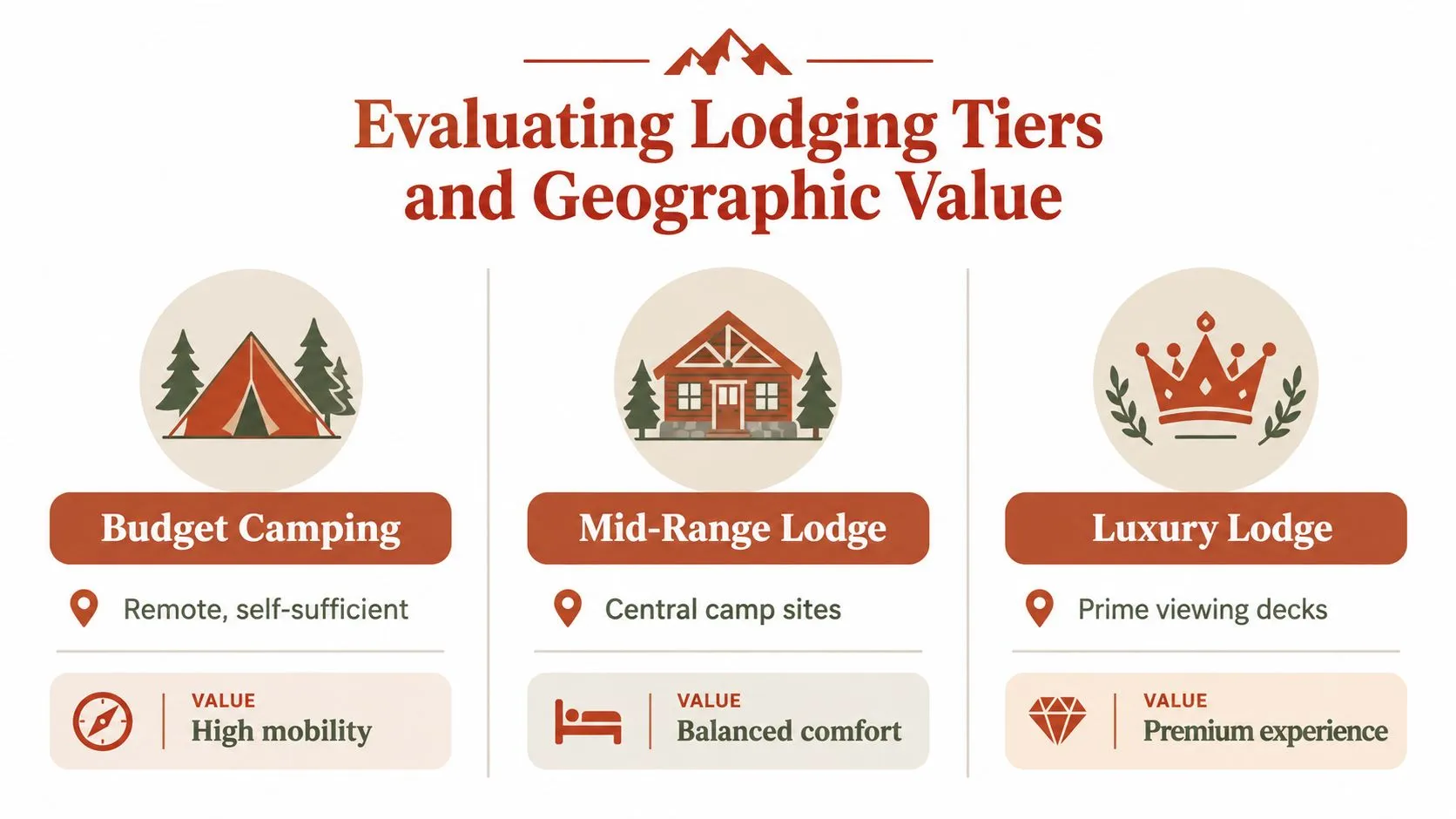
Budget camping is about mobility and simplicity. Mid-range lodges usually strike the best balance for comfort and location. Luxury camps can be excellent, but only if they're positioned near the movement instead of far from it. Amenities don't rescue a poor location.
The strongest evidence here is blunt. Research found that greater distance between lodges and wildebeest hotspots significantly reduced both lodge visitation and travelers' lodging choices, which means proximity is a critical factor in safari value. In plain English, being close matters. If your lodge is pretty but remote from the herd's current position, your trip value drops fast.
Choose location before frills
A lodge with a perfect plunge pool but weak access to the migration is a poor migration choice. A simpler camp in the right sector can outperform it every time, because the experience lives outdoors, not in the bathroom fixtures. That's especially true during short windows when the herds are concentrated and every game drive counts.
If you're choosing between comfort and location, don't fool yourself with marketing language. Pick location first, then comfort. The opposite order is how travelers end up spending a lot of money to look at an empty plain.
Comparing Verified Operators on Explola
The operator search is where many safari plans fall apart. People compare glossy descriptions, get lost in vague inclusions, and end up with quotes that don't line up. You need a cleaner method. Use a platform that lets you compare verified operators side by side, then pressure-test the routing, not just the price.
Use filters to remove noise fast
Start by narrowing the field with your hard requirements. Budget, lodging level, departure dates, and migration zone should come first. If you don't filter early, you'll waste time reading itineraries that were never a fit for your dates or your tolerance for rough logistics.
Then compare day-by-day routing. Look at whether the route stays in one zone long enough to matter, whether it includes a movement-aware camp, and whether the operator has built in flexibility. If the itinerary sounds rigid, it probably is. If it talks in broad promises without routing logic, move on.
Ask for proof, not polish
Use authentic traveler reviews and direct messaging to verify that the operator has handled migration timing before. Ask how they handle herd shifts, where they position backup nights, and whether they can adjust daily routing if the movement changes after you arrive. Don't accept cheerful generalities. Migration planning rewards specific answers.
For travelers comparing operators outside a single marketplace, a general resource like find your ideal safari tour company from Passport and Adventure can help frame the questions you should be asking, but the ultimate test is still the routing detail and responsiveness.
A practical comparison sequence
Shortlist by route fit. Remove anything that doesn't match your migration phase and travel window.
Check inclusions carefully. Look for transfers, park fees, and camp changes that are explicitly spelled out.
Compare flexibility. Favor itineraries that can react to field reports and changing herd locations.
Read reviews for pattern, not praise. Repeated mentions of clear communication matter more than generic compliments.
Message before you book. The quality of the reply tells you a lot about the trip you'll get.
Explola centralizes that process by connecting travelers with verified safari operators, offering side-by-side comparisons, direct inquiry flow, and an inquiry tracking dashboard. Use those tools to keep the discussion concrete instead of letting it drift into vague promises.
Finalizing Your Booking and Safari Strategy
The final decision should not come down to the cheapest quote. It should come down to which operator understands that the migration moves, and plans accordingly. The right booking is the one that gives you route flexibility, clear communication, and a camp position that matches your dates.
Ask direct questions before you pay. What happens if the herd shifts? How many nights are you placing me in the zone with the best odds? Which crossing sectors can you reach from my camp? If the answers are evasive, that's your warning.
The strongest migration safaris are built by operators who treat the trip as a living plan, not a fixed script. That means transparent routing, honest expectations, and enough room in the itinerary to absorb weather changes. It also means refusing to overpay for a rigid plan that leaves you stranded in the wrong place.
If you want the trip to work, prioritize communication and geographic logic over brochure gloss. That's the difference between a safari that feels managed and one that feels lucky.
Explola gives you a place to compare verified safari operators, review migration-focused itineraries, and send direct inquiries without the usual back-and-forth. If you're planning a Tanzania safari migration, use Explola to compare routes, test flexibility, and book with more confidence.
Ready to experience this?
Explore Related Safaris
Destinations Mentioned

Founder of Explola and a passionate advocate for authentic African travel. He writes about safari destinations, conservation, and connecting travelers with trusted local operators across Africa.
Get Safari Tips & Destination Guides
Join our newsletter for exclusive travel tips, wildlife insights, and safari planning advice.