The most popular advice about Africa in January is also the least useful. You'll often read that the month is either universally wet, too hot for comfortable travel, or the ideal peak season for every safari destination. None of those descriptions survives a closer look. January is a regional choice, and the right answer depends on whether you want calving wildlife in northern Tanzania, green scenery in Southern Africa, a beach extension in Zanzibar, or mild winter conditions in North Africa.
A successful January trip starts with a map, not a calendar slogan. Match your preferred wildlife cycle, temperature range, rainfall pattern, road conditions, and activity mix to a specific country and park. Once you do that, January becomes less a compromise month and more a period with several highly distinct travel opportunities.
January Across the Continent Beyond the Generalizations
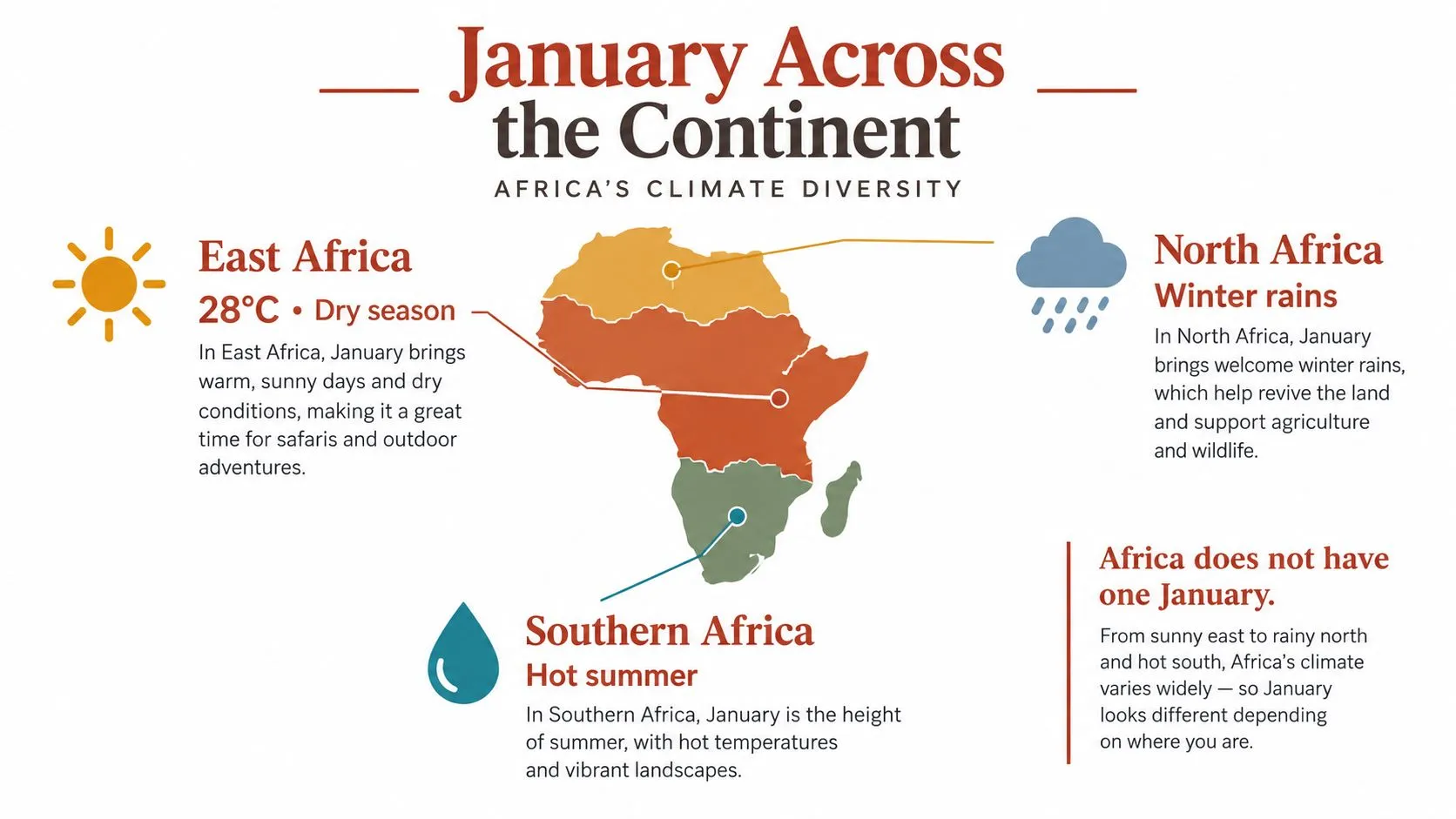
Africa doesn't have one January. The continent crosses hemispheres, altitude zones, deserts, tropical forests, savannahs, coastlines, and Mediterranean-influenced regions, so the month can feel like high summer in one itinerary and mild winter in another.
Southern Africa sits in the warmer part of its annual cycle. Many safari areas can be hot, humid, and green, with rain arriving in short bursts that transform the scenery and influence road travel. North Africa, by contrast, is in winter. Egypt, Morocco, and the wider northern band can bring cooler mornings and evenings, with weather patterns that feel completely different from a South African or Tanzanian safari.
East Africa complicates the picture further. Tanzania and Kenya can offer warm wildlife viewing alongside seasonal showers, while elevation changes create cooler conditions in highland areas. A coastal stay in Zanzibar has a different operational profile from a game drive in the southern Serengeti, even though both may appear in the same itinerary.
Start with the experience, then choose the latitude
Travelers often ask whether January is “good for Africa” as if the continent sells one seasonal product. A more useful question is: Which January experience are you trying to buy?
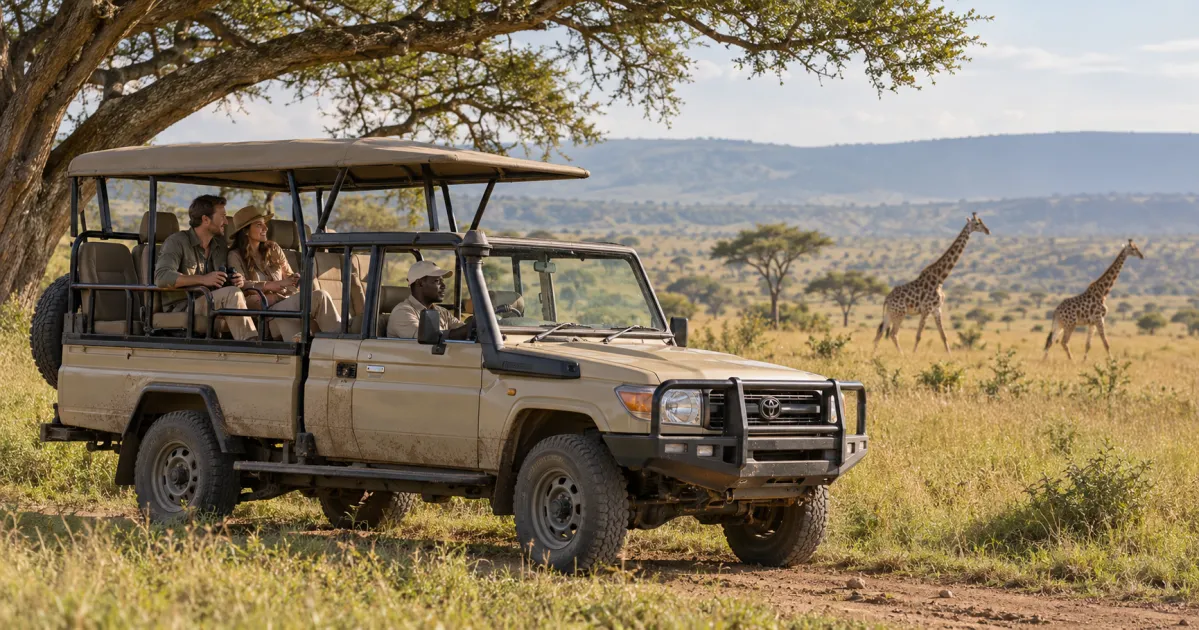
For concentrated wildlife activity, look at the southern Serengeti and Ndutu plains.
For lush scenery and summer birdlife, consider Southern African parks, while accepting a greater chance of rain and changing road conditions.
For cooler cultural or historical travel, North African destinations may be more comfortable than tropical safari regions.
For a safari and beach combination, compare inland rainfall and coastal conditions separately instead of assuming that one forecast represents the whole trip.
This country-and-park approach is also more practical for choosing travel dates, accommodation, transfers, and insurance. A guide to the best time of year for an African safari can help organize the calendar, but the final decision still needs to account for the exact route.
Practical rule: Never book “Africa in January” as a destination. Book a named country, a named park, and a route that makes sense in that month.
The generalization that January is just a wet season fails because rainfall is not distributed evenly, and neither are wildlife opportunities. The generalization that January is universally peak season fails for the same reason. Some areas have a compelling biological event, while others offer a greener, more weather-dependent alternative to the main dry-season travel window.
Decoding Temperature and Rainfall Patterns
The climate figures make the regional split clear. Typical January temperatures reach about 32°C in Nigeria, 32°C in Tanzania, 31°C in the Democratic Republic of the Congo, and 26°C in South Africa, while Egypt averages approximately 19°C. Rainfall is just as uneven, ranging from about 0 mm in Chad, 2 mm in Somalia, and 4 mm in Egypt to approximately 156 mm in both the Democratic Republic of the Congo and South Africa, 77 mm in Rwanda, and 76 mm in Tanzania, according to the January climate overview for Africa.
Those numbers don't tell you exactly what will happen on every game drive, but they do tell you how differently a January packing list and itinerary can look. Egypt calls for layers that handle mild daytime conditions and cooler evenings. South Africa may require light clothing, sun protection, and rain protection in the same bag. Tanzania can be hot while still producing showers that affect unpaved roads and the timing of transfers.
What rainfall changes on the ground
Rain matters because it changes more than the view from a lodge veranda.
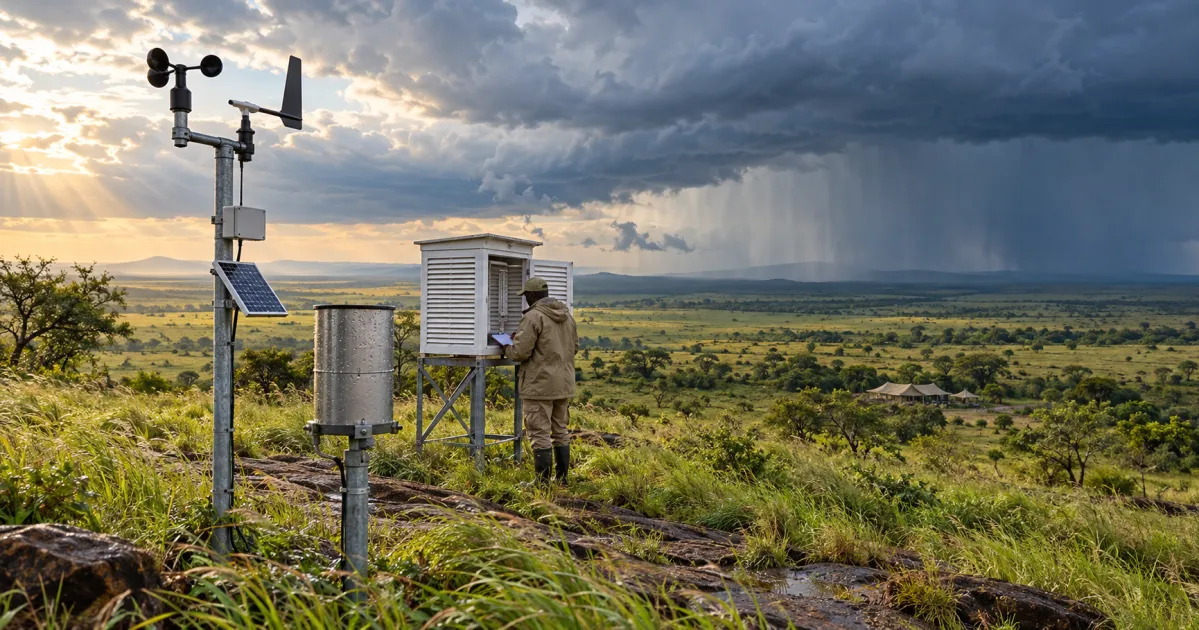
A localized shower can slow a road transfer, soften an unpaved track, or make a remote camp harder to reach. It can also improve photographic color, refresh grazing, and produce dramatic skies. The operational question isn't whether rain is “bad.” It's whether the itinerary has enough flexibility to absorb it.
For that reason, ask operators specific questions before you pay a deposit:
Road exposure: Which sections of the route use unpaved roads, and what happens if a heavy shower affects them?
Transfer design: Are internal flights, private transfers, or additional transit nights included?
Activity reliability: Can the itinerary replace a delayed drive with another activity?
Camp access: Does the accommodation remain reachable when local roads deteriorate?
Storm planning: What backup arrangements exist if weather affects a flight or road connection?
Packing from the forecast, not the brochure
A “hot climate” label is too broad to guide clothing choices. Temperature, rainfall, altitude, and the timing of drives matter more than the continent name printed on a tour page.
In a northern itinerary, pack breathable daytime clothing with a warmer layer for morning and evening. In a Southern or East African safari route, prioritize quick-drying fabrics, a compact waterproof layer, and footwear that can handle damp ground. A neutral outer layer remains useful for dust, sun, and cool early departures, but it shouldn't replace proper rain protection.
The best January itineraries make these trade-offs visible. They don't promise perfect weather. They explain where conditions may slow travel, where showers may improve the terrain, and which wildlife or cultural experiences remain worthwhile when the forecast changes.
The Serengeti Calving Season Phenomenon
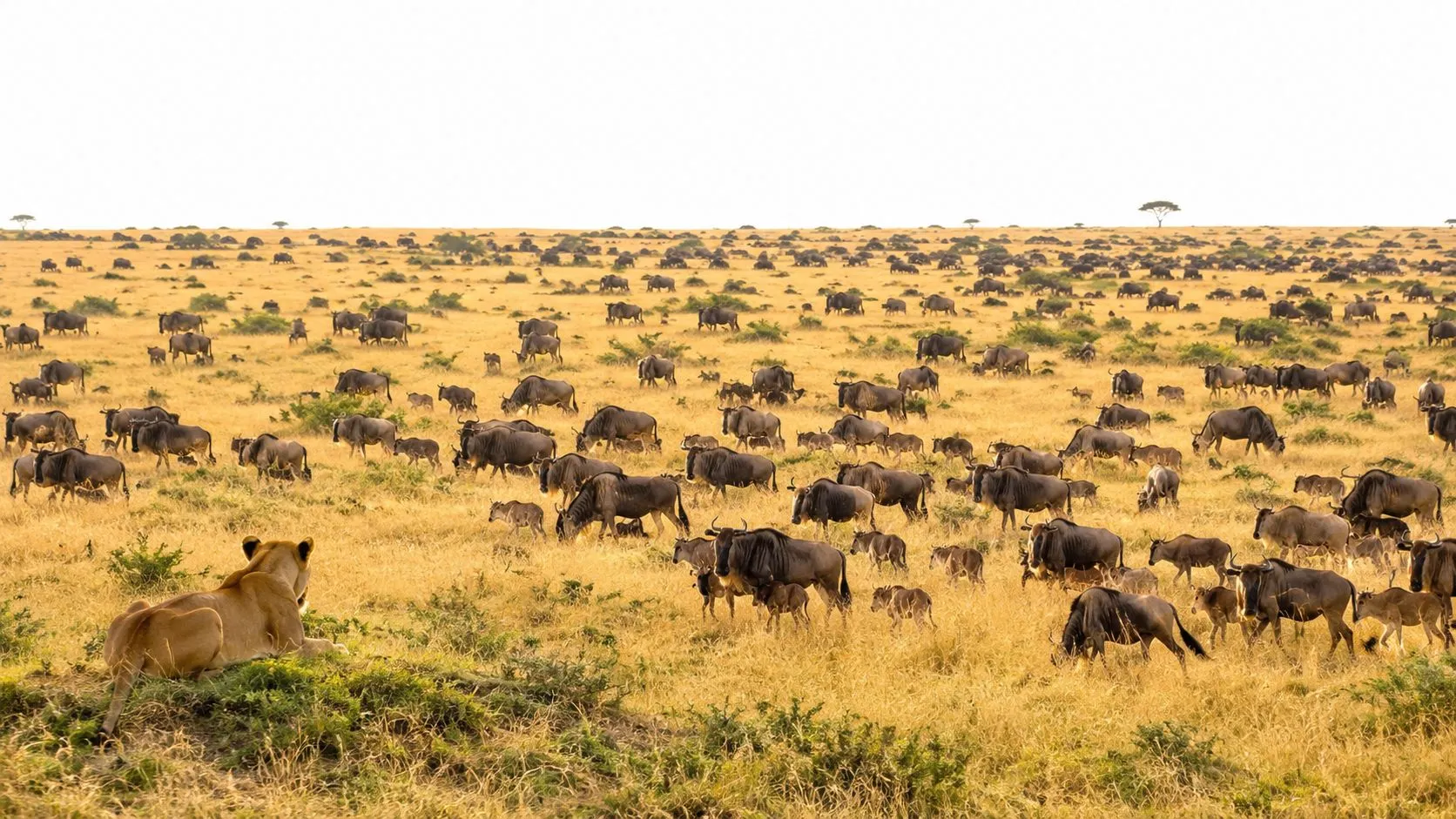
In the southern Serengeti and adjacent Ndutu plains, January can turn a routine game drive into a concentrated wildlife encounter. Seasonal rainfall renews the short-grass pasture, and wildebeest herds gather across open terrain during the early calving phase. The terrain becomes visually green, but the main attraction is the relationship between fresh grazing, vulnerable newborn animals, and predators working the edges of the herds.
Lions, cheetahs, and hyenas respond to the availability of newborn ungulates. Open ground helps guides locate movement, follow predator behavior, and position vehicles for photography without relying entirely on dense vegetation or luck. The experience isn't only about seeing a large herd. It's about watching a complete ecological sequence, from grazing and calving to vigilance and pursuit.
Location matters more than the label
A tour advertised as a “migration safari” may not place you close to the active calving areas. Southern Serengeti and Ndutu access is materially different from staying in central or northern Serengeti locations. The difference affects drive time, road conditions, camp relocation schedules, and the likelihood of reaching the plains where the herds are concentrated.
That's why a strong itinerary names the area rather than relying on a broad seasonal phrase. Check whether the camp sits in or near the southern zone, whether it relocates seasonally, and how the operator handles the route between airstrips, lodges, and game-drive areas. The month-by-month guide to the best time to visit the Serengeti is useful for understanding the seasonal logic, but your operator should still explain the exact January logistics.
A migration label is not a location. Ask where you'll sleep and how you'll reach the herds.
The green-season compromise
January's green scenery is a major advantage for photographers. Fresh vegetation adds depth and color, newborn animals create intimate scenes, and open terrain can make predator behavior easier to follow. Birdlife can also feel especially rewarding when the land is active after rain.
The compromise comes on the road. Localized showers can reduce speed on unpaved tracks and make schedules less predictable. A guide may need to wait, reroute, or allow more time for a transfer. That isn't a failure of the safari, but it becomes frustrating when a booking has been sold as a tightly timed sequence of guaranteed connections.
Before booking, request an itemized explanation of what the quoted price includes. Internal flights, private transfers, and additional transit nights can materially change both comfort and value. A lower headline price may not represent a better trip if it leaves long road sections, awkward connections, or weather-related contingencies outside the package.
January also brings practical communication questions, especially for travelers coordinating arrival changes or meeting family members in Tanzania. Keeping a reliable way to contact local operators is sensible, and a guide explaining how to call Tanzania with VoIP can be useful when conventional roaming is inconvenient.
The strongest calving-season itinerary accepts that wildlife value and logistical certainty are different things. You're choosing a period with excellent ecological drama, not a promise that every road will remain fast or every schedule will run unchanged.
Choosing Your Destination by Region
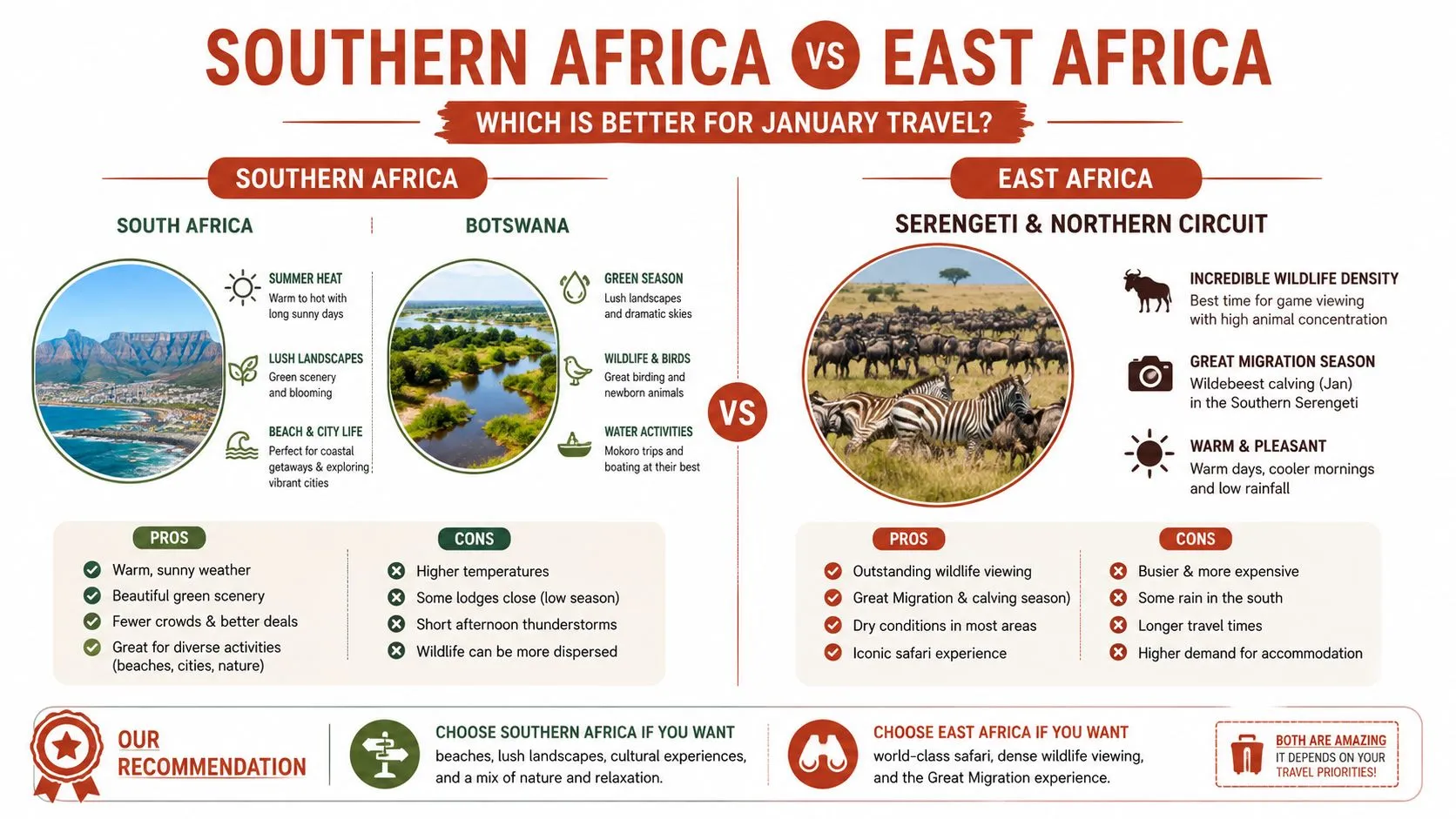
Southern Africa and East Africa offer very different January propositions. Neither deserves a continent-wide verdict, because each can suit a different traveler.
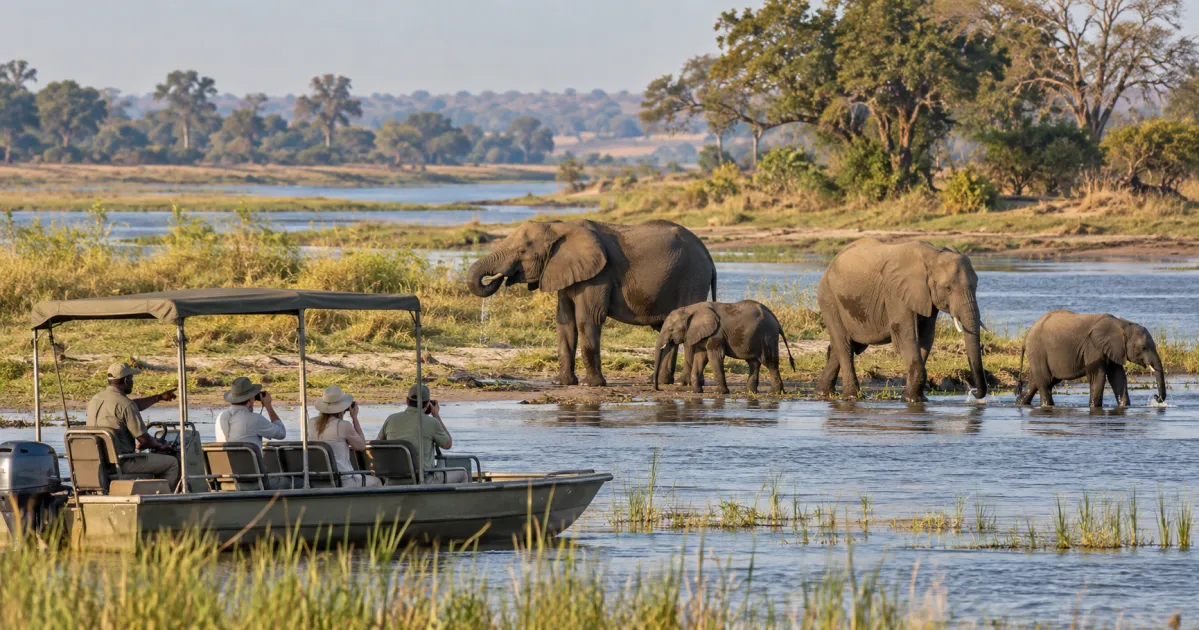
Southern Africa, including South Africa and Botswana, is generally in a wetter summer pattern. The advantages are vivid vegetation, active birdlife, warm conditions, and scenery that looks very different from the dry-season image used in many safari brochures. The disadvantages are more variable road conditions, possible afternoon storms, and the fact that thickening vegetation can sometimes make animal detection less straightforward.
East Africa offers a different balance. Tanzania's southern Serengeti has the calving opportunity described above, while Kenya can combine warm conditions with seasonal rainfall and strong wildlife viewing. Travelers who value a defined biological event may prefer Tanzania. Travelers who want a broader route with Kenya and Tanzania may accept more transfer complexity in exchange for variety.
Compare the trade-offs
Published January rainfall figures show the range even within safari markets, with approximately 89 mm in Tanzania's Serengeti, 95 mm in Kenya's Maasai Mara, about 110 mm around Botswana's Khwai and Okavango, and roughly 230 mm in Zambia's South Luangwa, as summarized in this January African safari destination comparison.
| Region | January appeal | Main trade-off |
|---|---|---|
| Southern Serengeti and Ndutu | Calving activity, open terrain, predator encounters | Showers can affect unpaved-road travel |
| Maasai Mara and wider Kenya | Flexible wildlife and cultural itineraries | Rainfall and route choice need close checking |
| South Africa | Summer landscapes and varied activities | Weather can be changeable in safari areas |
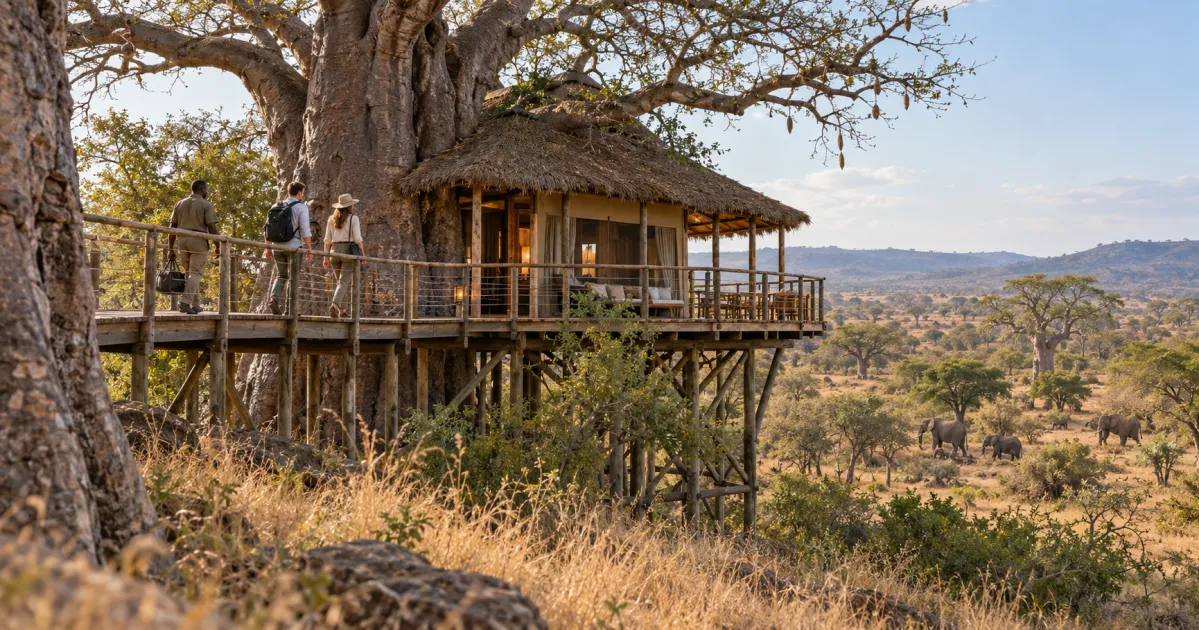
| Botswana's Khwai and Okavango | Green scenery, birdlife, and water-based possibilities | Wet conditions can influence access and activity design |
| South Luangwa | A more remote, lush safari atmosphere | Higher rainfall can create greater logistical sensitivity |
Match the region to your travel style
Choose the southern Serengeti if newborn wildlife and predator behavior are your priority. Choose South Africa if you want a broader trip that can combine safari with urban, coastal, or wine-country experiences, while recognizing that the Western Cape can have warm, dry summer conditions even when safari regions elsewhere are wetter.
Choose Botswana if you value a greener, more atmospheric wilderness setting and are comfortable asking detailed questions about water levels, camp access, and activity changes. Consider South Luangwa if remoteness matters more than simple transfers, but don't treat its January rainfall as a minor footnote.
Zanzibar works well as a coastal extension for travelers who want to combine an inland safari with time by the sea. It shouldn't be used as evidence that the entire East African route has one weather pattern. Kilimanjaro is another separate decision. A trek depends on altitude, acclimatization, route design, and mountain conditions, not just on whether a safari calendar labels January as favorable.
Crowds and pricing also need careful interpretation. A destination with a compelling seasonal event may attract strong demand, while a wetter green-season destination may offer a different value proposition. Ask for the full itinerary, accommodation category, included transfers, group size, and cancellation terms instead of comparing headline prices alone.
Health Precautions and Essential Packing
Malaria planning should be handled at the level of the park and route, not with a generic warning about Africa. Scientific evidence identifies January as the month with the highest incidence in one malaria travel dataset. Research on Zanzibar and mainland East Africa places the principal transmission season approximately from November or January through April to June, while South African transmission is associated with warmer, wetter months and a reported peak in January and February, according to this scientific review of malaria risk and seasonality.
That doesn't mean every January safari carries the same risk. Elevation, rainfall, location, local transmission patterns, and the exact route all matter. A traveler staying in one city has a different exposure profile from someone moving through several lowland parks and sleeping in open-sided safari accommodation.
Make health preparation specific
Arrange an appointment with a qualified travel-health professional before departure. Take the full itinerary, including parks, border crossings, coastal stays, altitude changes, and transit nights. Ask whether chemoprophylaxis is recommended, how to prevent mosquito bites, and what symptoms require urgent medical attention after returning home.
Practical prevention includes long sleeves when mosquitoes are active, repellent used according to its instructions, and accommodation practices that reduce exposure. Don't treat a lodge's comfort level as proof that malaria risk is absent. Likewise, don't assume that a January safari is automatically unsafe. The correct decision is individualized and destination-specific.
Pack for movement between climates
The most useful safari wardrobe is adaptable rather than excessive. Your list should reflect the exact route, not an imagined generic African setting.
For cool starts: Bring light layers that can be removed as temperatures rise. A fleece or warm overshirt may be more useful than a heavy coat.
For rain: Pack a compact waterproof jacket and protect electronics in dry bags or waterproof pouches. A poncho can be practical during open-vehicle drives.
For sun: Use a wide-brimmed hat, sunglasses, high-factor sunscreen, and breathable long-sleeved clothing.
For roads: Choose closed, comfortable shoes with grip. Avoid packing footwear that takes a long time to dry.
For health: Carry personal medication in hand luggage, plus copies of prescriptions and essential medical information.
For connectivity: Keep chargers, a power bank, and a practical system for securing small electronics.
Travelers preparing for a longer field assignment may also find the broader Peace Corps packing list useful for thinking about durable, multipurpose gear. A safari doesn't require expedition equipment, but reliable lighting, compact organization, and items that work across changing conditions can make camp life easier.
For a category-by-category checklist, use this African safari packing list, then remove anything that doesn't fit your route. Overpacking makes internal transfers harder, while underpacking rain protection or health essentials creates avoidable stress.
Planning Your January Safari Itinerary
Build the itinerary around one primary reason for traveling. If that reason is calving wildlife, put southern Serengeti or Ndutu access at the center and choose accommodation that reduces the distance to the active plains. If your priority is a varied holiday, combine a safari region with a coastal or urban stay, but avoid forcing too many long transfers into a weather-sensitive route.
The next decision is transport. Ask whether the operator recommends internal flights, private road transfers, or a combination. Flights can reduce long overland sections, while road travel offers more flexibility and a clearer sense of the terrain. In either case, allow room for localized showers to affect timing, especially when the route depends on unpaved roads.
Use a practical booking sequence
Name the target experience. Decide whether your priority is calving, photography, birdlife, beach time, trekking, or a broad first safari.
Choose the park before the lodge. Accommodation should support access to the wildlife area, not force the route to work around a convenient property.
Request operational detail. Confirm road sections, flight inclusions, transfer times, camp relocation arrangements, and backup plans.
Check the health profile. Give a travel-health professional the final route, including coastal and lowland areas.
Compare like with like. Review lodging, meals, activities, transfers, park fees, group size, and cancellation terms together.
Keep the schedule resilient. Avoid making a critical international connection immediately after a long road transfer through a rain-sensitive area.
A January itinerary should state what weather may change and what won't. Wildlife viewing can remain excellent in green conditions, but road speeds and visibility may vary. A transparent operator will explain that distinction instead of presenting “migration season” or “green season” as a complete answer.
Before booking, read the day-by-day plan carefully. Look for named parks, realistic transfer times, clear inclusions, and accommodation positioned for the experience you want. If the itinerary only lists countries and broad attractions, ask for more detail. January rewards travelers who investigate the route rather than selecting a month from a generic best-time chart.
Explola connects travelers with verified African safari operators and lets you compare country, park, itinerary, lodging, and activity options for January travel. Visit Explola to review specific Tanzania and Kenya safari routes, ask operators about calving access and rain-related logistics, and organize your shortlist before requesting a direct quote.

Daniel writes for the Explola blog, where he covers African safari destinations, wildlife, travel trends, and practical trip planning. His work is centered on making safari travel easier to understand, compare, and plan.
Get Safari Tips & Destination Guides
Join our newsletter for exclusive travel tips, wildlife insights, and safari planning advice.