A one-week mid-range African safari for a family of four typically lands between $14,000 and $25,000 before international flights. The number that matters is the family total, not a simple four-times-per-person rate, because safari pricing gets distorted by room setups, child pricing, park fees, and whether your family needs a private vehicle.
That's where most safari cost articles fail families. They throw out a per-person number, usually per night, and leave you to guess what happens when you add two children, interconnecting rooms, airport hops, conservancy fees, and the very common reality that younger kids make a shared vehicle a bad idea.
I'm going to be blunt. If you're budgeting an African safari cost for a family of 4, the headline rate is often the least useful number in the quote. The question is what your invoice looks like once the “on the ground” pieces are converted into a family total.
What a Family Safari Really Costs in 2026
A seven night family safari can swing by several thousand dollars before you even touch international flights. The mistake is staring at a per person rate and assuming you can just multiply by four. Families do not buy safaris that way. You are paying for rooms, child policies, park fees, transfers, and often a vehicle setup that changes the math fast.
A reliable planning benchmark from Magical Africa's safari cost guide puts a one week mid-range family safari in the low to mid five figures before long haul airfare. That is a realistic starting point for 2026, not a worst case scenario. If your target is a proper safari with good wildlife areas, decent family rooming, and smooth logistics, budget accordingly.
The number that matters is the family invoice.
What the family total usually includes
A real family of four quote usually bundles several cost layers:
Accommodation and meals for seven nights
Game drives and guide services through the lodge or camp
Park or conservancy fees, sometimes included, sometimes billed separately
Ground or air transfers between airports, airstrips, and camps
Family logistics such as two rooms, a family tent, or a private vehicle supplement
The expensive surprises are rarely the room rate. They are the line items families ignore on the first read. Park fees add up four times over. Light aircraft hops can cost almost as much as an extra night. A “child rate” often applies only if the child shares with adults, and many camps cap room occupancy in ways that force two rooms.
Practical rule: If a quote leads with a per person rate, ask for the full family total with children's ages, room setup, park fees, and every transfer listed separately.
2026 Family-of-Four Safari Cost Benchmarks (7 nights, excluding international flights)
| Tier | Typical Family Total | Typical Daily Spend | What You Get |
|---|---|---|---|
| Lower-cost family safari | $8,400 to $12,500 | About $1,200 to $1,785 per day | Simpler lodge or camp combinations in Kenya or Tanzania, tighter routing, fewer premium extras, and less flexibility on privacy |
| Mid-range family safari | $14,000 to $25,000 | About $2,000 to $3,570 per day | Strong wildlife areas, comfortable lodge based stays, guided activities, and a quote structure that often includes more of the core on-the-ground costs |
| Luxury family safari | $13,000 to $22,400 and above | About $1,860 to $3,200 plus per day | High-end properties, sharper service, more exclusive settings, and fast cost escalation once you add private guiding, premium parks, or fly-in routing |
Yes, the luxury line overlaps with mid-range on paper. That is normal in safari pricing. A shorter luxury routing in a cheaper season can cost less than a longer mid-range trip with heavy park fees and multiple flights. The label matters less than the invoice breakdown.
My advice is simple. Price the trip as a family unit from day one. That is how you avoid the classic shock of seeing a reasonable headline rate turn into a much larger final bill once safari components are added.
How Safari Pricing Is Built
Safari quotes are built backwards from bed inventory, vehicle use, and access fees. Lodges publish a per-person, per-night rate, and operators stack the rest on top. Broad market pricing often starts with about $125 to $1,500 per person per night, with budget safaris around $150, mid-range around $350, and luxury around $750 or more, according to this overview of safari pricing tiers.
For a family of four, that headline number is only the first layer.
The bill usually has five moving parts: accommodation, park fees, transport between camps, game-drive setup, and family-specific room rules. This is why a safari that looks affordable at the per-person level can become expensive fast once you price it as two adults, two children, one or two rooms, and a route that works on the ground.
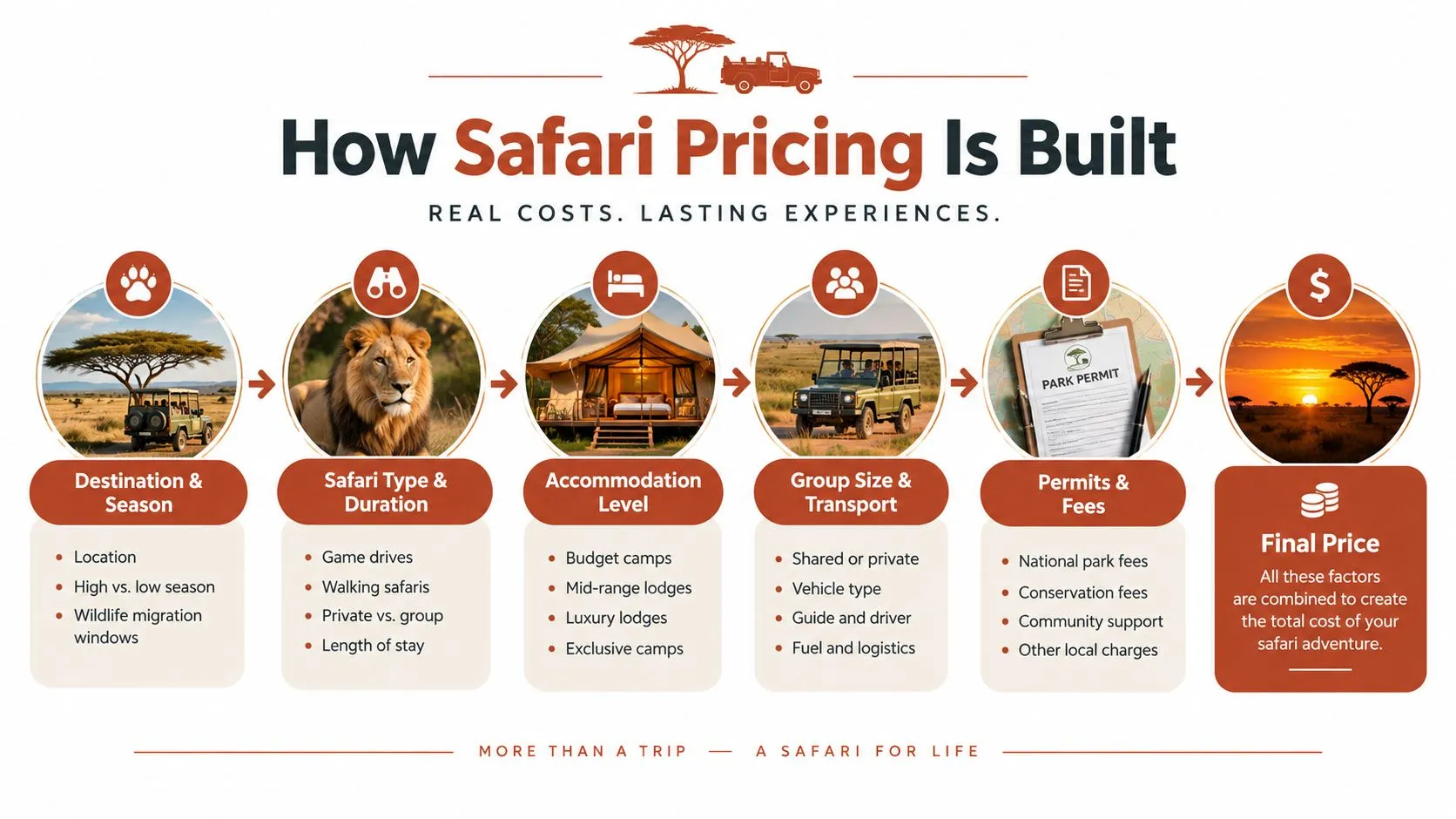
The core pieces in a safari quote
A standard nightly rate usually covers the lodge stay, meals, and scheduled activities run by the property. In plain terms, that often means:
Accommodation and full board
Shared game drives
A camp or lodge guide
Routine hosting at the property
That is the base product. It is not the full family trip cost.
The line items that push the family total up
These are the charges that change the invoice:
Park entry fees
Conservation or concession fees
Bed levies and local taxes
Drinks
Gratuities
Road transfers
Light-aircraft flights between camps
Private vehicle supplements
Single-room or family-room pricing differences
Private vehicle cost is one of the biggest pricing traps for families. A shared vehicle works for some couples. It is a poor fit for many families with younger children, different sleep schedules, or anyone who wants control over stop times and drive length. If you end up adding a private vehicle later, the trip total jumps.
Child pricing is another place families get misled. One camp may discount children heavily if they share with parents. Another may charge near-adult rates once a child moves into a second room. The rooming plan drives the price almost as much as the lodge category.
My advice is simple. Ask every operator to show the family-of-four total as separate lines: lodging, park fees, transfers, and private vehicle costs. If they only show a per-person rate, the quote is incomplete.
Budget, Mid-Range, and Luxury Tiers Compared
A family of four can spend about the price of a used car or the down payment on a house for one safari week. The gap between tiers is that wide because safari pricing is not just about nicer beds. It is about whether your family is driving or flying, sharing or taking a private vehicle, and staying in mainstream parks or private conservancies.
For a family of four planning a 7-day private safari in Kenya or Tanzania, this family safari pricing guide for East Africa places mid-range around $4,500 to $8,000, luxury around $10,000 to $20,000+, and ultra-luxury fly-in itineraries around $35,000 to $60,000+. Read those as family totals, not per-person teaser rates. That distinction matters because family travel picks up room combinations, vehicle costs, and transfer charges that couples can sometimes avoid.
How I define the tiers
Budget is the cheapest workable version of a safari, usually road-based, simpler lodging, and less privacy.
Mid-range is where the market gets sensible for families. You get better-located camps, more comfortable rooms, and logistics that do not waste half the trip in transit.
Luxury is about access and control. Better wildlife areas, shorter transfer days, stronger guiding, and a trip built around your family's pace.
Budget vs Mid-Range vs Luxury Safari for a Family of 4 (7 nights)
| Feature | Budget | Mid-Range | Luxury |
|---|---|---|---|
| Typical family total | Entry-level family pricing | The core family market | Premium private or fly-in pricing |
| Accommodation style | Simple lodges, permanent tents, guesthouse-style stays | Comfortable camps and well-run lodges in stronger locations | High-end lodges, conservancies, and premium tented camps |
| Vehicle setup | Often shared, or private only on a tighter road itinerary | Private vehicle is realistic and often worth paying for | Private by default, with maximum timing flexibility |
| Transfers | Mostly road transfers | Road plus some domestic air on smarter routes | Frequent internal flights and less time on rough roads |
| Wildlife experience | Good sightings in busier public parks | Better balance of sightings, comfort, and crowd levels | Stronger exclusivity, fewer vehicles, and premium access |
| Best fit | Families protecting budget above everything else | Families who want a good trip without waste | Families buying time, privacy, and top access |
Where the money goes up between tiers
The jump from budget to mid-range usually buys comfort and efficiency. The jump from mid-range to luxury buys time and exclusivity.
That is the part families should understand before signing anything.
A budget safari can still deliver great wildlife, but it often comes with longer drives, stricter schedules, and less room to adapt if one child is tired or melting down by day three. Mid-range fixes a lot of that. You usually get better room setups, better food, better camp locations, and a trip that feels less like endurance travel.
Luxury gets expensive fast because it stacks premium line items at once. Higher nightly rates. Private conservancy or concession fees. Light-aircraft transfers. More expensive family suites. Once those are all in the same quote, the family total moves quickly.
My recommendation by family type
For most families of four, mid-range is the right answer. It is where you stop overspending on labels but still avoid the friction that makes parents regret booking the cheapest option.
Use budget only when the route is simple and road-based, or when you are doing South Africa in a way that naturally keeps costs down. In East Africa, the cheapest private safari often looks acceptable on paper and feels tiring in practice.
Pay for luxury only if you will use what luxury buys. Private conservancies, fewer vehicles at sightings, short hop flights instead of all-day drives, and room setups that work for families. If those things do not matter to you, keep the money.
Country and Park Cost Differences
A family of four can spend roughly half as much in one safari country as another, even before international flights. The mistake is comparing headline nightly rates instead of the full family bill once park fees, transfers, and room rules are added.
South Africa is usually the cheapest country for a family safari. Botswana is usually the most expensive. Kenya and Tanzania sit in the middle, but only on paper. Once you add a private vehicle, stronger camp locations, and internal flights or long overland links, East Africa can land much closer to luxury pricing than many parents expect.
The country itself does not set the whole bill. The park does. A lower-priced country can still produce an expensive quote if you choose a premium reserve, add air hops, or need a family unit in short supply.
Where families actually pay more
South Africa stays competitive because families can self-drive, use a wide range of lodges around greater Kruger, and avoid mandatory charter flights.
Kenya gets expensive in the Maasai Mara when you add a private vehicle, conservancy fees, or flight connections instead of road transfers. If you want a realistic breakdown by trip style, review this Kenya safari cost guide for every budget in 2026.
Tanzania often ends up pricier than first-time buyers expect because Serengeti and Ngorongoro itineraries stack major park charges and long routing days. Fly-in versions climb fast.
Botswana is expensive for structural reasons. Small camps, light-aircraft logistics, and concession models push up the cost before you even start talking about room category.
Uganda can look moderate until permits enter the quote. Gorilla trekking can outweigh the lodge bill for part of the trip.
7-Night Family-of-4 Safari Cost by Country (2026, Excluding Flights)
| Country / Signature Park | Mid-Range Total (Family of 4) | Key Cost Drivers | Typical Add-On |
|---|---|---|---|
| Kenya / Maasai Mara | $4,500 to $8,000 | Private vehicle choice, camp category, routing style | Internal transfers |
| Tanzania / Serengeti + Ngorongoro | $4,500 to $8,000 | Park-heavy circuits, road versus fly-in design | Additional transit logistics |
| South Africa / Kruger area | Qualitatively lower entry point | Self-drive viability, broad accommodation spectrum | Guided activities beyond base stay |
| Botswana / Okavango Delta | Higher-end market positioning | Fly-in access, private concessions, small-camp model | Light-aircraft transfers |
| Uganda / Bwindi + Queen Elizabeth | Qualitatively variable with major permit pressure | Permit-driven pricing, specialist activity structure | Gorilla-related trip components |
My advice is simple. Choose South Africa if cost control is the priority. Choose Kenya or Tanzania if you want the classic East Africa wildlife experience and accept that park fees and transport will take a bigger share of the budget than many family quotes first suggest. Choose Botswana only if you already want the fly-in, small-camp format enough to pay for it.
Children, Rooms, and Family Pricing Rules
A family of four can pay thousands more than the headline safari rate suggests, because family pricing is built around room rules, age bands, and vehicle policy, not just nightly rates.
One useful family-specific benchmark shows budget road safaris around $150 to $220 per adult per night and $75 to $110 per child per night, mid-range private guide and tented-camp trips around $350 to $550 per adult per night and $175 to $275 per child per night, and luxury conservancy safaris around $600 to $900 per adult per night and $300 to $450 per child per night, according to this family-specific safari rate breakdown. For a real family of four, those rates can turn into 7-night totals of about $3,700 to $5,500, $8,700 to $13,700, and $15,000 to $22,500 respectively before international flights.
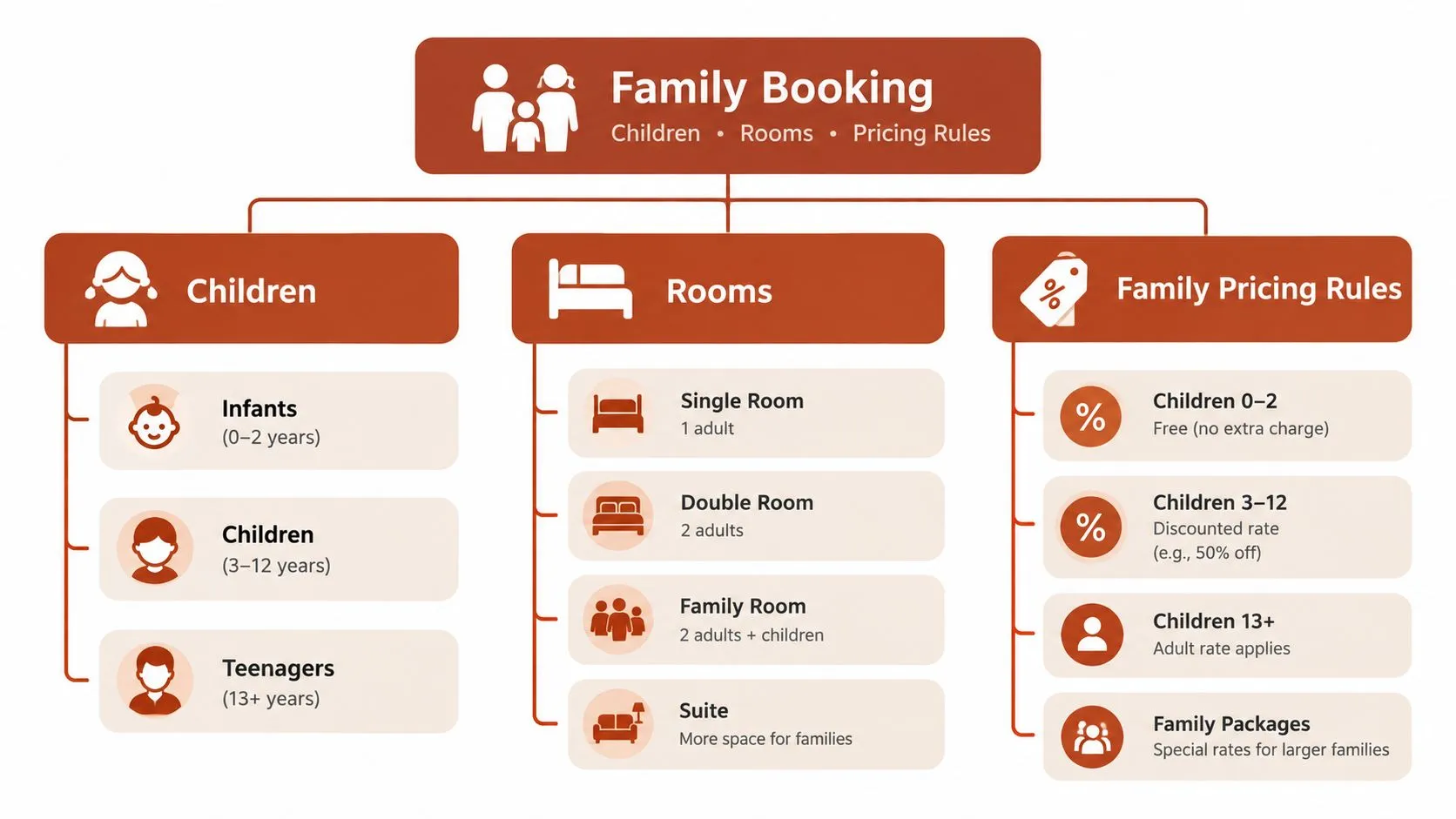
The room setup usually decides whether the quote stays sensible.
A family room can save real money. Two separate rooms often wipe out the child discount because you start paying a second room minimum, extra guide logistics, and sometimes a higher meal-plan structure. Many camps also define a child differently than parents expect. A 12-year-old may get a reduced rate in one lodge and near-adult pricing in the next.
Where parents lose the savings
Child rates are real. So are the traps.
The bill usually climbs because of:
Two-room requirements when the camp will not place four people in one tent, suite, or villa
Teen pricing once a child moves into a higher age bracket
Private vehicle charges when families want flexibility, need shorter game drives, or are not allowed to join shared departures with young children
Activity restrictions when a child is too young for walking safaris, mokoro outings, boat trips, or certain conservancy rules
The biggest mistake is comparing two safari quotes without matching the family setup line by line. One operator may price two adults and two children in a family tent. Another may price two doubles, a private vehicle, and child minder support. The second quote can be far higher even if the camp category looks the same.
My booking rule for families
Ask these questions before you compare any total:
Can all four of us sleep in one unit, and what bedding setup is provided?
If we need two rooms, are they interconnecting, guaranteed adjacent, or just in the same camp?
What exact ages get child rates, and at what age does near-adult pricing start?
Is a private vehicle optional, recommended, or effectively required for our children's ages?
If those answers are vague, the quote is not ready. A family safari price only means something once the operator has spelled out the room configuration, child policy, and vehicle arrangement for all four travelers.
Sample 5, 7, and 10 Day Itineraries With Totals
A family of four can burn through the cost of an extra safari night just by adding one light-aircraft hop and a private vehicle. That is why sample itineraries need real family totals, not neat per-person rates that hide the expensive parts.
I price these trips from the invoice up. Beds are only one line item. Park fees, road transfers, bush flights, and family-specific vehicle needs are usually what push the total higher than parents expected.
5-day sample. Best value if you keep it road-based
For five days, keep it simple. One wildlife area. One lodge or camp. Road transfers instead of flights.
A practical family-of-four budget trip in South Africa, Kenya, or northern Tanzania usually lands around $3,500 to $6,500 total if you choose straightforward accommodation, shared activities where allowed, and a route that does not require extra air transfers. The reason this format works is simple. You are paying for fewer moving parts.
A realistic split often looks like this:
Cost Line | Typical Family of 4 Total |
|---|---|
Lodging and meals | $1,800 to $3,200 |
Park or conservancy fees | $400 to $1,000 |
Ground transfers | $300 to $800 |
Game drives and guide costs | $500 to $1,000 |
Extras and tips | $200 to $500 |
Estimated total | $3,500 to $6,500 |
This is the itinerary I recommend for families testing safari for the first time. You will see plenty of wildlife without spending money on flights your children will barely remember.
7-day sample. The best balance for most families
Seven days is the strongest value for a family of four. It gives you enough safari time to justify the long-haul flight, but it does not pile on too many transfer days.
As noted earlier in the tier comparison, the broad mid-range benchmark for a family of four in East Africa sits well above the cheap-looking headline rates many articles quote. In practice, a 7-day family total usually works out like this:
Cost Line | Mid-Range Family of 4 | Luxury Family of 4 |
|---|---|---|
Lodging and meals | $4,000 to $7,000 | $8,000 to $14,000 |
Park or conservancy fees | $1,000 to $2,000 | $1,500 to $3,000 |
Transfers or domestic flights | $800 to $2,000 | $2,000 to $6,000 |
Private vehicle or family-specific game drive setup | $700 to $1,500 | $1,500 to $4,000 |
Extras, drinks, tips | $400 to $1,000 | $800 to $2,000 |
Estimated total | $6,900 to $13,500 | $13,800 to $29,000 |
That spread is wide for a reason. Two camps with the same star level can produce very different family bills once you add conservancy fees, a private vehicle, and flights between parks.
If you want to see how a higher-end family itinerary is packaged in the market, this 7-day luxury family safari and relaxation trip is a useful reference point.
10-day sample. Great trip, expensive logistics
Ten days usually means one of two things. You add a second major safari region, or you start paying for flights to avoid long drives.
That is where family totals jump fast. A longer trip often improves the experience, but it rarely lowers the daily cost once extra transfers and premium camps enter the plan.
Cost Line | Mid-Range Family of 4 | Luxury or Fly-In Family of 4 |
|---|---|---|
Lodging and meals | $6,500 to $11,000 | $14,000 to $24,000 |
Park or conservancy fees | $1,500 to $3,000 | $2,500 to $5,000 |
Internal flights and transfers | $1,500 to $4,000 | $4,000 to $10,000 |
Private guiding, premium activities, extras | $1,000 to $2,500 | $2,500 to $7,000 |
Tips, drinks, incidentals | $600 to $1,500 | $1,000 to $3,000 |
Estimated total | $11,100 to $22,000 | $24,000 to $49,000 |
My advice is blunt. Do not book a 10-day safari just because it sounds more complete. Book it when the extra nights remove hard travel days, give you a better park mix, or let your family settle into camps without constant packing. If the added days only increase transfers, your bill grows faster than the experience improves.
Inclusions Versus Extras That Change the Bill
A family safari quote can look settled, then jump by thousands once the omitted line items are added back in. For a family of four, the biggest pricing mistakes usually come from assuming transfers, park fees, and private vehicle use were bundled when they were not.
“All-inclusive” usually means the camp rate covers your room, meals, and shared game drives. It does not mean the full family trip cost is locked.
What is usually included
Start with the base camp package. In most quotes, that means:
Accommodation
Meals
Scheduled shared game drives
Camp-based guiding
Shared safari vehicle use
That is the lodging package, not the full holiday bill.
What pushes the family total higher
The expensive extras are rarely random. They are the exact items families need most for comfort and logistics.
Line Item | Usually Included | Usually Extra |
|---|---|---|
Accommodation | Yes | |
Meals | Often | Premium drinks may be extra |
Shared game drives | Often | |
Park or conservancy fees | Sometimes | Often billed separately |
Private vehicle | Common extra for families | |
Internal flights or airstrip transfers | Sometimes | Frequently extra |
Gratuities | Usually extra | |
Premium drinks | Common extra | |
Family-specific room upgrades | Often extra |
Private vehicles are the classic budget breaker. A couple can share a game drive vehicle without much friction. A family with younger children usually wants flexibility, faster breaks, and control over drive length. That often means paying a daily supplement that was never in the headline rate.
Flights inside Africa create the second big jump. A camp may advertise an attractive nightly rate, but reaching it can require light-aircraft seats, baggage limits, and paid airstrip transfers for all four travelers. Those charges belong in the family total, even if the first quote keeps them separate.
Park and conservancy fees also get buried too often. Some operators include them. Others list them later as pass-through costs. Either way, your family pays them.
Use one rule before you approve any safari quote. Put every cost into two columns: included and extra. If the operator cannot show where park fees, internal transfers, private vehicle use, drinks, tips, and room setup sit, you do not have a price you can compare properly.
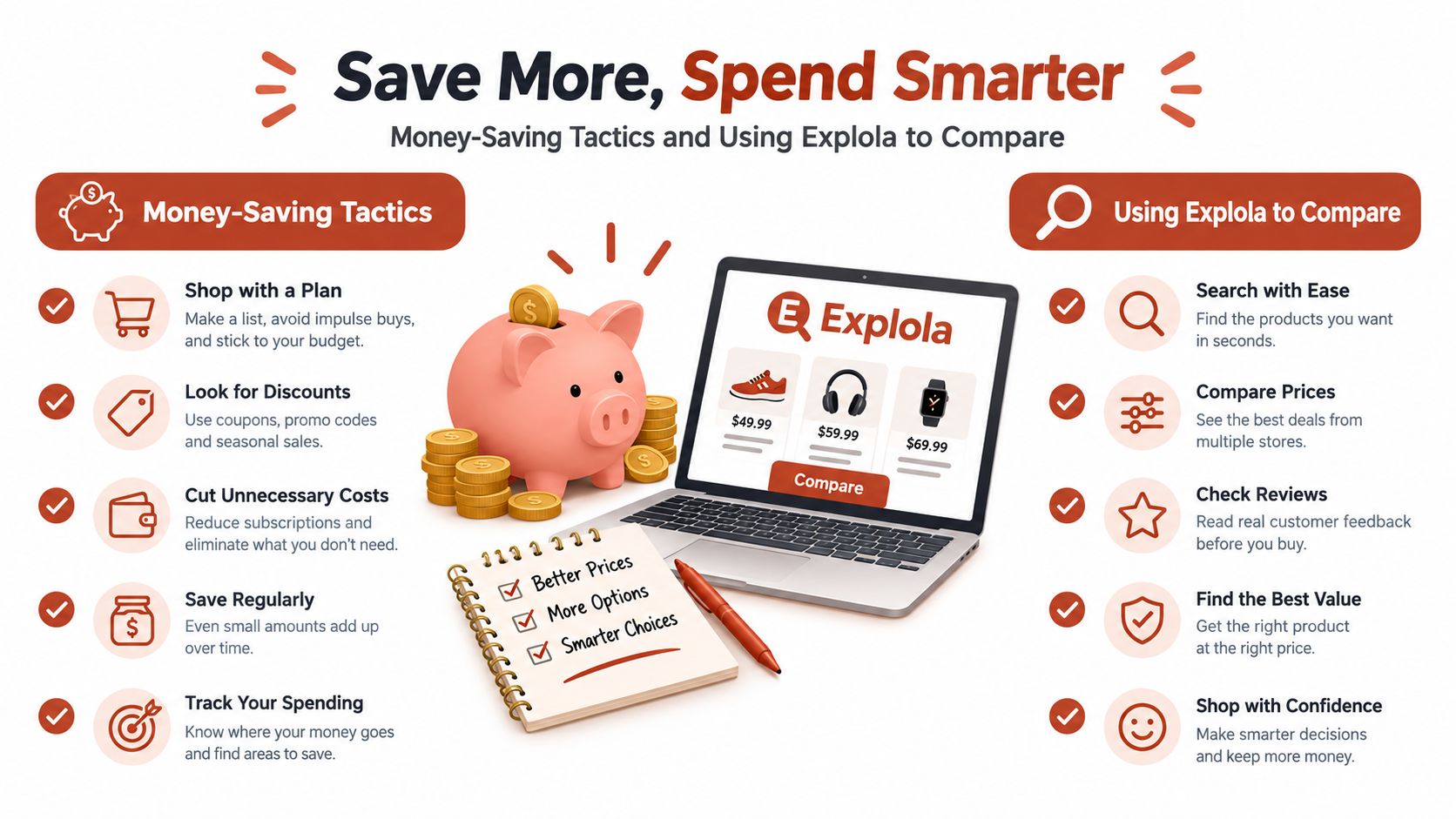
Money-Saving Tactics and Using Explola to Compare
A family safari gets expensive fast because small line items multiply by four. The best savings usually come from trip design, not from shaving a little off the nightly rate.
RemoveUploadDownloadRegenerateAsk AI
The savings levers that actually matter
Start with the choices that change the full family total.
Choose a country that fits your budget style: South Africa is usually the easiest entry point for families because road access, self-drive options, and a wider spread of family lodges keep transport costs under control.
Cut camp changes: Every move can trigger another transfer, another set of porter and tip expectations, and another day that feels like logistics instead of safari.
Price the private vehicle from day one: Families with younger kids usually want their own vehicle. Add that cost early and compare real totals instead of pretending a shared setup will work.
Use child pricing to your advantage: Age bands matter. A 5-year-old, a 12-year-old, and a 15-year-old can produce three very different quotes at the same lodge. Ask for the exact family-of-four total based on your children's ages, not a generic child discount.
Match the trip to the right cost tier: If your priority is keeping costs down without ending up on the wrong type of safari, this practical guide to a Tanzania safari on a budget in 2026 is a useful reference.
How to compare quotes without fooling yourself
I compare family safari quotes on one sheet, line by line, with every number converted into a true family-of-four total. That is the only way to spot a quote that looks cheap because it hides park fees, excludes flights, or assumes your children can share a room arrangement the lodge will not allow.
Check five things first:
Rooming. One family suite and two separate rooms are priced differently and create different child-rate rules.
Vehicle basis. Shared game drives and a private vehicle are not close substitutes for a family with children.
Transfer plan. A road transfer quote and a light-aircraft quote may serve the same park but produce very different final bills.
Fee handling. Park and conservancy charges must be either included or listed separately in writing.
Extras. Drinks, gratuities, laundry, and child-specific logistics still count because your family still pays them.
If you want a separate resource for the broader mechanics of budgeting for a trip, you can checkout the article budgeting for a trip in 2026, use it before you set your safari ceiling. Families usually overspend before departure by underestimating flights, insurance, airport hotels, and transfer days.
For actual comparison shopping, Explola helps because it lets you compare safari itineraries from verified operators, inspect inclusions side by side, and request itemized family quotes instead of relying on a vague starting-from number.
The pre-deposit checklist I'd use
Child policy: exact ages accepted and exact rates charged
Room setup: one room, family suite, tented family unit, or two rooms
Vehicle basis: private or shared
Transfer basis: road, air, or mixed
Fee treatment: park and conservancy charges included or separate
Drinks and gratuities: what sits outside the quote
Cancellation terms: especially for school-holiday travel
Get those answers in writing before you pay a deposit.
If you're trying to pin down the African safari cost for a family of 4, Explola gives you a practical way to compare verified safari operators, inspect inclusions, and request itemized quotes that reflect your actual family setup. That is how you move from headline rates to a real family total.

Daniel writes for the Explola blog, where he covers African safari destinations, wildlife, travel trends, and practical trip planning. His work is centered on making safari travel easier to understand, compare, and plan.
Get Safari Tips & Destination Guides
Join our newsletter for exclusive travel tips, wildlife insights, and safari planning advice.