June through September is the strongest overall window for dry roads and predictable game viewing at Ngorongoro Crater, with annual precipitation of approximately 1,000 millimeters (40 inches). The best time to visit Ngorongoro Crater still depends on your priority, whether that's dependable access, newborn wildlife, migrant birds, green scenery, photography, or a quieter safari.
You're probably trying to fit one famous destination into a much larger Tanzania itinerary. Perhaps you're comparing a dry-season departure with a cheaper green-season option, or wondering whether a short rain shower can really change a crater day. The honest answer is that Ngorongoro rewards different travelers at different times.
I've seen visitors choose June for clear roads and then discover that cold highland mornings matter more than expected. I've also seen travelers accept wet-weather uncertainty and come away with greener terrain, young animals, and better photographic conditions. The mistake isn't choosing the “wrong” month. It's choosing a month without deciding what you want the safari to deliver.
Why There Is No Single Best Month to Visit Ngorongoro
Most safari advice leads with June through October because dry conditions make driving easier and viewing more predictable. That recommendation works well for a first visit, especially if you want a straightforward crater descent, firm tracks, and clear sightlines. It becomes incomplete when it treats every traveler as though they has the same objective.
Ngorongoro's enclosed ecosystem supports high wildlife densities throughout the year. Animals don't just disappear when rain arrives. Wet months change the setting instead. Grass becomes greener, breeding activity increases, and migrant birds become more relevant to the experience. A traveler focused on dependable access may prefer the dry season, while a photographer or birder may value the visual and ecological changes brought by rain.
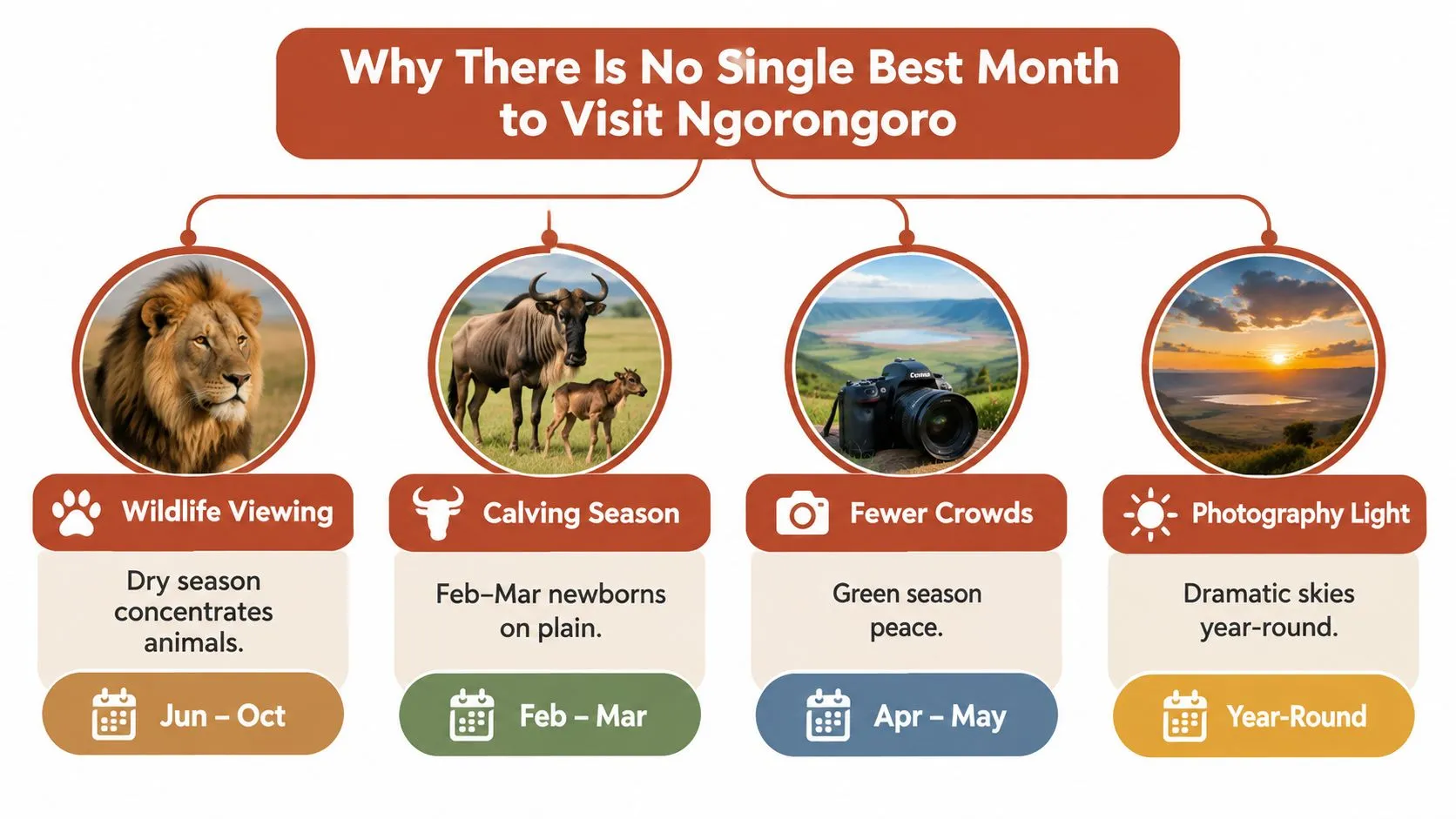
Match the month to the trip
A useful decision starts with one question: what would make you feel the trip was successful?
Reliable driving: June through September generally offers the most dependable road conditions.
Newborn wildlife: January and February are associated with breeding activity and young zebras and wildebeest.
Birding: The rainy season is more attractive when migrant species and lush habitats matter most.
Greener scenery: November through May can bring richer scenery, though roads and access become less predictable.
A quieter atmosphere: Travelers willing to accept showers can consider wetter periods instead of following the busiest conventional window.
The broader best time to visit Tanzania safari guide is useful when Ngorongoro forms part of a route that also includes the Serengeti. Timing has a wider regional effect there, because the surrounding plains respond differently from the crater floor.
Practical rule: Choose the season for your least negotiable priority, then plan around its drawbacks.
The dry season isn't automatically better. It's operationally easier. The wet season isn't automatically worse. It's less predictable but can be more rewarding for particular interests. Once you separate road reliability from wildlife quality, the decision becomes much clearer.
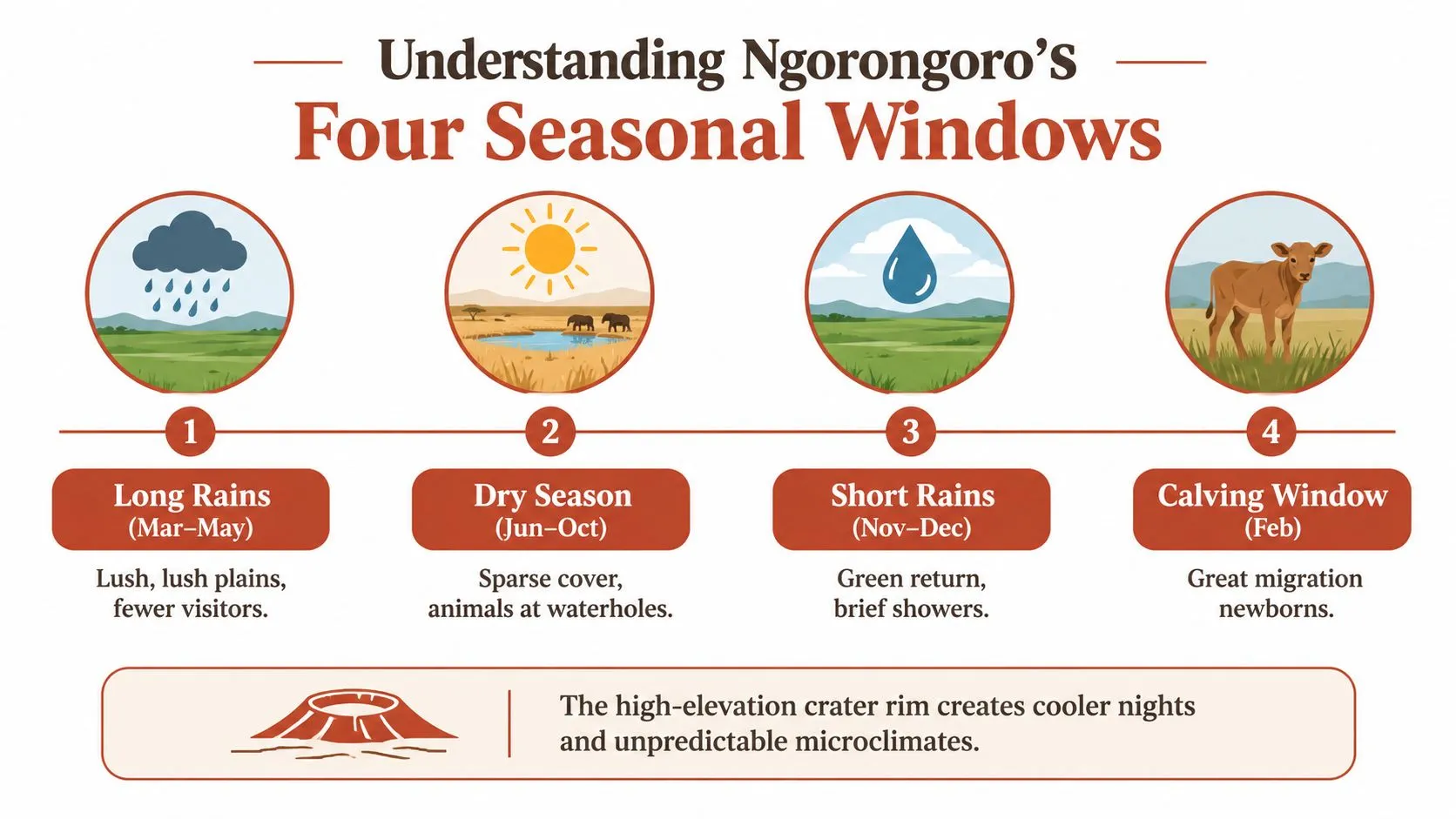
Understanding Ngorongoro's Four Seasonal Windows
Ngorongoro sits in high-elevation terrain, so it doesn't behave like coastal Tanzania. The crater rim can feel cold before sunrise, weather can shift quickly, and rain on the highlands can influence the roads used to reach and descend into the crater.
Climate data records approximately 1,000 millimeters (40 inches) of annual precipitation, with the main dry season from June through September and the rainy season from October through May. April is identified as the wettest month, while January and February can still receive roughly 90 to 110 millimeters of rain per month. See the detailed Ngorongoro climate data when comparing exact travel dates.
June through September
This is the principal dry season and the safest recommendation for travelers who want predictable movement. Lower rainfall usually means firmer roads, less chance of weather-related delays, and clearer visibility across the crater floor. Reduced surface water can also make animals easier to locate around permanent water and productive grazing areas.
The trade-off is temperature. Early-morning drives can be notably cold, particularly in June and July, so warm layers aren't optional.
October through December
October often retains dry-season advantages, while November and December introduce the short rains. These showers can refresh the area without creating the same prolonged wet conditions associated with the long rains. Conditions can still change quickly, so operators need flexibility around crater entry and driving time.
This period suits travelers who want a transition between dry scenery and a greener scene. It's less suitable for anyone who expects every day to follow a fixed weather pattern.
January and February
January and February form a valuable transitional window. Rainfall remains possible, but the months are specifically associated with breeding activity and young zebras and wildebeest. That makes them appealing for photographers and families who care more about animal behavior than perfectly dry tracks.
The surrounding Serengeti and Ngorongoro ecosystem also becomes relevant during this period. A historical account describes an annual circular migration involving about 1.5 million wildebeest and other ungulates, with herds using southeastern plains near Ngorongoro during the wet season before moving north and west as the plains dry from May to June. The ecological context is explained in this rainy-season safari planning guide.
March through May
The long rains produce vivid scenery and the highest likelihood of wet roads and itinerary changes. April is the least predictable month from a rainfall perspective. Travelers can still visit, but they should avoid building a schedule that depends on late arrival or inflexible crater access.
This is a strong choice for green-season terrain, birding, and travelers who accept weather as part of the experience.
Comparing Peak Dry Season versus Green Season Safari Experiences
The practical comparison is straightforward. Peak dry season favors reliability, while green season favors atmosphere, ecological change, and seasonal variety. Neither guarantees a particular sighting, and neither removes the need for an experienced driver who understands local conditions.
| Season | Road Conditions | Wildlife Viewing | Birding | Crowds | Best For |
|---|---|---|---|---|---|
| June through September | Generally firmer and more predictable | Clear viewing and animals may be easier to locate around permanent water | Good, though the focus is often on mammals | Usually busier | First-time visitors, reliable access, classic safari conditions |
| March through May | Wet roads and possible itinerary changes | High resident wildlife densities, with lush surroundings and seasonal behavior | Strong period for migrant species | Often quieter | Green scenery, birders, photographers, flexible travelers |
Driving and visibility
Dry-season tracks usually make the day easier to manage. A driver can spend less time adapting to slippery sections or changing access and more time positioning the vehicle for viewing. Shorter grass and clearer conditions may also help visitors scan the crater floor.
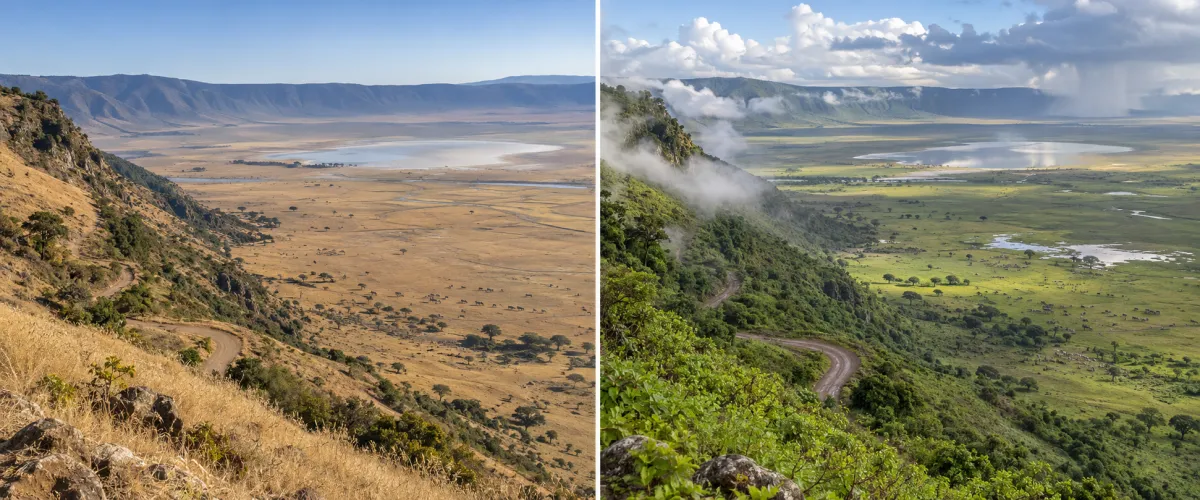
During the green season, rain can affect visibility and movement. The reward is a scene with stronger color, dramatic skies, and animals interacting with fresh vegetation. If you're comfortable with a changing plan, that atmosphere can matter more than a perfectly dry road.
Wildlife and birding
Ngorongoro maintains strong resident wildlife viewing throughout the year. The distinction is seasonal emphasis. Dry months suit people who want a concentrated, easy-to-follow mammal experience, while rainy months bring breeding activity, newborn animals, lush habitats, and migrant bird species.
January and February deserve special attention for travelers combining wildlife viewing with the wider migration cycle. They offer a different story from the classic dry-season game drive, not necessarily a weaker one.
Crowds and overall comfort
Dry-season demand can make popular sightings feel more structured around other vehicles. Green-season travelers may gain a calmer visual experience, but they exchange that advantage for wetter roads and a greater need for flexibility.
Families should weigh this carefully. A child may remember a muddy track as an adventure, but a long delay in cold rain can also make the day tiring. The right decision depends on tolerance, not on a universal ranking.
How to Choose Your Optimal Ngorongoro Visiting Window
Start with your primary safari goal, not the calendar. Once that's clear, choose the season that supports it and plan for the inconvenience attached to it.
Use this decision checklist
For a first safari, choose June through September if dependable roads, straightforward logistics, and generally clear viewing matter most. This is the safest all-round recommendation for travelers who don't want weather to dominate the day.
For newborn wildlife, target January and February. Breeding activity and young zebras and wildebeest can create more emotionally powerful encounters than a standard dry-season sighting. Accept that rain remains possible.
For birding, favor the wetter part of the year when migrant species are more likely to be present. Bring binoculars and allow time to appreciate the wider habitat rather than focusing only on large mammals.
For green-season photography, consider March through May or the short rains. Storm clouds, fresh vegetation, and softer light can produce more distinctive images than uniformly clear skies. A flexible itinerary is essential.
For quieter travel, look beyond the conventional peak. Shoulder and wet periods can feel less pressured, but “quieter” doesn't mean empty, and rain can still affect access.
For family comfort, prioritize a rim overnight and an early start. A warm room, short transfer, and well-organized vehicle often matter more than selecting a theoretically perfect month.
Treat budget as a planning variable
Pricing can vary by operator, lodging, group size, and departure date, so don't assume the cheapest month automatically provides the best value. Compare what's included, how long you'll have on the crater floor, and whether the operator has a realistic wet-weather plan.
A good itinerary should show the expected crater entry time, overnight location, departure time, and contingency options. Those details reveal more than a season label.
What Safari Seasons Actually Look Like on the Crater Floor
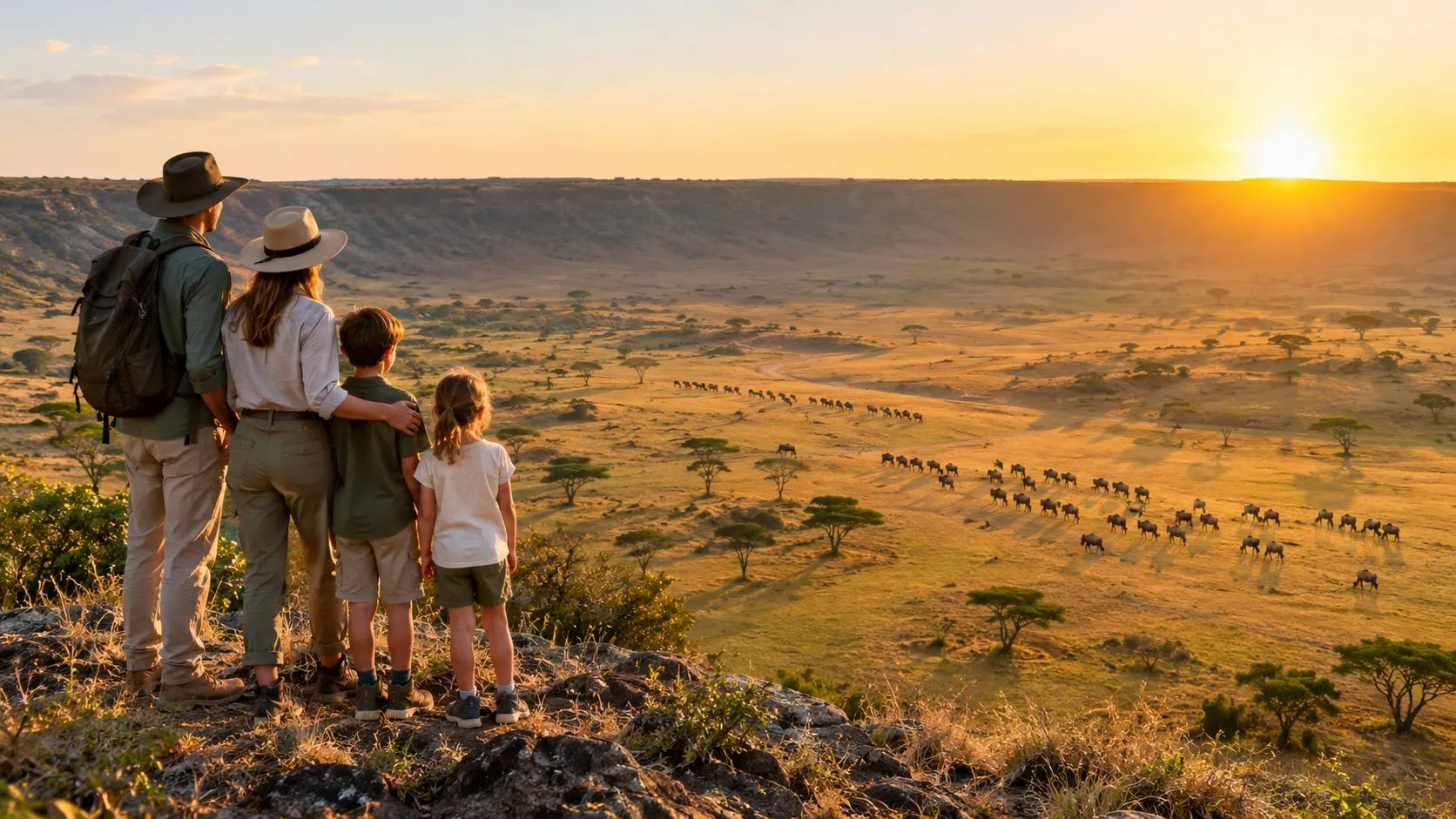
A dry-season crater morning has a particular rhythm. A family staying near the rim leaves before sunrise, wrapped in warm layers, and reaches the descent route while the light is still cool and blue. As the day opens, the firm track makes movement straightforward, and the clear air helps the driver search broad grasslands for resident mammals.
The family's excitement comes from consistency. They're not waiting for one unlikely event to make the day work. The crater's enclosed setting supports regular wildlife viewing, and the dry terrain makes animal movements easier to follow. By late morning, the sun has softened the cold, but the family still appreciates having packed fleece layers for the return.
A wetter day tells a different story
In January or February, a photographer may spend the morning watching young animals rather than ticking off a checklist of species. The grass is greener, clouds build over the crater walls, and a passing shower changes the light across the floor. The roads may be damp, but the scene has movement and texture that a cloudless day cannot provide.
The wider ecosystem matters here. Historical research links January and February with breeding activity and young zebras and wildebeest, while the regional migration follows a larger seasonal cycle involving about 1.5 million wildebeest and other ungulates. That doesn't mean every crater visit produces a dramatic migration scene, but it does explain why timing matters when Ngorongoro is combined with the Serengeti.
Travelers who want to preview the visual character of natural destinations before committing to an itinerary may find these virtual tour articles useful for setting expectations around scenery and viewpoints.
Shoulder months reward flexibility
A November or March visit can begin under soft cloud, brighten during the drive, and finish with rain on the rim. Wildlife viewing may remain strong, but the operator has to adjust speed, route, and timing. The result can feel more personal because the day isn't built around the same rigid dry-season assumptions.
Lodging, Arrival Timing, and Packing Strategies by Season
Arrival timing can matter more than the month you choose. Official operating limits generally open the gates at 06:00 and close them at 18:00, while the Seneto descent gate closes at 16:00, according to the Ngorongoro regulations. A late approach can compress the day even when the weather is excellent.
Stay close when crater time matters
A rim lodge or camp puts you near the morning descent and reduces the risk of losing time on the approach. That advantage is especially valuable for families, honeymooners, and photographers who want the first light or need a slower morning routine.
Staying farther away can work when budget or route design takes priority, but the itinerary should state the expected arrival time clearly. Don't accept “early start” as enough detail. Ask when the vehicle leaves, which gate it will use, and whether the plan allows for queues or weather-related delays.
Arrival rule: A perfect month can't rescue an itinerary that reaches the descent gate too late.
Ngorongoro's visitor volume makes this planning more important. The conservation area recorded 1,061,620 visitors in Tanzania's 2024/25 financial year, compared with 908,627 the year before, representing growth of roughly 17%. Those figures come from the regulations source cited above, and they underline why departure strategy matters as demand rises.
Pack for altitude, not the brochure image
Use a layered system rather than one heavy jacket:
Early morning: Fleece, insulated jacket, hat, and comfortable closed shoes.
Midday: Removable layers for warmer conditions on the crater floor.
Rainy months: Waterproof outerwear, a protective bag for camera equipment, and patience for damp tracks.
Every season: Binoculars, sunscreen, lip balm, water, and spare storage for personal items.
Cold nights can approach freezing in the highlands, so lodge comfort and vehicle preparation deserve attention even during warmer months. If your itinerary includes several parks, consider broader risk planning and review practical guidance on travel insurance before departure.
Challenging Peak Season Conventions for Better Safari Value
Peak season earns its reputation for good reasons. June through September usually delivers the most dependable roads and a classic dry-season experience. But easy logistics and maximum wildlife abundance aren't identical goals, and travelers often treat them as though they are.
Long-term ecological research found that several large herbivores, including buffalo, eland, and elephant, were more abundant in the crater during wet-season surveys. The finding doesn't make the rainy season universally superior. It does challenge the idea that dry conditions always produce the strongest wildlife experience. The research is summarized in this long-term Ngorongoro ecological study.
Where shoulder timing can work better
November and March can suit travelers who want a greener setting without building the entire trip around the wettest part of the year. Conditions still vary, and operators may need to modify routes, but travelers gain the chance to experience seasonal change rather than a standardized dry-season terrain.
March through May can also appeal to photographers, birders, and visitors who value atmosphere over timetable certainty. April deserves extra caution because it's identified as the wettest month. If you choose it, build in flexibility and avoid a tightly packed schedule.
Value means more than a lower rate
A lower lodge price isn't useful if the itinerary sacrifices the crater time you wanted. Compare the operator's departure plan, accommodation location, vehicle arrangements, weather contingencies, and communication process. A responsible operator should explain both what the season offers and what it can disrupt.
The best time to visit Ngorongoro Crater is therefore a decision about trade-offs. Choose June through September for the strongest blend of road reliability and predictable viewing. Choose January and February for breeding activity and young animals, or the wetter months for green scenery, birding, and a less conventional safari. Explola lets you compare Tanzania safari itineraries from verified operators, review inclusions and schedules, and request direct quotes that reflect your priorities. Visit Explola to compare Ngorongoro routes and find an itinerary built around the season you want.
Ready to experience this?
Explore Related Safaris
Destinations Mentioned

Founder of Explola and a passionate advocate for authentic African travel. He writes about safari destinations, conservation, and connecting travelers with trusted local operators across Africa.
Get Safari Tips & Destination Guides
Join our newsletter for exclusive travel tips, wildlife insights, and safari planning advice.